Altering the “identity card” of the constitution

‘Preamble’ controversy: The argument for the change is flawed in its genesis

shishir

Shishir Tripathi | January 29, 2015


All through my student years while reading the NCERT (National Council of Educational Research and Training) books, two things which always fascinated me were Gandhi’s Talisman and the Preamble of India.

The first dealt with the basic philosophy and the guiding principles behind the actions of “we the people” and the other talked about that of the state.

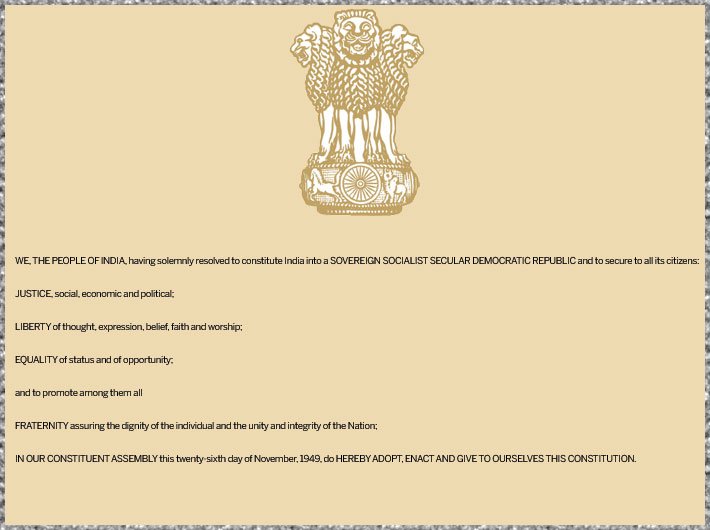
Apart from stating what the Indian state should be doing to ensure a just society, the Preamble also clearly stated what the edifice of the Indian state as an ideological construct should be.

Apart from learning about in the constitutional amendments, there was nothing which made me feel that the Preamble I was reading all these years was not the “original” one, that was enacted in 1950 by the constituent assembly.

For me, the country I live in was, in many ways, if not in absolute terms, was everything that the Preamble stated. For me, it was SOVEREIGN SOCIALIST SECULAR DEMOCRATIC REPUBLIC.

I never read ‘socialist’ and ‘secular’ in isolation. I never felt it was an imposed derivative to the original “Idea of India”. Socialist and secular was added by the 42 constitutional amendment Act in 1976.

Even though I lived in a communally charged town of Uttar Pradesh, where every election was preceded by a communal conflict followed by communal polarisation, it never felt that a theocratic state was breathing down my neck. I did not get any concession for belonging to an upper caste brahmin family nor was I disadvantaged for that. In spite of all the rhetoric of India being a secular state, and figuring it out to instead be a pseudo-secular state, later in college, I never doubted the Nehruvian philosophy expressed in these two words, “socialist and secular”.

The word socialist was also not a misnomer for me. The daily dose of entertainment, which I looked forward to after coming back from school, was broadcast by state-owned Doordarshan and came for free. The train in which I travelled to my grandmother’s place every summer was also owned by the Indian state. Later, while working as a journalist and covering railways I realised that a greater part of the expense that was incurred on my summer sojourns was borne by our “socialist” state.

The whole debate over omitting the word “socialist and secular” from the Preamble leaves me baffled and with two simple questions. These questions arise out of the questions raised by those who want to re-frame the constitutional philosophy.

Why do we need to keep these words: we are secular anyways, whether these words exist or not in the Preamble. Fair enough. It seems a valid argument. But I will accept it only if I get an answer for my question.

Are we “SOVEREIGN DEMOCRATIC REPUBLIC” because it is stated in the Preamble? Certainly not. We are “sovereign democratic republic” because of our constitution, which prescribes free and fair elections and calls for an elected head of state.

So should we omit all these words?

Constitutional expert N A Palkhiwala says Preamble is the “identity card” of the constitution. Can we alter the identity card without altering the identity itself? If we tend to do so there will be a mismatch. A mismatch, which will not only look odd, but will also make the “Idea of India” a sham.

Comments


Other News

₹5,000 crore saved from suspected financial fraud

In a significant gain for citizen protection in the digital economy, the Department of Telecommunications (DoT) has helped prevent suspected cyber fraud losses of more than ₹5,000 crore through its Financial Fraud Risk Indicator (FRI) within fifteen months of its launch on May 22, 2025. This money did

Capital acquisition proposals worth Rs 1.10 lakh crore for defence forces cleared

The Defence Acquisition Council (DAC), under the chairmanship of Raksha Mantri Rajnath Singh, on Monday accorded Acceptance of Necessity (AoN), that is, in-principle administrative approval to various acquisition proposals of the defence forces at an estimated cost of about Rs 1,10,000 crore.

How Rafi, Raj Kapoor helped pave the way for a great uranium deal

There`s a certain moment in diplomacy that`s too personal to be captured in a communiqué, too small to make the front page, but more revealing than the front page. This week, prime minister Narendra Modi reached Tashkent and, amid the pomp of state visits, managed to evoke the old Bollywood tunes

Distinguishing Fish 1 and Fish 2: The pragmatism behind India’s WTO ratification

 India became the 123rd WTO member to ratify the multilateral Agreement on Fisheries subsidies (AoFS) when it deposited the Instrument of Acceptance for Phase 1 on July 20, 2026. The ratification is restricted to disciplining Illegal, Unreported and Unregulated fishing (IUU), protection for overfished

The 7% growth problem: Why the next 7% will be harder

India has become accustomed to hearing the 7% growth number. It is now less a milestone than an expectation. Yet the paradox is becoming clearer: maintaining 7% growth may be considerably harder than achieving it once. India’s real GDP grew 7.7% in FY2025–26, following growth of 6.5% in FY202

The Constitution cannot be altered: Justice Abhay Oka

Justice Abhay Oka, who retired from the Supreme Court in May 2025, has said that the Constitution of India cannot be altered. Explaining the landmark Kesavananda Bharati judgment (1973) on the basic structure of the Constitution, he said, “This is one judgment that has saved democracy in India.&rdq

Upcoming Conferences


-->

Archives

Current Issue

Opinion

Facebook Twitter Google Plus Linkedin Subscribe Newsletter

Twitter