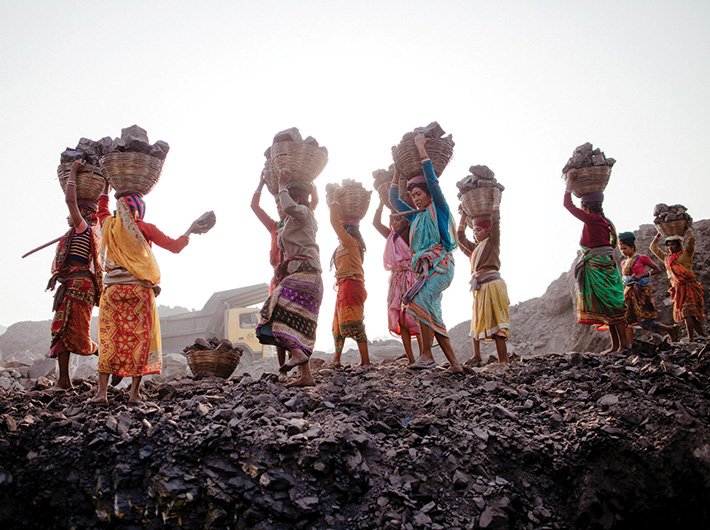
A job is not just about earning money, as MNREGS assumes, it also involves pride. A bit of tinkering is needed to rectify this and other design flaws.
Amartya Sen, in his book “Employment, Technology and Development”, distinguishes among three different aspects of employment:
1 The income aspect : Employment gives income
2 The production aspect: Employment yields an output.
3 The recognition aspect: Employment gives person the recognition of being engaged in something worth his while.
For villagers, all these aspects are very important: while they do need income, they do need to produce more as there are production gaps in most items they produce, whether its crops or craftwork or bricks. Above all, villagers and farmers suffer from a very low self-esteem, as agriculture is now ranked as the occupation of last choice by most. The next generation would rather be unemployed in a city than be a farmer. Hence it is important that villagers do work which they respect and which makes them feel that they are doing something worthwhile. MNREGS has, if properly designed and managed, an opportunity to address all three aspects and employment.
Unfortunately the obsession, both at the design stage of MNREGS and therefore during its implementation, with only the income aspect of employment has led to a programme in which there has been little impact on production and the type of work promoted has been as meaningless as that during drought relief.
As an old villager replied when I suggested him to demand his right to work, “Who really wants the right to dig meaningless pits and roads which get washed away?” And yet, he was unemployed, it was summer and there was no work, he had an un-irrigated farm. But his panchayat felt that the easiest thing they could do was do work on this road, which, as he said, had already been washed away once.
The desire, in the early stages of MNERGS, not to allow ‘local elites’ to capture the scheme under the guise of production has now led to a situation where planning, technical support and capacity building of panchayats have been largely avoided and MNREGS has created assets which become non-productive. This affects the demand for work as it is not something which villagers really want.
I have never seen a village in western India not vociferous in demanding better drinking water or a better road or seeds in time. And yet, in these same villages, demand for “the right to work” is muted, because most of them see work as a means to an end, and not an end in itself. Also, wherever villages have seen MNREGS leading to development of productive assets, demand has shot up, and panchayats have had to respond to this demand with better planning of MNREGS funds.
I think the initial assumptions were faulty: the assumption that the local government staff at the district and block levels would pro-actively help panchayats to develop plans, and the assumption that the panchayat had the capacity to involve the village, especially the poor and women, in developing a village plan (or “shelf of works”) and implement it under the fairly complex guidelines. The assumption was that panchayats would plan, the local staff would provide technical support and outsiders would help in social audit. Wherever these conditions prevail – and in this large country there are always dynamic local officers and pro-active panchayats, MNREGS has worked. But studies show that these success stories are rare, and hence the systemic causes of the failure of MNREGS have to be addressed.
The second problem has been the universalisation of MNREGS. In regions where wage rates are higher than the MNREGS wages, this scheme has become a win-win situation for subversion. It’s actually a massive con where nobody complains because nobody loses!
Let me describe what happens in a typical village. The labourer leases out his job card to the sarpanch at the beginning of the work season for a fixed, lump sum amount in advance (Rs 1,000-3,000) depending upon his/her negotiating power and then takes up better paying work within/ outside the region. The panchayat talks to the other village leaders and decides on the work which needs to be done (desilting ponds, new roads etc) and then talks to the contractor for getting that work done through machinery. The muster rolls are adjusted, payment received in the names of the labourers from the bank, and work is completed. The surplus, after paying the contractor, is distributed within the system. Nobody is unhappy; the panchayat makes money, labourers get paid without work, contractor gets work, the pond gets desilted, and the government records show high employment generation and budget utilisation. So nobody complains!
Unfortunately this strategy of advance payment to labourers in exchange of signed job cards and bank receipt books is also found in poor tribal regions where labourers do need money but are not empowered enough to fight it out or have no faith in the MNREGS payment being timely, hence cannot afford to wait back.
So how do we address these different aspects of employment and prevent misuse of government funds?
The first part is to ensure that we give importance to, and measure the achievements of, all three aspects of employment rather than just the ‘wage’ aspect.
Once we agree on that principle then we can redesign the MNEREGS (some of this is already addressed in the recent amendments to MNREGA) to ensure that the time and resources allocated to helping panchayats plan for their ‘production’ aspect is given priority.
In a few states like Madhya Pradesh, the state governments have been very dynamic and have involved field-based NGOs to support panchayats in developing plans for using MNREGS funds for productive assets. Planning and supervision support from the NGO ensures that the quality of the asset is good; land gets levelled, trees are raised and water harvested. This leads to increased demand and villagers push their panchayats for better quality planning and implementation. Because villagers see productive assets being developed, and increased food and income security because of their labour work, it revives their pride in being good farmers – gives them a sense of dignity. So large-scale facilitation of panchayats to develop planning and supervision skills should be the focus of MNREGS.
What do we do in regions/villages where MNREGS is actually not required/needed? Let us remember that these villages will actually have the best capacity to access resources from the government system; they will raise demand, prepare plans etc, but not for the purposes for which MNREGS was created! Maybe such districts could be identified, and MNREGS work allowed only for BPL households or widows etc; i.e., a targeted scheme where amounts involved would be low hence not worth the effort of the panchayat or local elite to try and subvert.
[Sen’s work quoted at the beginning is a monograph prepared under ILO’s Work Employment Programme (WEP), published as a book by OUP in 1975]
Oza is chief executive officer at Aga Khan Rural Support Programme (India)