
Bimal Jalan’s new work sheds light priorities that the govt can implement to realise the potential of the nation’s economy
GN Bureau | June 24, 2022

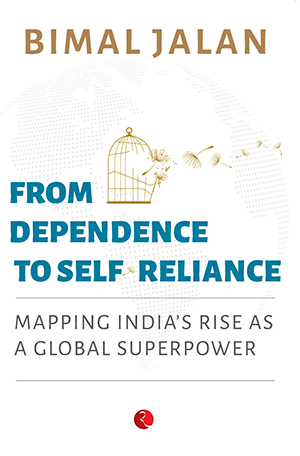
From Dependence to Self-Reliance: Mapping India’s Rise as a Global Superpower
By Bimal Jalan
Rupa Publications, 184 pages, Rs 695
Bimal Jalan, a former governor of the Reserve Bank of India (RBI), has been one of our finest commentators on economy, known for lucid and reader-friendly analysis. In recent years, he has authored three books that give a broad-brush outline of India’s contemporary economic history: ‘India After Liberalisation: An Overview’ (2021), ‘India Reckoning: Rewards and Discontents of Democracy’ (2021), and ‘India Then and Now: An Insider’s Account’ (2020). His latest work, ‘From Dependence to Self-Reliance: Mapping India’s Rise as a Global Superpower’, “continues the strand of thought of” those three works, as he writes in the preface.
 In particular, the new book aims to add to “the ongoing debate about India’s approach to future economic growth, as well as governance and political issues in the twenty-first century”.
With the BJP government in the second term with an unprecedented popularity across the country and majority in Parliament, the political profile of the government has undergone a major change. The government, with an unambiguous mandate, is now in a position to launch political reforms on its own without relying on the discretionary powers of members belonging to other parties. ‘From Dependence to Self-Reliance’ sheds light on some of the priorities that the government can implement at present, as well as in the future, in light of past experience.
Based on extensive research and data, this book provides a way forward to developing India as an economic stronghold. Its ten chapters are divided into three sections: Economy, Governance and Politics, covering a gamut of changes that have taken place since India gained independence and how these changes have had a ground-breaking impact on the development of the nation. It is a must-read to gain an in-depth understanding of India’s rise to power in the realm of economy, politics and technology.
There`s a certain moment in diplomacy that`s too personal to be captured in a communiqué, too small to make the front page, but more revealing than the front page. This week, prime minister Narendra Modi reached Tashkent and, amid the pomp of state visits, managed to evoke the old Bollywood tunes
India became the 123rd WTO member to ratify the multilateral Agreement on Fisheries subsidies (AoFS) when it deposited the Instrument of Acceptance for Phase 1 on July 20, 2026. The ratification is restricted to disciplining Illegal, Unreported and Unregulated fishing (IUU), protection for overfished
India has become accustomed to hearing the 7% growth number. It is now less a milestone than an expectation. Yet the paradox is becoming clearer: maintaining 7% growth may be considerably harder than achieving it once. India’s real GDP grew 7.7% in FY2025–26, following growth of 6.5% in FY202
Justice Abhay Oka, who retired from the Supreme Court in May 2025, has said that the Constitution of India cannot be altered. Explaining the landmark Kesavananda Bharati judgment (1973) on the basic structure of the Constitution, he said, “This is one judgment that has saved democracy in India.&rdq
Mammals of India By A.J.T. Johnsingh and P.O. Nameer HarperCollins India in association with Bombay Natural History Society
When Shell bought Sprng Energy in 2022, India`s renewable energy market appeared to offer precisely what global energy majors were seeking: scale, growth and a place in one of the world`s largest energy transitions. Four years later, Shell is selling the same business to Aditya Birla Group for an enterpris











