
Radhika Iyengar’s ‘Fire on the Ganges’ is an invitation to a shared act of empathy – and a fine example of long-form journalism too
GN Bureau | December 8, 2023
Fire on the Ganges: Life among the Dead in Banaras
By Radhika Iyengar
4th Estate / HarperCollins, 348 pages, 599
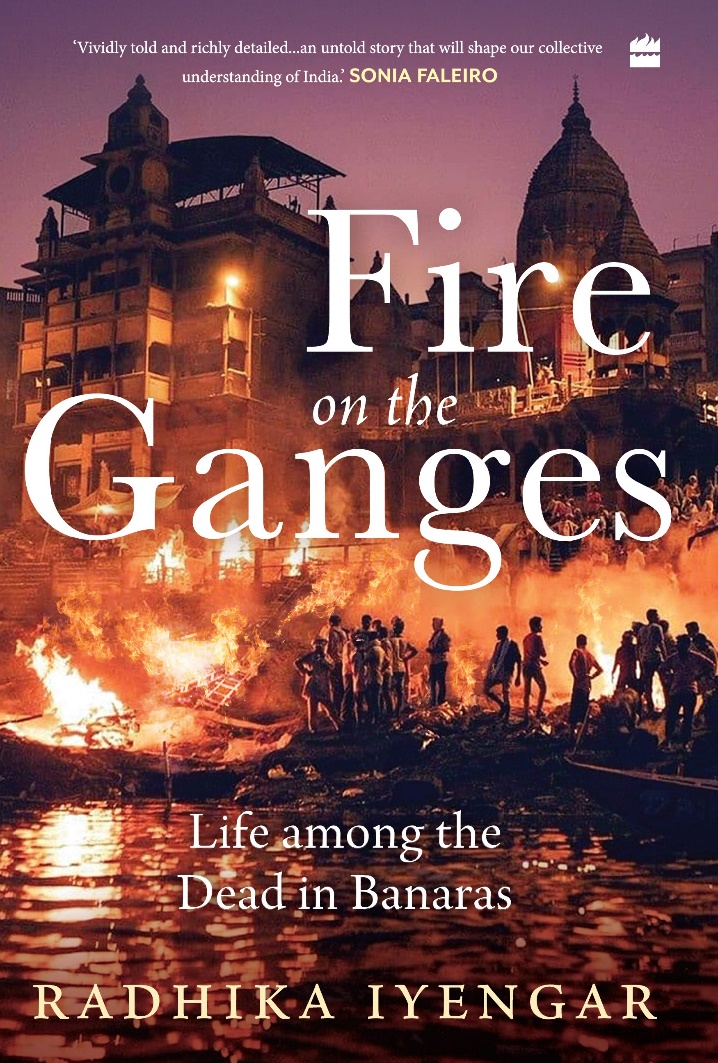 ‘Fire on the Ganges’, by Radhika Iyengar, is about the Dom community, who perform cremations in Banaras. Based on the author’s interactions with many members of this community over eight years – from 2015 to 2023, the book is the outcome of possibly the most intense and longest reporting assignments in recent times. ‘Fire on the Ganges’ is also the first attempt to chronicle the quotidian life of the Doms.
The Doms aspirations and realities change over the years, though their fate remains the same. Theirs is a Dalit sub-caste, and they have been among the more suppressed among the suppressed groups in Hindu society. Yet, it is also believed that they have the ownership of the ‘sacred fire’ without which the soul will not achieve liberation from the cycle of death and rebirth. That should have earned them respect from others. But, as one of them tells the author, “Even today, if we walk in the same lane as an upper-caste Hindu, chances are that he will abuse us. And if we touch them by mistake, they criticize and threaten us.”
Iyengar holds a Master’s degree in journalism from the famed Columbia University Graduate School of Journalism, and the craft of long-form writing (show-don’t-tell, telling detail, creating images, and so on) is at work here; telling multiple narratives in a way that would make the reader keep turning the pages. ‘Fire on the Ganges’, also described as a work of slow journalism and oral history, takes an outsider into the unseen world of the Doms, and invites the reader to look at the world from their eyes. The result is a shared act of empathy – even as the narrative remains strictly objective.
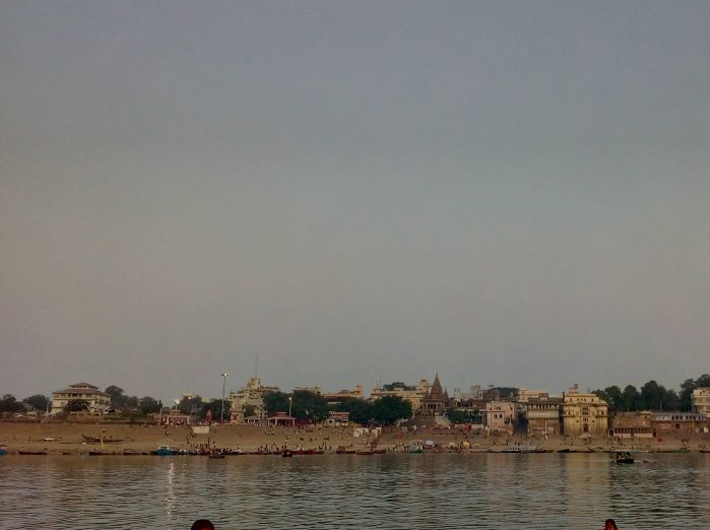
The ancient city of Banaras forms an intriguing backdrop to the Doms’ stories. ‘Fire on the Ganges’ “plunges into Banaras’s historical past, while narrowing its lens on a few spirited characters from the Dom community. Through their tales of struggle and survival, loss and ambition, betrayal and love, it tells the at-times-heartbreaking, at-times-exhilarating story of a community struggling to find a place beyond that accorded to it by ancient tradition”.
In a statement, Iyengar says, “In Banaras, the Doms are a community of corpse-burners, treated as “untouchables” by a majority of dominant caste Hindus. Yet, within this community, there are a few individuals who are striving to become much more than what tradition and society dictates. This book documents their courageous, life-altering decisions and experiences, of how they are doggedly changing their own narrative.”
As a work of long-form journalism and as a deeply researched portrait of contemporary India, ‘Fire on the Ganges’ joins the ranks of ‘Behind the Beautiful Forevers’ (2012) by Katherine Boo and ‘The Good Girls’ (2021) by Sonia Faleiro.
In a significant gain for citizen protection in the digital economy, the Department of Telecommunications (DoT) has helped prevent suspected cyber fraud losses of more than ₹5,000 crore through its Financial Fraud Risk Indicator (FRI) within fifteen months of its launch on May 22, 2025. This money did
The Defence Acquisition Council (DAC), under the chairmanship of Raksha Mantri Rajnath Singh, on Monday accorded Acceptance of Necessity (AoN), that is, in-principle administrative approval to various acquisition proposals of the defence forces at an estimated cost of about Rs 1,10,000 crore.
There`s a certain moment in diplomacy that`s too personal to be captured in a communiqué, too small to make the front page, but more revealing than the front page. This week, prime minister Narendra Modi reached Tashkent and, amid the pomp of state visits, managed to evoke the old Bollywood tunes
India became the 123rd WTO member to ratify the multilateral Agreement on Fisheries subsidies (AoFS) when it deposited the Instrument of Acceptance for Phase 1 on July 20, 2026. The ratification is restricted to disciplining Illegal, Unreported and Unregulated fishing (IUU), protection for overfished
India has become accustomed to hearing the 7% growth number. It is now less a milestone than an expectation. Yet the paradox is becoming clearer: maintaining 7% growth may be considerably harder than achieving it once. India’s real GDP grew 7.7% in FY2025–26, following growth of 6.5% in FY202
Justice Abhay Oka, who retired from the Supreme Court in May 2025, has said that the Constitution of India cannot be altered. Explaining the landmark Kesavananda Bharati judgment (1973) on the basic structure of the Constitution, he said, “This is one judgment that has saved democracy in India.&rdq











