
A Ramasamy’s compilation is a unique documentary research, now available in English translation
GN Bureau | June 23, 2023
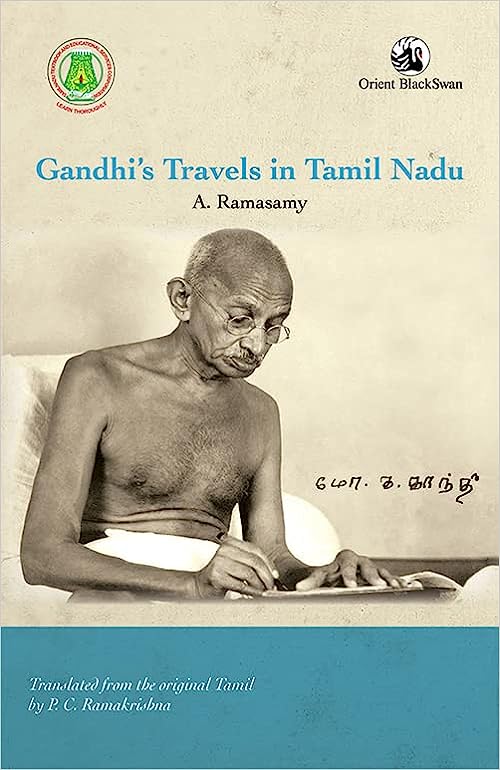
Gandhi's Travels in Tamil Nadu.
By A. Ramasamy, Translated from the original Tamil by P. C. Ramakrishna.
Orient BlackSwan, 688 pages, Rs 1,995.00
Mahatma Gandhi had a unique relationship with Tamil people. In South Africa, when he was barely beginning his career in public service as well as in law, a Tamil labourer named Balasundaram sought his help against his master. Gandhi succeeded in securing justice for him, and started taking interest in the lives of indentured labourers in the Colony, many of whom were Tamils. Soon, he was learning the Tamil language too.
So, in 1896, when he made a trip to India, he made it a point to visit Tamil Nadu (then called Madras State). On returning home for good in 1915, again he visited the state. In India, he would spend significant time on trips to various places, from what is now Pakistan to what is now Bangladesh. As for Tamil Nadu, he made 30-odd visits , by one count, in about as many years.
When Gandhi’s birth centenary was nearing, a journalist named A. Ramasamy (whose birth centenary is being celebrated in Chennai on June 23, 2023) had an idea of compiling a documentary work on all of Gandhi’s visits to Tamil Nadu. With extraordinary research in the archives of leading newspapers apart from poring over Gandhi’s works and correspondence over three years, he brought out this book, Thamizhnaattil Gandhi, in Tamil, in 1969.
Ramasamy later moved on, focusing on journalism. He served as news editor of the dailies ThamilNadu, Gramarajyam-Weekly and Dinamani. A staunch Gandhian, he was secretary of the Gandhi Manram and the Harijan Seva Sangam, Madurai, and also translated works of Gandhian literature.
‘Gandhi’s Travels in Tamil Nadu’ highlights the deep and abiding connection and friendship Gandhi had with Tamil Nadu and its people, from the time that he, as a young lawyer, led the struggle of Indian contractual labourers, many of them Tamilians, against the colonial government in South Africa, to when he returned to India to lead the Congress and the freedom movement. It covers the period from his very first visit to (what was then) Madras State/Province in 1896, to his last visit to the state in 1946, a year before Independence.
Painstakingly retracing Gandhi’s footsteps in the land of Valluvar, Ramasamy travelled across the country, met and corresponded with people associated with Gandhi, pored through government archives, letters, books and newspapers of the period, collecting important and interesting details. We learn it was in Tamil Nadu that the British Parliamentary delegation held discussions recognising that India’s freedom was inevitable. We learn about fearless young martyrs like Valliammal, and of the publicised argument between Annie Besant and Gandhi over his 1916 speech in Benares. It was also the Tamil student fraternity that first gave Gandhi the title ‘Father of the Nation’.
As evident from Gandhi’s numerous speeches included herein, the volume also underscores the vital contribution of the Tamil people to the Indian freedom struggle, and draws our attention to the many Tamilian heirs to the Gandhian legacy who continued his work well after him. Rich in anecdotal and historical detail, carefully compiled, this book would interest anyone who wishes to know about Gandhi’s evolution as a leader, his unique relationship with Tamil Nadu, and the larger history of the freedom movement.
More than half a century later, this unique documentary work appears in English, translated by P. C. Ramakrishna, a theatre actor and member of The Madras Players, India’s oldest English theatre group. He has translated, dramatised and staged the Tamil novel ‘Karunai Kolai’ by Sivasankari as ‘Mercy’ in English.
This book is published in association with the Tamil Nadu Textbook and Educational Services Corporation, an unusual initiative for any state government. While this organization runs a ‘Tamil Literature in English Translation Series’, it can consider other gems of Gandhiana, rare research works compiled in Tamil, for a larger readership.
The Cabinet Committee on Economic Affairs (CCEA), chaired by prime minister Narendra Modi, has approved implementation of the ITMS Project by Delhi Police at an estimated cost of Rs.1,789.52 crore, inclusive of taxes. The project will cover 42 identified traffic corridors and will be implemented in three
The extraordinary transaction volumes and value (₹29.82 Lakh crore in August 2026 alone) of the Unified Payments Interface (UPI) have made it not only an Indian success story, but a global one. In 2024, UPI accounted for nearly 49% of the world’s real-time payment transaction volume, with more th
Diplomacy is akin to an art, wherein the summitry, conflict resolution and negotiations form apt constituents of the entire context of deal making and “playing for keeps” in the international arena. The Xi-Trump summit in Washington last week, in which the American president broke all conside
Moving to Delhi-NCR for education can be an exciting experience for students from Northeast India. It gives us a chance to meet new people, experience a different culture and become more independent. But living away from home also comes with challenges that people who have not experienced them may not al
The government has reduced the Basic Customs Duty (BCD) on major imported crude edible oils with a view to moderating domestic edible oil prices, providing relief to consumers and mitigating inflationary pressures arising from the sharp increase in international edible oil prices.
In his opening address at the 18th BRICS Summit in New Delhi on September 12, prime minister Narendra Modi did something India`s diplomacy has been building towards for three years: he moved the ‘Voice of the Global South’ from a slogan to a work plan. Addressing the leaders, he argued that t











