With contributions from economists, policy experts and industry leaders, a new anthology confronts three of India’s most urgent challenges: environmental sustainability, unequal participation in the economy and the persistent norms and stereotypes that mould economic life
The Business Of Business Is (Not) Just Business: How Behavioural Tools Can Drive Real Change
Edited by Sutapa Banerjee, with Foreword by Nadir Godrej
HarperCollins, 336 pages, Rs 699
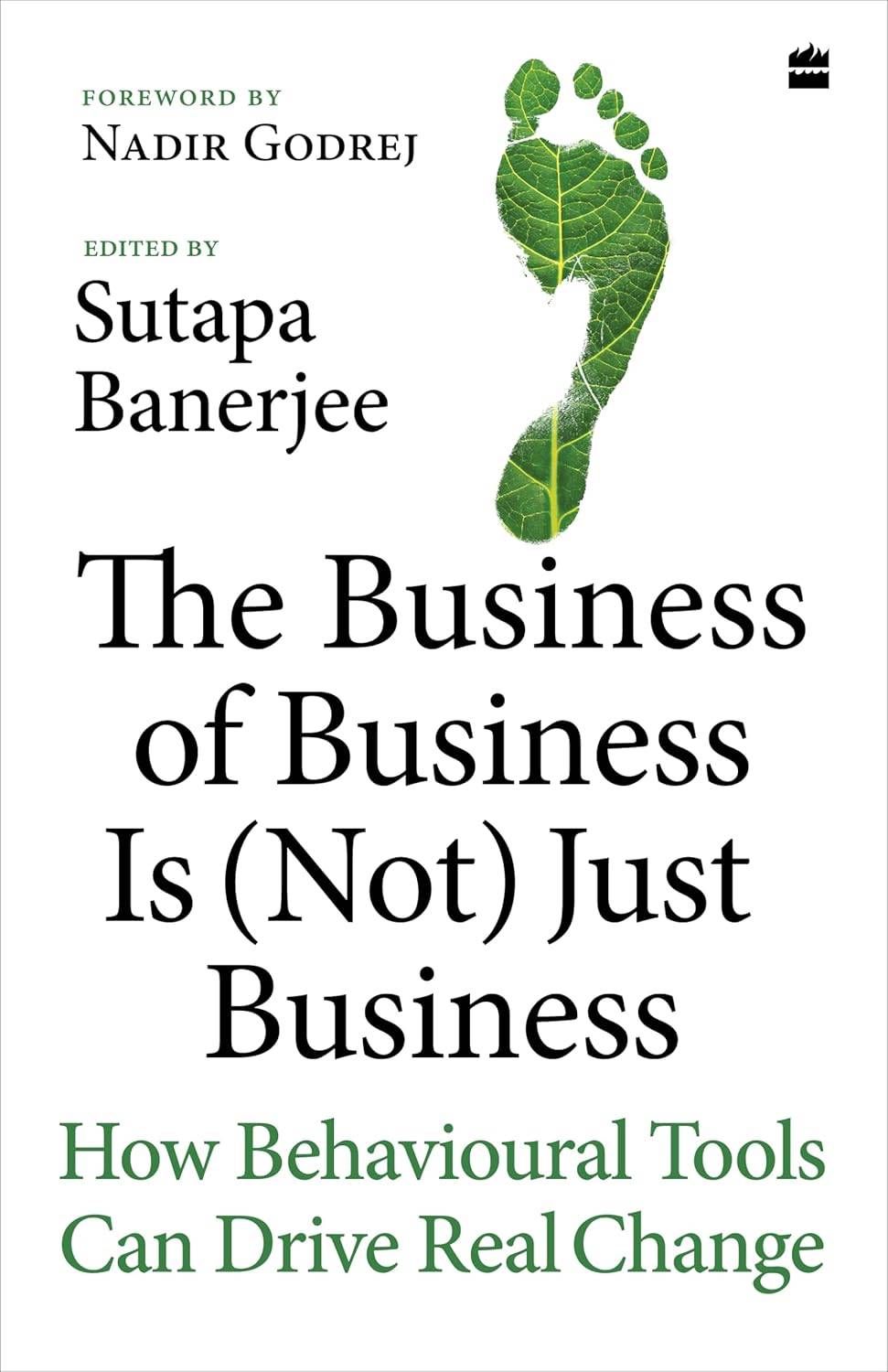
Corporate firms are part of society too and their function has to go beyond the profit principle. With rising awareness, ‘sustainability’ and ‘inclusion’ are becoming buzzwords in boardrooms. But is there real change on the ground?
Edited by Sutapa Banerjee, and structured as a thought experiment, this anthology cuts through corporate virtue-signalling and feel-good slogans to unpack the deeper incentives, regulations and behavioural insights that influence businesses.
The contributors – economists, policy experts, investors and industry leaders – confront three of India’s most urgent challenges: environmental sustainability, unequal participation in the economy and the persistent norms and stereotypes that mould economic life.
Here is an excerpt from the book – from an essay by Kartikeya Sarabhai, founder-director of the Centre for Environment Education (CEE) and chairman of Ambalal Sarabhai Enterprises. He was part of India’s delegation to the 1992 Earth Summit at Rio and has contributed to multiple UN and COP dialogues. Co-author of the UNESCO report on Climate Change Education in India, he also chairs the group designing environmental content for India’s new school textbooks under NEP 2020. Educated at Cambridge University and MIT, he received the Padma Shri in 2012.
From Compliance to Leadership: A Climate Educator’s View
By Kartikeya Sarabhai
Climate Change is by far the greatest threat to the survival of life as we know it on this planet. Not just human life, but all animals and plants are under threat. It is a creeping calamity that began when we learned the secrets of using fossil fuels 275 years ago. While our actions till the middle of the 20th century could be put down to ignorance, that excuse no longer holds. Increasingly, we have been warned about the consequences of neglecting the environmental impact of fossil fuel use on the climate.
As I write this, I am sitting on my veranda in Ahmedabad, looking out at a thunderstorm and heavy rain, and it is only 28 May [of 2023], the day of the IPL finals between Gujarat and Chennai. However, the cancelled match is the least of our problems. India is a country where the monsoon rains govern the water cycle. The onset of the southwest and northeast monsoons used to be predictably timed: 1 June in Kerala, 10 June in Mumbai, and 15 June in Ahmedabad. But unseasonal rains throw things out of gear, causing a tremendous impact on the rural economy. Farmers have far less resilience than IPL cricketers.
India is a large country on the way to becoming the most populous country in the world. In the seventy-five years since independence, it has made remarkable progress on several fronts. From a life expectancy of just thirty-two years at the time of independence in 1947, the figure has risen to nearly seventy years today. India also has the largest youth population, accounting for nearly 20 per cent of global youth. Its economy is one of the fastest-growing among large countries. Starting from a very low per-capita carbon and environmental footprint, India needs more equitable carbon space as it develops. It cannot follow the classical development model, which is fossil fuel intensive.
India remains a developing country and still has a long way to go before catching up with first-world standards. Almost 10 per cent of the population still lives below the poverty line. On several other indicators, there is work to be done. The prime minister has set a target for 2047, when India completes 100 years of independence, for the country to be considered ‘developed’. But the challenge remains: to maintain rapid growth while also being climate and environmentally responsible.
Background
Over the past decades, the Indian government has undergone a sea change in the way it views business and private enterprise. In the early years after independence, the state and public sector enterprises were expected to lead India’s growth. Under the ‘License Raj’ regime, businesses were not seen as partners in development. The belief was that, without strict regulation, businesses would not align their interests with those of nation-building. When environmental awareness grew, and the first environmental legislations were enacted, this attitude persisted. The government focused on control, while industry primarily lobbied to stop or dilute regulations. The majority of businesses saw their role as essentially meeting compliance requirements.
It was only in the early 1990s, when the first steps were taken to liberalize the economy, that one saw a perceptible change in the way businesses were perceived. The policy shift saw the unlocking of entrepreneurship. The growth of the private sector was now seen as a part of India’s development strategy. The period was marked by a gradual shift from regulations to incentives. At the same time, internationally, the role of business in environmental conservation was evolving. This international discourse, especially within the United Nations system, in which India actively participates, had a significant impact on domestic thinking as well.
Some of the measures and policies that India initiated regarding the role of businesses in development and sustainability went beyond prevailing international thinking. A significant milestone was the enactment of corporate social responsibility (CSR) regulations through the Companies Act, 2013. Until then, industry saw its role as limited to cleaning up its own production. CSR regulations required large businesses to directly engage in development work. Promoting environmental sustainability was one of the areas identified for CSR spending. This led to businesses working with non-governmental organizations (NGOs) and getting directly involved in looking at developmental issues. However, this legislation was confined to large enterprises.
Since the publication of books such as ‘Cradle to Cradle’, the earlier concept of ‘cradle to grave’ responsibility began to be replaced. While this model focused on responsibility for a product’s entire life cycle, the newer concept introduced the idea of circularity—one of nature’s most powerful concepts—which is now influencing global economic thinking. Businesses have started looking not only at the entire value chain but beyond it as well. The effort has been to build processes to achieve circularity. Small and medium enterprises (SMEs) and the informal sector are increasingly becoming a part of the ‘circle’.
The concept of net zero emerged from the global dialogue on achieving climate neutrality. At the opening of COP26 in Glasgow, Prime Minister Narendra Modi announced that India would cut its emissions to reach net zero by 2070. This is an ambitious target and requires a multi-sectoral strategy. Commenting on the role of business, the Observer Research Foundation noted:
Businesses have a pivotal role to play in this. Their actions, resources, capacity to innovate and greater reach are vital to swiftly decarbonise sectors, infrastructure, value chains, and the products and services they provide. Businesses are already playing a key role in the climate fight, helped by the growing customer and investor focus on sustainability, as well as increasing regulatory and disclosure requirements. Solving a problem at the national or international level is also becoming a key driver with this collaboration.
Several business houses have since announced their own net-zero targets and developed action plans to achieve them.
[The essay proceeds to give the international context, touch upon themes of reporting and dialogue, global actions, the Indian view, industry initiatives, afforestation and greening, Net Zero and India, circular economy, and government policy support, before reaching to the conclusion.]
Conclusion
As I conclude this chapter, news reports are declaring that July 2023 has been the hottest month in recorded history. United Nations Secretary-General Antonio Guterres has stated that the planet is entering an ‘era of global boiling’. Scientists widely agree that this extreme heat is primarily linked to fossil fuel use. Fuel consumption is tied to nearly every business process, from electricity generation to waste management. Business is now very much at the core of the sustainability and climate change efforts needed to achieve both national and global targets. Larger corporations are already gearing up for this challenge. Smaller businesses, too, must be equally involved. The circular economy model offers both the inspiration and the opportunity for achieving sustainable development. Solving the climate crisis demands that businesses work together and feel a sense of shared ownership and responsibility.
[The excerpt reproduced with the permission of the publishers.]