
A photo story capturing the journey of Amarnath yatris in Jammu and Kashmir
Photos by Javeed Shah | August 23, 2018

A curving throng of devotees outside the cave shrine of Amarnath, where water dripping from the ceiling freezes into a cylindrical mound worshipped by the devout as a Shivling. Legend has it that it was discovered by Bhrigu Muni, a rishi. Texts dating to the 11th century and to the Mughal era have been cited referring to the shrine. The most recent ‘discovery’ of the shrine is attributed to a shepherd called Buta Malik in the mid-19th century. Since then pilgrims have been visiting the shrine by the thousands daily during the Amarnath Yatra season, making the five-day journey from Pahalgam on foot or pony, braving, in recent decades, militancy, in addition to the weather and the steep mountain path. More than 2.6 lakh have already visited it this year.
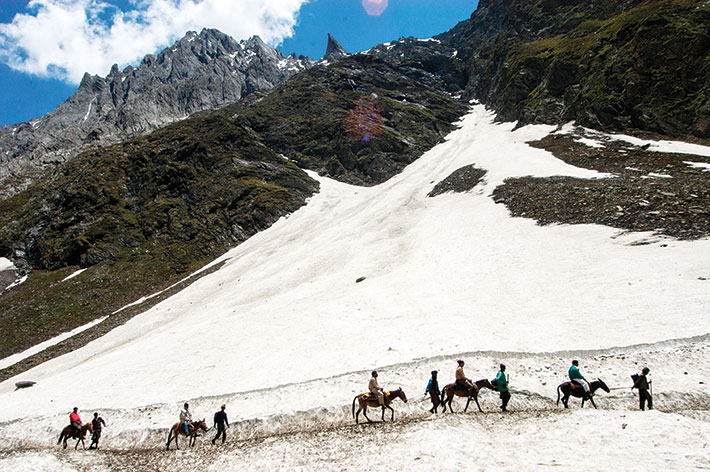
Rendered into toy figures by the tall, dark mountains and the stark white expanses of ice and snow, a string of pilgrims on ponies led by pony-walas who double up as guides makes its way towards the cave shrine. Of late, global warming has been a major concern in the Himalayas, considered by scientists to be the ‘Third Pole’. If the increased rate of glacial melting is a scientific concern, pilgrims worry about what global warming could do to the ice Shivling.
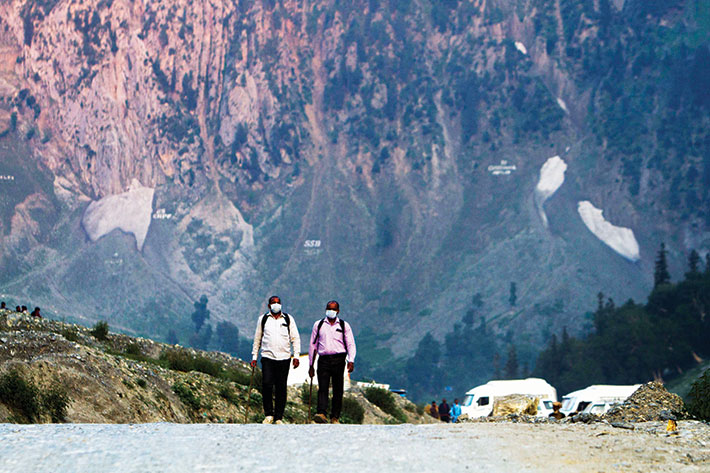
Incongruous in this looming, mountainous diorama, two pilgrims seem like office-goers but for the trekking sticks. The ambulances made available by the government make the Yatra safer for pilgrims who are unable to take the strains imposed by the high altitudes.
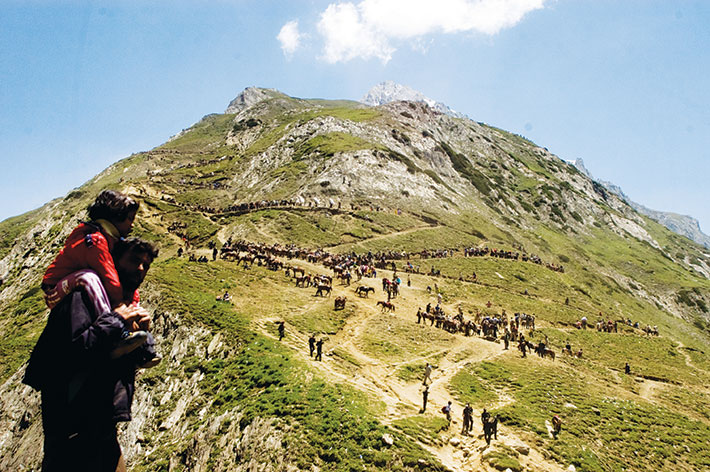
Ponies rest and wait for pilgrims to take up to the cave shrine. A child, meanwhile, gets a ride on a relative’s shoulders.

There have been many terrorist attacks on Amarnath pilgrims in this state beset by miltancy. Only last year, seven people were killed. Understandably, security is a major concern. This year, over 40,000 CRPF and state police personnel have been deployed to secure the yatris’ safety.
Digital payments have become a reflex for urban India, but the confidence earned in paying has not yet carried over to borrowing. That is the central finding of `How Urban India Pays Report 2026`, released by Pahlé India Foundation in collaboration with Amazon Pay. Based on a survey of 5,149 consu
Commerce and industry minister Piyush Goyal has called upon businesses in India and the United Kingdom to translate the opportunities created by the India-UK Comprehensive Economic and Trade Agreement (CETA) into expanded trade, investment, partnerships and job creation. Addressing the Bu
The Gandhian movement in India, after Gandhi’s death, failed, says Ramachandra Guha, and blames Vinoba Bhave for it. But the movement found new, fertile grounds around the world and succeeded in bringing about a change in South Africa, the US and elsewhere. It is high time it returned home. Of cour
Tavleen Singh, noted journalist and political commentator, has turned to fiction, with her debut novel ‘The Actor’ (HaperCollins India). Set in the near future, it has a superstar, Amit Singh, turning to politics, when the political landscape is dominated by prime minister Guru Gaynendraj
The union cabinet, chaired by prime minister Narendra Modi, on Tuesday approved the setting up of a Special Purpose Vehicle (SPV), called Integrated Transport & Logistics Authority (ITLA), to strengthen research, planning, appraisal, monitoring and impact assessment within the broad domains of Transp
Foundational Literacy and Numeracy (FLN) are often described as the building blocks of education. Yet, their significance goes well beyond a child’s ability to read a sentence, write a response or solve a basic mathematical problem. These foundational skills shape how children understand the world,










