
Modi keeps his word: Turns up heat on benami properties

Action against benami properties coupled with demonetisation is an attempt to tackle corruption

GN Bureau | August 16, 2017

#Narendra Modi   #corruption   #benami properties  
(Illustration: Ashish Asthana)

When prime minister Narendra Modi spoke about action against benami properties while delivering the I-Day address from the Red Fort ramparts, he was in fact fulfilling a promise he made during the last Mann ki Baat of 2016.
 
“The law against benami property was lying in limbo for years. Now, we have come up with a law against benami property. In such a short time, the government has confiscated benami properties worth over Rs 800 crore. When these things happen, the common man develops faith that the country is for the honest persons,” said Modi on Tuesday.
 
Modi, who had carried out demonetisation on November 8, had widened the effort to tackle corruption by taking on benami properties.
 
“We will take action against ‘benami’ properties. This is major step to eradicate corruption and black money… We are going to take action against the properties which are purchased in the name of others (benami). That is the property of the country,” said Modi during his last Mann ki baat of 2016.
 
The Benami Transactions (Prohibition) Act, 1988 was amended through the Benami Transactions (Prohibition) Amended Act, 2016. The amended Act, 2016 came into effect from November 1, 2016.
 
The Act says that “No person shall enter into any benami transaction.”
 
“…purchase of property by any person in the name of his wife or unmarried daughter and it shall be presumed, unless the contrary is proved, that the said property had been purchased for the benefit of the wife or the unmarried daughter. Whoever enters into any benami transaction shall be punishable with imprisonment for a term which may extend to three years or with fine or with both,” says the Act
 
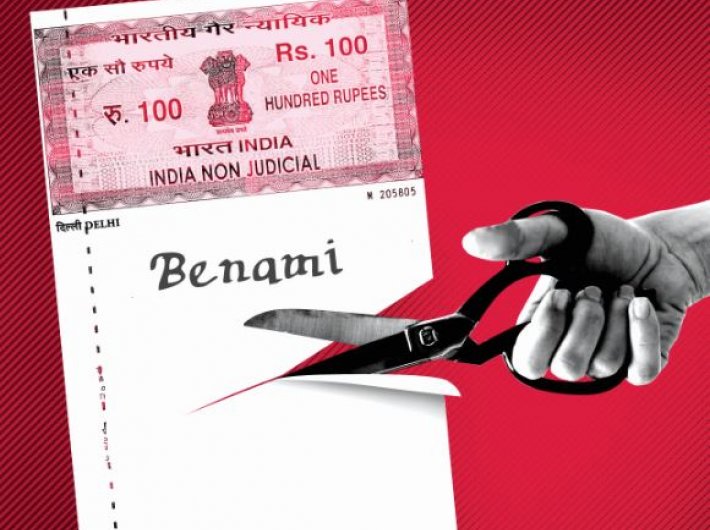
What exactly is benami property?
 
Any property bought by an individual which is not under his or her name is benami property. Commonly, benami property is in the name of the wife and children and unaccounted money, better known as black money, is ploughed into purchase benami property.
 
Santosh Kumar Gangwar, minister of state for finance in written reply to a question in Rajya Sabha on July 25, 2017, said: “Action against the benami transactions under the new law is an ongoing process. More than 400 benami transactions have been identified since the coming into effect of the amended law. Provisional attachment of properties under the Act has been done in more than 230 cases. The market value of properties under attachment is more than Rs. 800 crore. The benami properties attached include deposits in bank accounts, immovable properties.”
 
The minister said that the Act prohibits benami transactions and empowers the authorities specified in the Act to provisionally attach and eventually confiscate the benami properties.
 
“The Act also provides for prosecution of any person found guilty of the offence of benami transaction by the competent court. The offence of entering into a benami transaction is punishable with rigorous imprisonment for a term not less than one year but which may extend to 7 years and shall also be liable to fine which may extend to 25% of the fair market value of the property,” he said. 


Comments


Other News

AI: Code, Control, Conquer

India today stands at a critical juncture in the area of artificial intelligence. While the country is among the fastest adopters of AI in the world, it remains heavily reliant on technologies developed elsewhere. This paradox, experts warn, cannot persist if India seeks technological sovereignty.

RBI pauses to assess inflation risks, policy transmission

The Reserve Bank of India (RBI) has begun the new fiscal year with a calibrated pause, keeping the repo rate unchanged at 5.25 per cent in its April Monetary Policy Committee (MPC) meeting. The decision, taken unanimously, reflects a shift from aggressive policy action to cautious observation after a signi

New pathways for tourism growth

Traditionally, India’s tourism policy has been based on three main components: the number of visitors, building tourist attractions and providing facilities for tourists. Due to the increase in climate-related issues and environmental destruction that occurred over previous years, policymakers have b

Is the US a superpower anymore?

On April 8, hours after warning that “a whole civilisation will die tonight,” US president Donald Trump, exhibiting his unique style of retreating from high-voltage brinkmanship, announced that he agreed to a two-week ceasefire with Iran. The weekend talks in Islamabad have failed and the futur

Machines communicate, humans connect

There is a moment every event professional knows—the kind that arrives without warning, usually an hour before the curtain rises. Months of meticulous planning are in place. And then comes the call: “We’ll also need a projector. For the slides.”   No email

Why India is entering a ‘stagflation lite’ phase

India’s macroeconomic narrative is quietly shifting—from a rare “Goldilocks” equilibrium of stable growth and contained inflation to a more fragile phase where external shocks are beginning to dominate domestic policy outcomes. The numbers still look reassuring at first glance: GDP


Archives

Current Issue

Opinion

Facebook Twitter Google Plus Linkedin Subscribe Newsletter

Twitter






