3 reasons why BJP sweep doesn't mean end of caste factor

A wave flattens everything else before it. Real test would come in future local elections in Bihar, UP and Haryana

shantanu

Shantanu Datta | May 16, 2014


Only a follow-up election after this can tell us whether dalits have stopped voting for Mayawati.

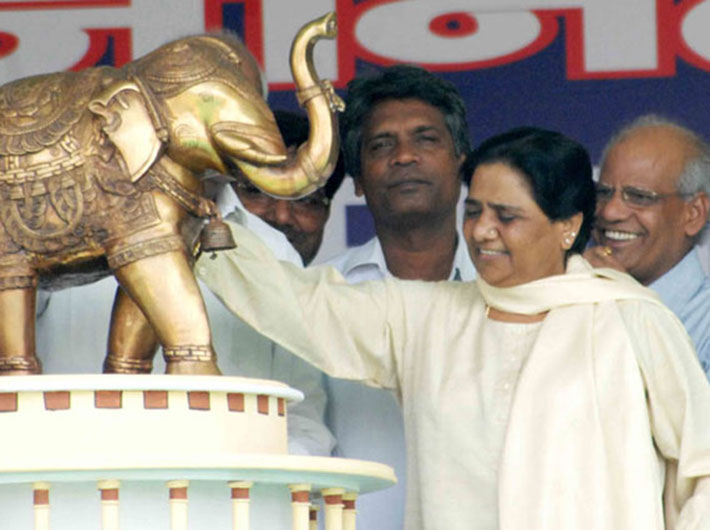
Has caste ceased to be a factor in India? The early trends on the result day of the general elections would indicate so, as many are inferring. The decimation of the Bahujan Samaj Party and the Samajwadi Party in Uttar Pradesh, and the likely defeat of the father-son duo of Ajit Singh (from Baghpat in UP) and Jayant Chaudhary (Mathura), among many other results/trends, would hint at that.

There are many other indicators for something as complex and deep-rooted for caste equations in India. While this is not to say that caste is an alien concept for other political parties, we take these four for the simple reason that the BSP and the SP, apart from Lalu Prasad’s Rashtriya Janata Dal (RJD) in Bihar, have perfected the art of nurturing caste sections and garnering votes. Ajit Singh’s INLD, meanwhile, has banked on the caste-cum-community votes of the Jat of western UP.

According to the update at 11.51 am on the election commission’s website, when this piece was written, the BSP’s vote share was 3.6 percent, the SP’s 2.8 percent and the RJD’s 0.5 percent. This is against 6.17, 3.42 and 1.27 percent, respectively, for the three parties. Of course, this is just the middle overs, to use a cricket parlance, and nothing can be said till the fat lady sings, to use another cricket commentary cliché, but the fact that the BSP was leading at that point in one seat, the SP in eight and the RJD in only five seats says a lot about cross-voting on caste lines.

The three parties between them won 48 seats in 2009 Lok Sabha elections.

So, has caste ceased to be a factor? Three reasons why it’s too early to bet on that.

1. If the BJP is winning 272 seats or thereabouts – as trends are showing it might – on its own, it can easily be called a ‘wave’. And a wave flattens everything else on its path.

2. The BJP fought this election primarily on the ‘development’ plank, showcasing its prime ministerial candidate Narendra Modi’s work as the chief minister of Gujarat for the last dozen years. According to all reports and estimates, the voters – weighed down over the last four years by sky-high inflation, runaway price rise and record joblessness – opted for the saffron party with a singular aim: economic. Caste, in such cases, does not enter the picture.

3. Even Modi did not shy away from using his OBC status as a campaign ploy – so many votes might have gone from one OBC caste to that of another. And in this case, with majority of voters pressing the button on the EVM for Modi, and not the local candidate, as Modi himself asked them to in advertisements and in many of his rallies, the voters might have gone for Modi’s caste, if not his ‘development record’.

The real test would be any local election after this, for that is when the caste factor would come into play once more.

Comments


Other News

Food inflation: Not a macroeconomic statistic but a developmental indicator

India`s retail inflation shows a reassuring picture at first glance. According to the latest data, Consumer Price Index (CPI) inflation edged up to 4.38% in June 2026 from 3.93% in May 2026, but continued to remain within the Reserve Bank of India`s (RBI) target band of 4% (+/- 2%). However, beneath this

Skin in the game or masterful market timing?

When a company founder opens their personal chequebook to buy shares in their own business, stock markets usually applaud. To the average retail investor, it feels like the ultimate vote of confidence, a sign that the people running the show have real skin in the game and believe brighter days are ahead.

India’s freedom struggle was shaped by wider Asian political thought

As we mark 80th anniversary of independence, ‘Asianism and the Fall of Empire’ (HarperCollins India) by historian Mithi Mukherjee offers a new perspective on Ind

What is colonialism? A relook at modern history

The Chromatic World Order: The Fiction That Rules Our World  By Sajid Mohamed Aakar Books  

Monsoon session of parliament adjourns sine die

The Monsoon Session, 2026 of Parliament which commenced on July 20 was adjourned sine die on Thursday. The session provided 19 sittings spread over a period of 25 days.   During the session 11 Bills were introduced in Lok Sabha and 2 Bills were introduced in Rajya Sabha. 12 B

Consumer Justice at a Crossroads

Over the past four decades, India`s consumer protection landscape has undergone a remarkable transformation. What began with the Consumer Protection Act, 1986 as a simple mechanism to empower ordinary citizens has evolved into a comprehensive framework capable of addressing challenges ranging from mislea

Upcoming Conferences


-->

Archives

Current Issue

Opinion

Facebook Twitter Google Plus Linkedin Subscribe Newsletter

Twitter