
Bank takes NPA too seriously, gets notice from NHRC

Central Bank of India names girl and her father as defaulters over non-payment of education loan

GN Bureau | March 3, 2016

#NHRC   #Central Bank of India  


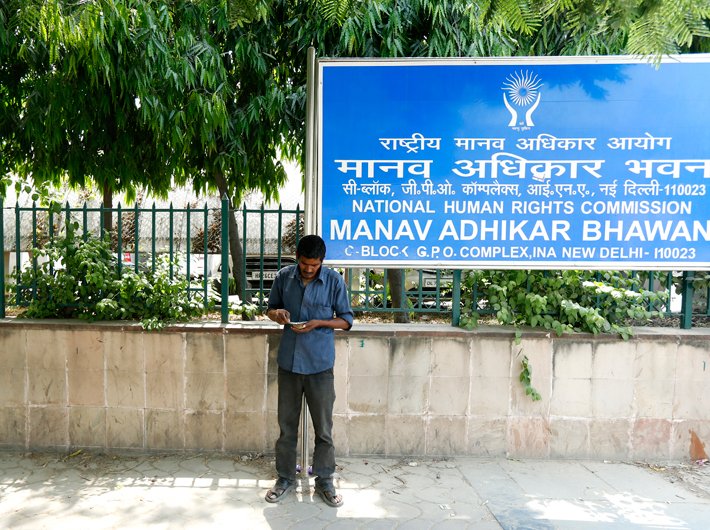
Unable to pay up her education loan, a girl in Tamil Nadu had to face serious embarrassment at the hands of a public sector bank which named the beneficiary and her father as defaulters. Taking cognizance of the matter, the National Human Rights Commission (NHRC) has issued a show cause notice to the chairman of Central Bank of India asking why it should not recommend monetary relief of Rs 1 lakh to the beneficiary for being insulted.

Apparently, the Manjoor branch of the bank in the Nilgiris district of Tamil Nadu displayed the girl as well as her father’s photographs captioning them wrongly as ‘missing’ and ‘defaulters’. Threatening telephonic calls were also made to her ailing father.

The commission’s show cause notice follows the admittance of error by the bank which has been given six weeks’ time to respond. In its report submitted to NHRC, the bank says that due to erroneous data entry in the system the victim’s loan account was wrongly classified as ‘non-performing asset’ (NPA). The bank’s move was against the advice of ministry of finance to all banks which says that names and photographs of students, who are unable to repay education loan or where there is a delay in the repayment, should not be published.

Justice D. Murugesan, member, NHRC, while issuing the show cause notice, observed that the display of photographs of the victim and her father on the notice board was a violation of their right to live with dignity, which is recognized as dereliction of article 21 of the constitution as well as human rights.

The victim had taken an education loan for Rs 2 lakh from the Manjoor branch of Central Bank of India to pursue her B.E. degree course. She completed the course in 2013 and according to the model IVA scheme, the first repayment had to commence from July, 2014 as per the moratorium. The moratorium included study period and a year after that to start the process of repaying the loan in 120 installments.  She had paid half of the loan amount in the first month itself after the moratorium. She said that the coercive methods adopted by the bank that too against the established norms of education loan repayment amounted to violation of human rights. It is also alleged that her ailing father had died due to shock after receiving threatening telephone calls from the bank.
 

Comments


Other News

Before India voted, the framers worried about the referee

“We are making a Constitution forever and not only for today.” Shibban Lal Saksena said this in the Constituent Assembly on June 15, 1949. He was warning that a ruling party might one day choose a loyalist to run India’s elections. Seventy-seven years later, the Supreme Court is wrestli

Delhi moves to real-time traffic management

The Cabinet Committee on Economic Affairs (CCEA), chaired by prime minister Narendra Modi, has approved implementation of the ITMS Project by Delhi Police at an estimated cost of Rs.1,789.52 crore, inclusive of taxes. The project will cover 42 identified traffic corridors and will be implemented in three

MDR on UPI: Can sustainability come without weakening the network?

The extraordinary transaction volumes and value (₹29.82 Lakh crore in August 2026 alone) of the Unified Payments Interface (UPI) have made it not only an Indian success story, but a global one. In 2024, UPI accounted for nearly 49% of the world’s real-time payment transaction volume, with more th

The Xi-Trump summit: The unending rivalry

Diplomacy is akin to an art, wherein the summitry, conflict resolution and negotiations form apt constituents of the entire context of deal making and “playing for keeps” in the international arena. The Xi-Trump summit in Washington last week, in which the American president broke all conside

“Indians, yet treated like outsiders”

Moving to Delhi-NCR for education can be an exciting experience for students from Northeast India. It gives us a chance to meet new people, experience a different culture and become more independent. But living away from home also comes with challenges that people who have not experienced them may not al

Import duty on major edible oils cut

The government has reduced the Basic Customs Duty (BCD) on major imported crude edible oils with a view to moderating domestic edible oil prices, providing relief to consumers and mitigating inflationary pressures arising from the sharp increase in international edible oil prices.  

Upcoming Conferences


-->

Archives

Current Issue

Opinion

Facebook Twitter Google Plus Linkedin Subscribe Newsletter

Twitter






