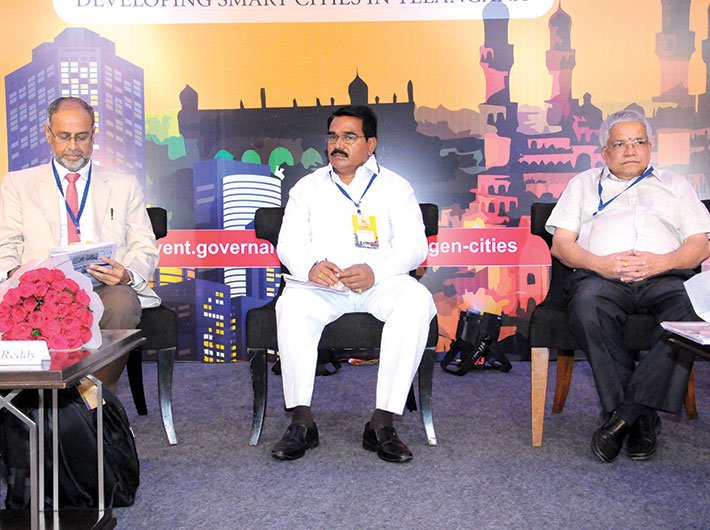
The newest state of the country faces many development challenges. The conference held discussions on various aspects that can resolve these challenges and make Telangana a smart city
Cities are engines of economic growth. Hence there is a need to make them smart and sustainable to improve the quality of life of citizens. This was the central theme of the NextGen Cities Telangana conference, held in Hyderabad, organised by Governance Now.
Giving the opening address, MG Gopal, principal secretary, municipal administration and urban development, Telangana, said that a city should primarily ensure clean drinking water and proper sanitation facilities for its citizens. “Lack of safe drinking water and sanitation affects the quality of life of people. Therefore, before we look at development in other sectors there is a need to look at water and sanitation as first priority for smart cities,” he said.
Echoing similar sentiments, S Niranjan Reddy, vice chairman, Telangana state planning board, said that a smart city should be able to provide good infrastructure such as water, sanitation and utility services, healthcare services, attract investments, and should have transparent processes to provide a favourable environment for commercial activities. The process of taking approval for various citizen-centric services should be made simple and online, so that citizens feel safe and happy.
Reddy also talked about the state government’s initiatives of slum-free Hyderabad and lake cleaning. In a bid to make Hyderabad the first Wi-Fi enabled city in India, a pilot project was launched recently. The Hyderabad metropolitan development authority (HMDA) has implemented Hussain Sagar lake development programme, which aims to improve the overall lake environment for enriching biodiversity and eco-tourism. The government of Telangana has also undertaken construction of outer ring road and eight-lane expressway. Moreover, the Telangana government is in the process of preparing a vision document for making Hyderabad a global city.
Currently, the urban population of India is 31 percent of the total population and contributes over 60 percent of the country’s GDP. “Urban population in Telangana state grew by 38.12 percent during 2001-2011, as compared to 25.13 percent in the preceding decade”, added Reddy. The capital city of Hyderabad accounts for over 29 percent of the state’s total urban population. As a result there is a need to make the state sustainable and smart, he said.
Speaking on the occasion, Dr Janardan Reddy, commissioner & director, municipal administration, Telangana, highlighted how the city of Hyderbad is trying to be energy efficient and taking various steps to ensure proper sanitation for its citizens.
Smart education, better awareness
T Vijaya Kumar, joint secretary, school education, Telangana, talked about the need of new and innovative ideas for imparting education. Giving the example of IMRO (interact to media running objects) — a power point presentation with a voiceover — he said, “SIET has spent more than two years to develop this [IMRO]. This is their idea of smart education. We need to move towards a digital scenario. With the changing generation, teaching methods should also change.”
The department is also focusing on building toilets in schools which is a major cause of concern. A mobile app named ‘swachh paathsaala’ is keeping a track on the construction of toilets in schools. The app is preloaded with GPRS coordinates of all schools in Telangana.
Technology for cities
Highlighting the importance of e-governance, Srinath Chakravarthy, vice president, NISG, said, “It [e-governance] must be accompanied by infrastructure and should have a framework. It must also be accompanied by an overall understanding that everything points back to improving the quality of life for citizens.”
Aamer Ahmed, Middle-East president (Saudi Arabia), Telangana Information Technology Association, said when we talk about smartness it is about digital innovation, which further means simplifying and solving problems. “From a technological perspective you can’t have innovation and digital transformation without having stable connectivity,” he added.
Rana Pratap, vice president, Telangana Information Technology Association, talked about how e-governance is fundamental and instrumental for smart cities. He also laid emphasis on the use of existing technology instead of building a new application or a system by giving the example of Hyderabad police to make his point. The Hyderabad police recently developed a WhatsApp control room where citizens can send their complaints through WhatsApp. The control room uses the existing technology (of WhatsApp) that users are already aware of. The control room has received tremendous success.
Adopting best practices
Smart City Kochi is a joint venture between the governments of Dubai and Kerala. Giving details of the project its CEO Gigo Joseph said, highlighted the need to develop a walk-to-walk township which has institutions, residential complexes, schools, colleges, and all other kind of facilities. “While developing IT parks, companies always put IT buildings and forget about rest of the place. They forget about where people live and where do they go? In case of a developing country, the only way in which it can become a sustainable smart city is by not hampering the existing cities,” he said.
“So, the components we choose while planning smart cities are economic, social, and environment sustainability,” he added. The Kochi smart city model is built around these three pillars. Technology is becoming an enabler to build these sustainable cities.
Urban mass transit
Hyderabad metro rail (HMR) is not just a mass rail rapid transport system but an effort in the direction of redesigning the city as it focuses on space and energy efficiency, said NVS Reddy, managing director, Hyderabad metro rail limited. “HMR is five times more efficient than road transport as it consumes just one fifth of energy consumed by road transport,” he said. A multi-model transport system is being designed which will integrate metro routes with bus bays. Even skywalks are being planned to connect buildings on either side of metro rail lines. Around 18.5 million square feet of built up space will be provided at metro stations for setting up malls and other utility centres to cater to people’s needs.
Steps are also being taken to cut down the pollution levels and carbon footprint in the city. “We are planning to launch CBC technology – a communication-based control system – which will help us in re-designing a people-friendly city,” added Reddy.
Dr K Keshava Rao, MP, Rajya Sabha, highlighted that cities should be human-oriented rather than just development-oriented, as more and more people are migrating to cities for opportunities. “There is no end to a smart city. Tomorrow it can be smarter as my demands will grow,” he said adding, “The question I want to ask all the people who are involved in building a smart city is that if their processes are true, can they exactly measure what is my need?”
[email protected]