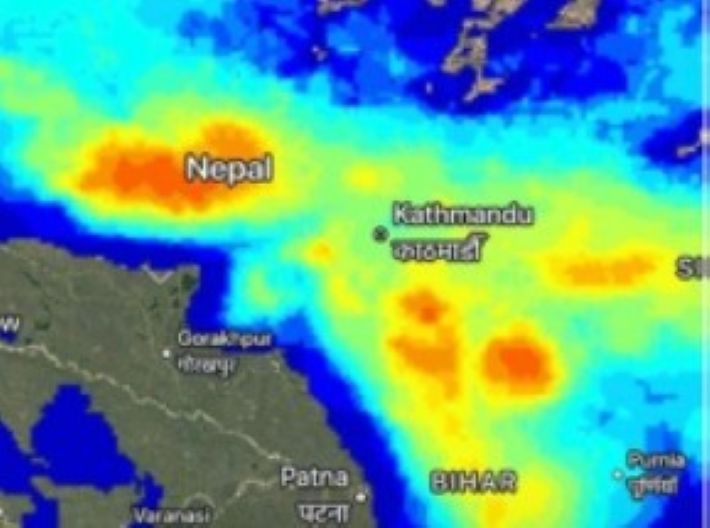
New flash floods in Nepal’s Gorkha district have renewed concerns over the changing dynamics of Himalayan weather systems, with scientists highlighting the growing influence of global warming on extreme rainfall
The interaction between active Western Disturbances, increased atmospheric moisture and the region’s complex topography aswell as global warming are important factors behind intense rainfall in the Himalayas, leading to flash floods in Nepal, according to meteorologists.
Nepal suffered catastrophic flooding on August 26, and six weeks later it has witnessed another destructive flash flood, this time in Gorkha district. According to the National Disaster Risk Reduction and Management Authority, a major landslide between Lokpa and Chumling in Chum Nubri Rural Municipality on October 11, blocked the Budhigandaki River, triggering a flash flood carrying large volumes of debris and causing physical damage.
The authority confirmed that 95 people, including nine foreigners, had been rescued, while five people remained missing. The incident has once again drawn attention to the vulnerability of Himalayan communities to sudden flooding and landslides, as scientists examine the role of changing weather patterns and climate change in intensifying such events.
“An active Western Disturbance was passing through the Himalayas, which has given widespread rainfall across the Himalayas. There is no doubt that there has been a rise in temperatures as well as the moisture content,” said Mahesh Palawat, Vice-President, Meteorology and Climate Change, Skymet Weather.
He explained that every 1°C rise in atmospheric temperature increases the atmosphere’s capacity to hold water vapour by approximately 7%, potentially contributing to heavier rainfall. The number of heavy-rainfall days has also increased, he noted, adding that similar conditions over Nepal could have contributed to rising river levels.
Dr K. J. Ramesh, former Director General of the India Meteorological Department, said the influence of global warming must be considered when interpreting contemporary weather events.
Western Disturbances are common during the post-monsoon and winter seasons, when the subtropical westerly jet shifts southward and steers these weather systems towards the Himalayas. However, according to Ramesh, climate-driven changes in atmospheric circulation are altering their behaviour.
“The arrival of an active Western Disturbance is a common phenomenon during this time of the year,” he said. “However, with the steady acceleration of Arctic melting due to climate change, these subtropical western jets are travelling much further south than their normal position.”
Ramesh added that these systems can interact with moisture from the Arabian Sea, which is experiencing warming. Such interactions can strengthen precipitation, making some post-monsoon and winter weather systems more intense.
The Arctic’s rapid warming offers further insight into the changing dynamics of Northern Hemisphere weather. Since 2006, Arctic annual temperatures have increased at more than twice the global rate. In March 2025, Arctic winter sea ice reached its lowest annual maximum extent in the 47-year satellite record.
Reduced sea ice means less sunlight is reflected into space, allowing the ocean to absorb more heat. These changes can influence atmospheric and oceanic circulation, with implications for weather patterns far beyond the Arctic.
Scientists have increasingly examined how rising global temperatures are affecting Western Disturbances, which play an important role in winter and post-monsoon precipitation across northern India and the Himalayan region.
The Hindu Kush Himalaya is particularly vulnerable to warming. According to a report by the International Centre for Integrated Mountain Development (ICIMOD), even if global warming is limited to 1.5°C, warming in the mountains could reach around 2°C. Under continued high-emissions scenarios, temperatures across the Hindu Kush Himalaya could rise by more than 5°C.
This disparity is associated with elevation-dependent warming, a phenomenon in which temperatures rise faster in high-altitude environments than at lower elevations.
Professor A. P. Dimri, Director of the Indian Institute of Geomagnetism, has raised concerns about the increasing severity of disasters along the southern margins of the Western and Eastern Himalayas. He emphasised that these events often result from the combined effects of precipitation, local topography and glacier melt.
Dimri explained that climate change has contributed to the meridional, or north-south, expansion of the subtropical westerly jet (SWJ). This broader circulation pattern provides Western Disturbances with greater scope to oscillate and propagate.
According to him, disturbances travelling along the jet stream’s southern margins can interact with moisture-bearing air masses and influence the position of the monsoon trough, potentially producing intense rainfall over the Himalayan region.
Nepal experienced similar conditions when a Western Disturbance interacted with moisture from the Arabian Sea, he noted.
The SWJ is a fast-moving upper-atmospheric wind current near the Himalayan and Tibetan highlands. Western Disturbances travel eastward within this circulation, bringing weather changes and precipitation. When moisture-laden air encounters mountain slopes, it rises, cools and condenses, producing orographic rainfall.
The recent floods underline the need to understand how global warming, atmospheric circulation and Himalayan topography interact. While individual disasters cannot be attributed to climate change alone, rising temperatures can increase atmospheric moisture and alter the behaviour of weather systems, potentially raising the risk of extreme precipitation.
For a region already exposed to steep terrain, fragile slopes, glacier melt and rapidly responding river systems, these changes carry significant consequences. Improved weather monitoring, early-warning systems and climate-resilient disaster preparedness will be crucial to reducing risks to Himalayan communities.
As scientists continue to investigate these evolving dynamics, Nepal’s latest floods serve as a reminder that understanding the changing climate is essential to anticipating and managing future disasters.