
Covid-19: India’s mortality rate lower than global figure

Recovery rate at 38.73 percent: 24 lakh samples tested

GN Bureau | May 20, 2020

#mortality rate   #WHO   #lockdown   #healthcare   #epidemic   #coronavirus   #COVID-19   #testing   #recovery  
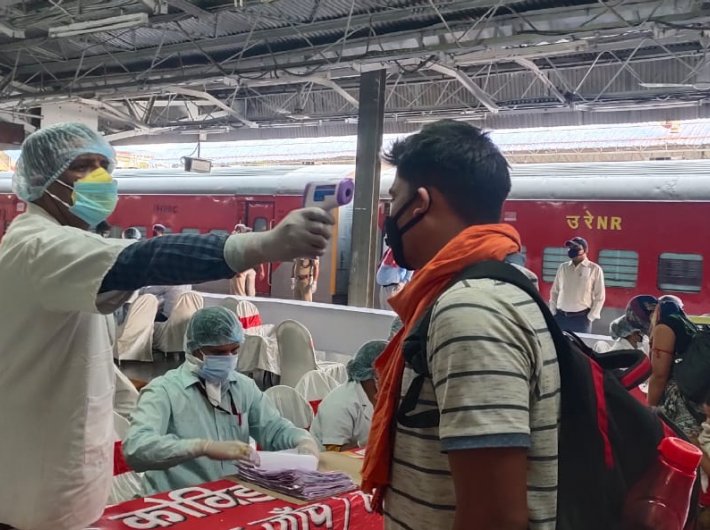
Screening of passengers on at Bhagalpur railway station as railway services resumed gradually earlier this month.

In the battle against Covid-19, India has managed to keep the mortality rate low at 0.2 deaths per lakh population, compared to some 4.1 deaths for the same population worldwide. Moreover, a total of 39,174 patients have been cured, registering a recovery rate of 38.73% which is improving continuously.

During last 24 hours, a total of 2,350 COVID-19 patients have been cured, an official note said late Tuesday. India currently has 58,802 active cases. These are all under active medical supervision. Of the active cases, only approx. 2.9% of the cases are in ICU.

The status of deaths per lakh population for countries having the highest number of deaths, according to the WHO situation report-119, is as follows: The worldwide total deaths: 3,11,847 (4,1 deaths per lakh population), the US: 87,180 (26.6), the UK: 34,636 (52.1), Italy: 31,908 (52.8), France: 28,059     (41.9), Spain:    27,650    (59.2), Brazil:    15,633    (7.5), Belgium: 9,052    (79.3). These are the latest figures available by Tuesday.

The relatively low death figures represent timely case identification and clinical management of the cases, the official release said.

Also, “a record number” of 1,08,233 samples were tested on Tuesday in the country, taking the total so far to 24,25,742. From one laboratory conducting COVID-19 test in January, India has very rapidly increased its testing capacity by adding over 385 government laboratories and 158 private laboratories for testing. Duly forging partnerships with all central government labs, state medical colleges, private medical colleges and private sector, the testing capacity in the country has been expanded. Other testing machines like TrueNAT and CBNAAT have also been mobilized to ramp up testing.

Through 14 AIIMS-like mentor institutions, handholding of labs across the country is undertaken to ensure adequate bio-safety standards and accreditation of the laboratories.  To maintain steady supply of testing material to the labs, 15 depots have been created by roping in India Posts and private agencies for distribution. Many Indian companies have been supported to undertake production of testing material which was earlier primarily sourced from abroad. This has helped in maintaining steady supplies across the country.
 

Comments


Other News

Experts call for stronger communication of air pollution science

Experts have emphasized the urgent need to improve how scientific evidence on air pollution is communicated to policymakers and the public to spur meaningful health and policy action. They were participating in a webinar titled “Communicating Air Pollution Science for Public Health Act

Maharashtra to partner with Starlink for satellite-based internet

In a step toward inclusive digital transformation, the Maharashtra government has signed a Letter of Intent (LOI) with Starlink Satellite Communications Private Limited. With this, Maharashtra becomes the first Indian state to formally collaborate with Starlink to deploy satellite-based internet services f

Young Birders’ Month: A nationwide celebration inspiring budding nature explorers

This November, children and young people across India are embarking on a joyful exploration of birds and nature as part of Young Birders’ Month (YBM) - a first-of-its-kind, month-long campaign created to spark curiosity and ecological awareness among young minds. This initiative is organized collabor

How Bangladesh’s bonhomie with ISI, China poses threat to India

Although New Delhi has not officially commented on the growing footprint of Pakistan’s Inter-services Intelligence (ISI) in Bangladesh, India`s strategic and security community appears to be highly concerned over last week’s development in Dhaka.  During Pakistan’s Joi

CSR in India: Stop counting rupees, start measuring impact

When India became the first country in the world to legislate corporate social responsibility (CSR) in 2013, it marked a bold experiment in blending profit with purpose. By law, companies with a net worth of ₹500 crore or more, or a turnover of ₹1,000 crore or more, or net profit of ₹5 crore or more

A perfect match of Eastern philosophy and modern self-help

Shaolin Spirit: The Way to Self-Mastery By Shi Heng Yi Particular Book/Penguin Books, 264 pages In the history

Visionary Talk: Amitabh Gupta, Pune Police Commissioner with Kailashnath Adhikari, MD, Governance Now


Archives

Current Issue

Opinion

Facebook Twitter Google Plus Linkedin Subscribe Newsletter

Twitter






