A powerful tool for protecting India's cultural heritage, while creating economic opportunities for communities
Geographical Indication (GI) tags have emerged as a powerful tool for protecting India's cultural heritage, while creating economic opportunities for local communities. By linking products to their place of origin, GI tags preserve traditional knowledge, prevent misuse, and enhance consumer trust. They help artisans, weavers, farmers, and producer groups secure better market recognition and gain access to premium markets. India's GI ecosystem has expanded significantly over the years, supported by a robust legal framework and growing public awareness. Government initiatives are further strengthening this ecosystem through financial assistance, export promotion, tourism integration, and dedicated marketing platforms. Together, these efforts are transforming GI products into drivers of rural development, cultural preservation, and export-led growth.
GI Tag: Safeguarding India's Unique Products
A weaver in Banaras spends weeks crafting a single Banarasi saree. Every thread of intricate zari work is woven with exceptional precision and skill. These techniques are not learned overnight. They are passed down through generations, preserving a centuries-old tradition.
Yet, despite the effort and craftsmanship involved, many authentic Banarasi sarees are often sold at prices far below their true value. Buyers may not always be able to distinguish a genuine handwoven saree from other imitations. This is where two words make all the difference- GI Tag (Geographical Indication).
A GI tag certifies that the saree is genuinely made in Banaras using traditional methods. It assures buyers of its authenticity, quality, and cultural heritage. As a result, the authentic Banarasi saree can command a significantly higher price in domestic and international markets. This ensures that the weaver receives greater recognition and better economic returns for their craftsmanship.
Significance of GI goods in Indian tradition, economy, sustainability
A GI tag serves as a seal of authenticity for artisanal crafts, safeguarding them against imitation, misuse, and unauthorized commercialization. Its significance, however, extends far beyond legal protection. For instance, the Channapatna toys received GI recognition in 2006. This recognition applies only to wooden toys made in Karnataka's Channapatna region. The toys must be produced using the region's distinctive lacquerware art. Although it may appear to be a simple certification, the tag can deliver far-reaching benefits.
A GI tag is more than a label. As per the Ministry of Textiles, it can raise rural artisans' incomes by 20–30%!
By certifying a product’s origin and unique heritage, GI tags instil confidence among buyers and enhance the product’s market appeal.
As consumers increasingly seek authenticity, tradition, and craftsmanship, GI recognition serves as a powerful symbol of quality and cultural distinctiveness.
Growing demand for GI-tagged products enables artisans to gain greater visibility, access premium markets, strengthen their bargaining power, and capture a larger share of the value generated by their work.
The recognition creates sustainable livelihood opportunities. They also play a vital role in preserving and promoting India’s rich cultural heritage and indigenous craftsmanship for future generations.
Success Story of Muzaffarnagar Jaggery: From Local Specialty to Global Markets
The GI tag for Muzaffarnagar Jaggery has helped strengthen its identity as a premium product with distinct quality and origin. Leveraging this recognition, Brijnandan Agro Farmer Producer Company successfully exported 30 metric tons of jaggery to Bangladesh in 2025. The GI certification enhanced buyer confidence and improved the product's marketability in international markets.
As a result, the farmer-led company gained access to export opportunities. It increased income prospects for its 545 members, and created greater value for locally produced jaggery.
* India is home to over 800 registered GI products and 607 GIs have been granted since 2014.
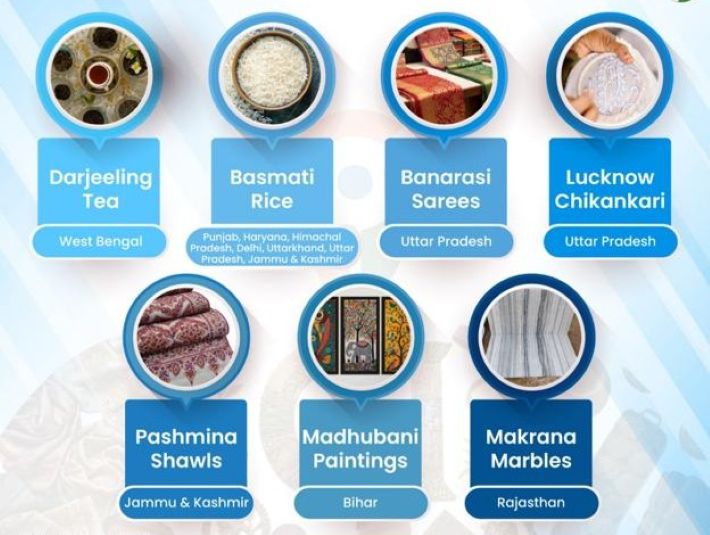
* Darjeeling Tea from West Bengal was the first product in India to receive a GI tag, with protection extended to both the product and its logo. Other early registrations included Aranmula Kannadi, a traditional handicraft from Kerala, and Pochampalli Ikat, a renowned textile craft from Telangana.
* In the last 10 years, authorized users for GI tags increased from 365 to 29,000 (as of January 2025).
Regulation of GI
Leading export destinations for Indian GI products include the UK, Italy, UAE, Bahrain, Qatar, the USA, South Korea.
As a form of intellectual property, GIs are recognised internationally under the Paris Convention for the Protection of Industrial Property and the World Trade Organization’s (WTO) Agreement on Trade-Related Aspects of Intellectual Property Rights (TRIPS). In India, their registration and protection are overseen by the Geographical Indications Registry under the 1999 Act.
Through the 2025 amendment, the fee for filing GI applications and related processes has been reduced by 80%. The renewal fee for the tag has also been cut from ₹3,000 down to just ₹500!
India established a legal framework for protecting products linked to specific regions through the Geographical Indications of Goods (Registration and Protection) Act, 1999 and the accompanying Rules notified in 2002. The framework became operational in 2003, and GI registrations commenced in 2004–05. The Geographical Indications of Goods (Registration and Protection) Rules, 2002, were amended in 2025.
Key Sectors & States with GI Tagged products
India is home to GI-tagged products across categories such as handicraft products, agricultural products, manufactured goods, food products and natural products.
Handicraft products: 445 handicraft products and 27 product logos have been registered under the Act (as of December 2025). Examples include Pashmina from Jammu & Kashmir, Baluchari Saree from West Bengal and Banaras Gulabi Meenakari Craft from Uttar Pradesh.
Agricultural products- 251 products have been registered, spanning a diverse range of crops, including cereals, fruits, vegetables, spices, and non-basmati rice.
Manufacturing products: 64 manufactured products have been registered, such as Nashik Valley Wine and Kannauj Perfume.
Food products- 66 food products, encompassing prepared, cooked, or processed delicacies are GI tagged. For eg. West Bengal's Bardhaman Mihidana and Sitabhog, Odisha's Kendrapara Rasabali, and Andhra Pradesh's famous Tirupathi Laddu.
Natural products: 5 natural products- Makrana Marble (Rajasthan), Chunar Balua Patthar (Uttar Pradesh), Lac of Purulia (West Bengal), Panna Diamond (Madhya Pradesh) and Ambaji White Marble (Gujarat) are GI-tagged in India. While these are strictly "Natural" products, hundreds of other natural-origin goods fall under the Agricultural Products category.
Several Indian states are driving India’s GI legacy. As of December 2025, Uttar Pradesh is the leading state with 81 GI-tagged products. It is followed by Tamil Nadu (76 GI-tagged products) and Maharashtra (55 GI-tagged products).