Read an excerpt from ‘Mammals of India’ by A.J.T. Johnsingh and P.O. Nameer, the first comprehensive guide documenting more than 450 mammals found across the subcontinent
Mammals of India
By A.J.T. Johnsingh and P.O. Nameer
HarperCollins India in association with Bombay Natural History Society
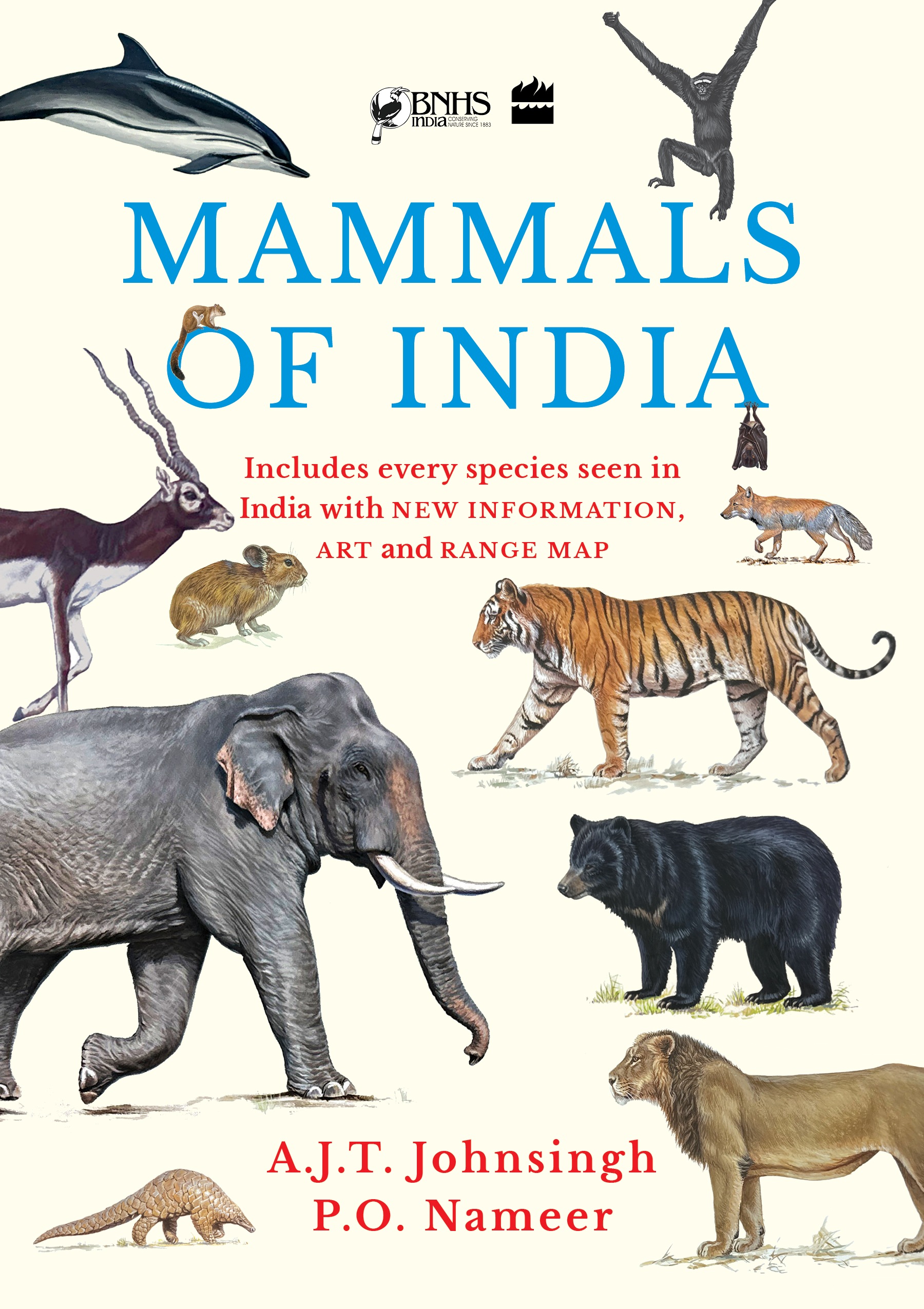 While India’s rich biodiversity includes a large number of mammals, there was no one-place comprehensive survey of them for a larger readership. ‘Mammals of India’ aims to fill this gap, as it documents more than 450 currently recognised species of Indian mammals. Dr. (late) A.J.T. Johnsingh, a vertebrate ecologist from Tamil Nadu, and Dr. P.O. Nameer is a Professor of Wildlife Science with the Centre for Wildlife Studies and the Dean of the College of Climate Change and Environmental Sciences, Kerala Agricultural University, have prepared this volume that includes fine illustrations apart from information on taxonomy, population density and conservation status of the mammals.
Here is an excerpt from the introduction of the book:
The evolution of the flora and fauna of a region is essentially an integral part of its geomorphological evolution. During the early Cretaceous, more than 145 million years ago, the Indian Peninsula was still attached to Gondwanaland. The latter was separated from the main Asian landmass, Eurasia, by the Tethys Sea in the northwest and a much more extensive northward-stretching Bay of Bengal in the northeast. Around the middle of the Cretaceous (circa [c.] 100 million years ago), the Indian Peninsula separated and began an inexorable drift northwards. When it collided with the Asian landmass around the late Cretaceous (c. 70 million years ago) and early Tertiary (65 million years ago), there began the most spectacular period of mountain building in the earth’s history.
There were three great upheavals in the earth’s crust during the Tertiary period. The first is believed to have resulted in the partial raising of the northern Himalayan regions, particularly in the eastern part, and is thought to have occurred during the Eocene epoch (55 million years ago). This formed a land bridge between Gondwanaland and Southeast Asia, particularly the Malaysian region across present-day Myanmar. This is considered to have enabled many present-day mammals to colonize the Indian subcontinent and to give the eastern Himalayan region, in particular, its predominantly Oriental faunal characteristics.
A second upheaval occurred during the middle Miocene, a period of intense activity (c. 16 million years ago). This created the present-day highly jagged Himalayan range—not only a physical barrier preventing the dispersal or movement of mammals, but also a climatic barrier blocking warm, moist monsoon winds northwards into central Asia. This resulted in the gradual desiccation of the Tibetan plateau region, giving Trans-Himalaya its distinctive mammalian fauna, much of which is desert-adapted. During the late Pliocene (c. 5 million years ago), smaller upheavals or movements of tectonic plates created an uplift of the Himalayan foothill zone, thus producing the Shivaliks. These were, originally, sedimentary deposits laid down 25 million years ago by rivers draining into the sea from the Himalayas.
Exploration in the Shivaliks has revealed a varied and fascinating range of fossils, showing that the Indian subcontinent was once populated by mammals that are now mostly extinct, or whose modern descendants survive only within the continent of Africa. There were no less than 11 kinds of elephants or mastodons and six kinds of rhinoceroses, as well as giraffe-like and hippopotamus-like mammals.
The formation of the Himalayan mountain range and the Shivaliks led to major ecological changes in habitats in the Indian subcontinent: (a) floral and faunal inflow from the Ethiopian, Palaearctic and eastern part of the Oriental/Indomalayan region and Myanmar benefitted more from the floral and faunal inflow from the Oriental region; (b) the Himalayas blocked monsoon winds, keeping Tibet dry and resulting in the southern slopes of the Himalayas, particularly of the Central and Eastern Himalayas, becoming densely vegetated; and (c) the formation of the Indo-Gangetic–Brahmaputra alluvial floodplains, characterized by great river systems arising from the Himalayas. It is aptly said that the Himalayas preside over the ecology and biogeography of India.
Soon after the formation of the Himalayas and during the following epochs, there were major climatological changes. One such event was the cooling down of the whole planet in the Pleistocene epoch (c. 2–3 million years ago), which experienced successive periods of glaciation when parts of the Himalayas were covered by an ice cap. This presumably forced many Palaearctic mammals to retreat southwards where temperatures were cooler but tolerable (e.g., Nilgiri tahrs and their subsequent evolution). The alternative was to perish, and much of the Shivalik fauna disappeared due to climatic changes during this period.
The Himalayas became a pathway from the mainland for Oriental mammals. It caused the inflow of mammals into the Oriental-Temperate Inflow (e.g., gorals, serows, takins) and the Oriental Humid Tropical Inflow (e.g., pygmy hogs, sangai). The differences in vegetation and climate, however, determined the further spread of these mammals. Gorals reached the mountains of Pakistan, serows stopped in Kashmir, and takins stopped in the central Himalayas. The Himalayas helped gorals to colonize as far south as the Shivaliks, at altitudes even as low as 300 metres. Some species (such as slow lorises, gibbons, pig-tailed macaques, pygmy hogs, sangai and Sumatran rhinoceroses) stopped in the eastern Himalayas and adjacent regions.
There is no doubt that in times before the late Pleistocene, tahrs occurred widely as a continuous population. Fossil remains have been found in the Shivaliks and on Piram Island located in the Gulf of Khambhat (Gujarat). Perhaps competition with more adaptable ungulates may have forced these goats to retreat and adapt to relatively precipitous mountains. Perhaps a period of unfavourable climate, probably dry heat, may have forced them to retreat to higher mountain ranges where the climate was more humid and cooler. Whatever the causal reasons, one population was able to survive in the comparatively low, hot mountain ranges of Oman and United Arab Emirates, giving rise to the Arabian tahr (Hemitragus jayakari). Another population retreated to the Western Ghats in south India. A third, known as the Himalayan tahr, was able to survive in the Himalayas. Thus, because of their relatively early isolation, tahrs evolved into three distinct species.
During one of the many glaciation events in the Pleistocene, mammals (with a continuous distribution from the western Palaearctic to the Ethiopian region) were probably forced to retreat southwards, where they survived in the warmer areas of the Middle East and the countries bordering the Mediterranean Sea. Some probable examples are lions, caracals, cheetahs, striped hyenas and urial. These animals were able to extend their range eastwards into the Indian subcontinent. Cheetahs became extinct in India as recently as 1948 (but were subsequently reintroduced in 2022 from Namibia and South Africa) and lions now survive in an isolated pocket in Gir National Park and Wildlife Sanctuary, with no intervening populations outside Africa.
The comparatively cool climatic conditions in coniferous forests or sub-alpine scrub, which are found in the higher western parts of the Himalayas, have also enabled many Palaearctic mammals of the boreal forest zone to colonize these regions. Examples of such mammals are lynxes, stoats, brown bears and red deer or hangul of Kashmir, the last of which has evolved into a very large and distinctive species.
The Indo-Gangetic–Brahmaputra Plain, once a huge depression created during the time of the formation of the Himalayas, filled with sediments over time. With its great riverine systems characterized by tall grass habitats and seasonal swamps, the plain provided a favourable habitat for the evolution of a number of endemic species unique to this region. Human settlements, coupled with subsequent changes in the course of rivers, have led not only to the diminution of this once vast swampy habitat but also to its division into two similar but widely separated tracts of tall grass and seasonal swampy habitats: one along the Indus River and the other along the Indo-Gangetic–Brahmaputra floodplains. The unique species and sub-species that evolved here include blind dolphins (Platanista gangetica and Platanista minor), hispid hares, hog deer and swamp deer.
[The excerpt reproduced with the permission of the publishers.]