
Indian Ocean more contested than ever: Western Naval Command Chief

Senior military leaders at Mumbai defence conclave stress indigenous manufacturing, MSME participation and strategic preparedness amid evolving Indo-Pacific challenges

geetanjali

Geetanjali Minhas | May 12, 2026 | Mumbai

#Defence  


The Indian Ocean is becoming increasingly contested and strategically significant as the Indo-Pacific emerges as the defining geopolitical theatre of the 21st century, Vice Admiral Krishna Swaminathan, Flag Officer Commanding-in-Chief of the Western Naval Command, has said.

 
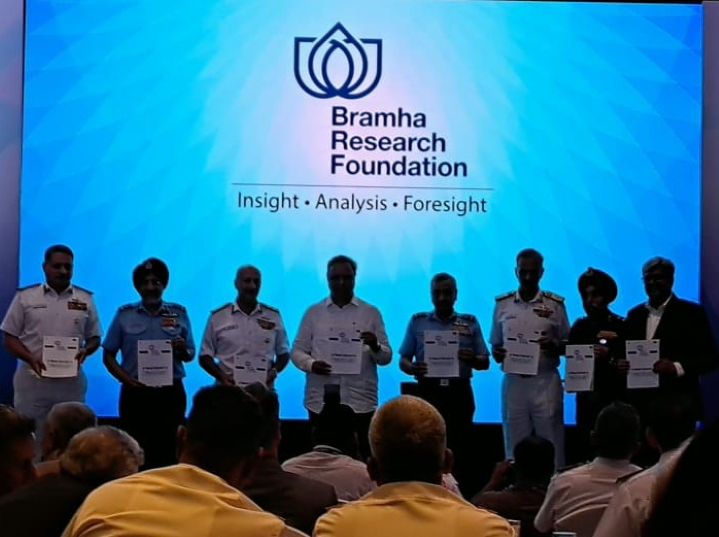
Speaking at the conclave on ‘Atmanirbharta in Defence - Opportunities for MSMEs’, organised by the Bramha Research Foundation in collaboration with the Indian Navy in Mumbai on Monday, Vice Admiral Swaminathan emphasised the critical importance of maritime security and indigenous defence manufacturing. The conclave coincided with the completion of one year of Operation Sindoor.
 
“Today, as the Indo-Pacific emerges as the defining theatre of 21st century geopolitics, the Indian Ocean is becoming even more contested, more watched and more consequential than at any point in living memory,” he said.
 
He noted that the Indian Ocean has historically remained India’s strategic arena and stressed that the Indian Navy continues to play a pivotal role in securing commercial sea routes and delivering humanitarian assistance across the region.
 
“This is not a peacetime ceremonial force but an operational navy deployed continuously across a vast and complex maritime theatre,” he said.
 
Highlighting the government’s evolving procurement priorities, Vice Admiral Swaminathan stated that indigenous manufacturing has become central to India’s defence policy framework.
 
“Indigenous manufacturing has now become the gold standard of government procurement,” he said.
 
He also pointed to significant opportunities for micro, small and medium enterprises (MSMEs) in defence vessel manufacturing, ship repair and refitting operations.
 
Air Marshal Ashutosh Dixit, Chief of Integrated Defence Staff, said more than Rs 5 lakh crore worth of recently approved defence projects carry a strong focus on Indian-made systems and domestic manufacturing. He described Operation Sindoor a defining example of India’s growing indigenous military capability and strategic resolve under the leadership of Prime Minister Narendra Modi.
 
He added that India’s defence exports have crossed Rs 39,000 crore, underscoring the country’s expanding footprint in the global defence market.
 
Air Marshal Dixit said future conflicts would increasingly be shaped by technological capabilities and industrial preparedness rather than conventional platforms alone.
 
He identified artificial intelligence, cyber warfare, autonomous systems, drones, advanced electronics and resilient supply chains as key determinants of strategic superiority in future warfare scenarios.
 
He said that strategic superiority will increasingly depend on resilient supply chains, rapid innovation, scalable manufacturing and strong MSME participation.
 
Calling MSMEs the backbone of India’s future defence ecosystem, he urged smaller industries to transition from being vendors to becoming long-term strategic partners in national security.
 
The conclave also reflected on the role of indigenous defence platforms such as BrahMos, Akashteer and the Indianised Su-30MKI in strengthening India’s operational preparedness and strategic confidence. It highlighted growing participation of Indian educational institutions like IIT’s and several local universities in defence research and development.

Comments


Other News

Astonishing breadth and depth of ancient Indian knowledge systems

The Greatest Books of Ancient India: Incredible Ideas about Science, Music, Maths, Art and More By Dr. Pradeep Chakravarthy and Dr. R. Thiagarajan Hachette India, 208 pages, Rs 399  

Strong El Nino threat over India`s monsoon, food & water security

India is heading into the southwest monsoon season this year under the shadow of a rapidly strengthening El Nino, with meteorologists warning that the climate phenomenon could significantly disrupt rainfall patterns, intensify heat stress and place additional pressure on the country’s agriculture-d

How corporates can nudge real change

The Business Of Business Is (Not) Just Business: How Behavioural Tools Can Drive Real Change Edited by Sutapa Banerjee, with Foreword by Nadir Godrej HarperCollins, 336 pages, Rs 699  

India stopped jailing people for paperwork. Now comes the hard part

A small pharmacist in Rajkot neglects to change a notice in his store under a little-known clause of a public health law. This was not only a non-compliance matter, but also a criminal offence, and a jail sentence was the punishment under the old system. Not a fine. Not a warning. Jail. Now scale

How to make our cities climate-resilient

Indian cities are growing at a pace that our infrastructure and climate can no longer sustain. This rapid urban sprawl increasingly strains urban systems, overshadowing the severe environmental fallout produced in its wake. The repercussions include Urban Heat Island Effect (UHI), Urban Floods, and many mo

Trump’s China setback pushes US to woo India

A week after Donald Trump’s visit to China – the first by an American president in nine years, US secretary of state Marco Rubio arrived in India on May 23 on a four-day visit aimed at resetting Washington DC’s relations with New Delhi and attending the third Quad ministerial meeting.


Archives

Current Issue

Opinion

Facebook Twitter Google Plus Linkedin Subscribe Newsletter

Twitter






