
Indian Railways celebrates 171 years of its pioneering journey

The first train in the country (and Asia) was flagged off from Boribunder (where CSMT stands today) on April 16, 1853

geetanjali

Geetanjali Minhas | April 16, 2024 | Mumbai

#Railways   #Mumbai   #History  


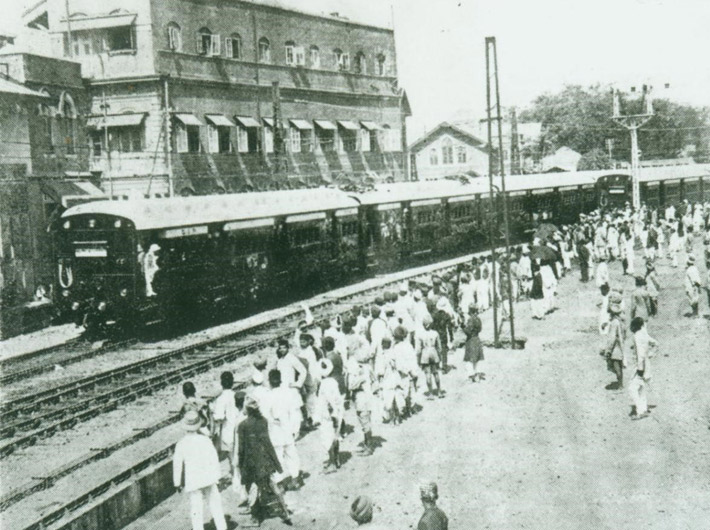
The Indian Railways is celebrating 171 glorious years of its existence. Going back in time, the first train in India (and Asia) ran between Mumbai and Thane on April 16, 1853. It was flagged off from Boribunder (where CSMT stands today). As the years passed, the Great Indian Peninsula Railway which ran the first train merged with the Indian Midland Railway Company in 1900 and extended its frontiers from Delhi in the North, Kanpur and Allahabad in the North-east and Nagpur in the East to Raichur in the South-east.  

On November 5, 1951, Central Railway was formed by integrating Nizam State, Scindia State and Dholpur State Railways. Today Central Railway has five divisions: Mumbai, Bhusaval, Nagpur, Solapur and Pune; and a network over 4,275 route kms spanning the states of Maharashtra, Madhya Pradesh and Karnataka through 466 stations.

From the first train in April 1853 to the most modern train of India, Vande Bharat Express, the Railways have successfully expanded network to the huge area in last 171 years. Central Railway runs six Vande Bharat Express trains: CSMT-Sainagar Shirdi, CSMT-Solapur, CSMT-Madgaon, CSMT-Jalna, Nagpur-Bilaspur & Nagpur-Indore Vande Bharat.
 
Central Railway also has many firsts like the first Shatabdi Express, first Jan Shatabdi Express, first Tejas Express among others. With trains like Punjab Mail in operation for more than 100 years, Central Railways has come a long way.

Since running the first electric train service in India between Bombay VT and Kurla Harbour on February 3, 1925, it laid the foundation of electrification of railways and Mumbai's suburban services which today have become the lifeline of the city. Today, Central Railway has achieved 100% electrification and the suburban network has also steadily increased.
 
At present Central Railway has five suburban corridors. The suburban services started with three coaches, gradually increased to nine coaches, 12 coaches and today some services have 15 coaches. Moreover presently the corridor also has AC suburban services.

In terms of loading, originating loading which was 16.58 million tonnes at the time of formation is now increased to 89.24 million tonnes in 2023-24 – the best ever so far.

Moreover,  infrastructure works like construction of new railway lines, doubling, construction of bridges, construction of new stations etc. are taken up at a fast pace. The highest volume of 348 kms of multi-tracking work was achieved in this financial year.

Alongside, the Neral-Matheran Light Railway too has completed 117 years. Its construction started in 1904 and the two feet gauge line finally opened to traffic in 1907. As a precautionary measure, the line used to be closed during the monsoons. Later, from September 29, 2012 shuttle services between Aman Lodge and Matheran were introduced to run during monsoons.

Comments


Other News

How Rafi, Raj Kapoor helped pave the way for a great uranium deal

There`s a certain moment in diplomacy that`s too personal to be captured in a communiqué, too small to make the front page, but more revealing than the front page. This week, prime minister Narendra Modi reached Tashkent and, amid the pomp of state visits, managed to evoke the old Bollywood tunes

Distinguishing Fish 1 and Fish 2: The pragmatism behind India’s WTO ratification

 India became the 123rd WTO member to ratify the multilateral Agreement on Fisheries subsidies (AoFS) when it deposited the Instrument of Acceptance for Phase 1 on July 20, 2026. The ratification is restricted to disciplining Illegal, Unreported and Unregulated fishing (IUU), protection for overfished

The 7% growth problem: Why the next 7% will be harder

India has become accustomed to hearing the 7% growth number. It is now less a milestone than an expectation. Yet the paradox is becoming clearer: maintaining 7% growth may be considerably harder than achieving it once. India’s real GDP grew 7.7% in FY2025–26, following growth of 6.5% in FY202

The Constitution cannot be altered: Justice Abhay Oka

Justice Abhay Oka, who retired from the Supreme Court in May 2025, has said that the Constitution of India cannot be altered. Explaining the landmark Kesavananda Bharati judgment (1973) on the basic structure of the Constitution, he said, “This is one judgment that has saved democracy in India.&rdq

How the flora and fauna evolved in the Indian subcontinent

Mammals of India  By A.J.T. Johnsingh and P.O. Nameer HarperCollins India in association with Bombay Natural History Society  

India`s renewable race is moving beyond megawatts

When Shell bought Sprng Energy in 2022, India`s renewable energy market appeared to offer precisely what global energy majors were seeking: scale, growth and a place in one of the world`s largest energy transitions. Four years later, Shell is selling the same business to Aditya Birla Group for an enterpris

Upcoming Conferences


-->

Archives

Current Issue

Opinion

Facebook Twitter Google Plus Linkedin Subscribe Newsletter

Twitter






