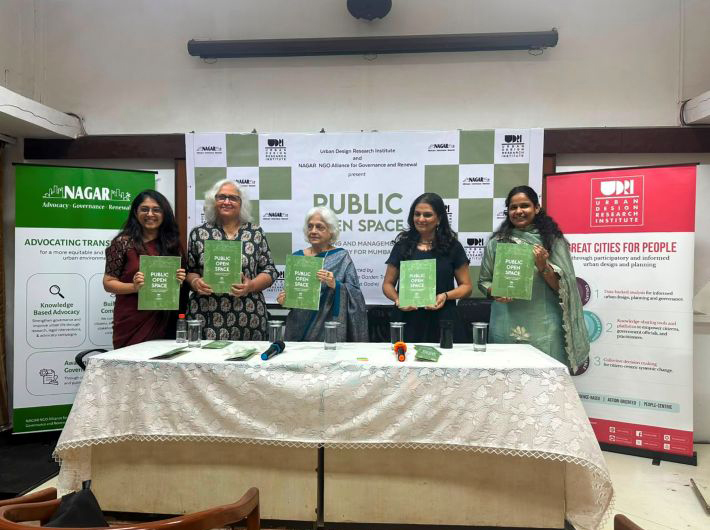
Mumbai's public space crisis is as much about mismanagement as it is about scarcity, and offers a governance roadmap that can be implemented without new legislation, according to a new report by the Urban Design Research Institute (UDRI) and the NGO Alliance for Governance and Renewal (NAGAR).
Mumbai currently has just 1.28 square metres of public open space per person -- a fraction of the 10 to 12 sq.m. per capita recommended under the national URDPFI Guidelines, says the report released Wednesday by the UDRI and NAGAR. The report's central argument goes further as it says that Mumbai's open space problem isn't only about land shortage. It's about how the city plans, manages and maintains the spaces it already has.
Titled ‘Public Open Space Mapping and Management Strategy for Mumbai’, the study moves beyond simply cataloguing the city's deficit. It lays out a practical strategy showing how better public data, stronger coordination between government departments, active citizen participation, and smarter targeting of funds can improve open spaces, largely within the existing governance framework, and without requiring major new expenditure or legislation.
The findings are grounded in detailed field surveys of 627 Development Plan designated public open spaces across the K-West and P-North wards. From this, researchers built a GIS-based database tracking accessibility, ownership, land use, amenities, encroachments, and maintenance conditions data intended to help identify priority interventions and support more transparent decision-making across agencies.
Notably, while the Development Plan 2034 allocates 6.13 sq.m. of open space per capita, a large share of that reserved land has yet to be acquired or developed.
Key Findings
* Existing open space availability stands at 1.28 sq.m. per person, against a national benchmark of 10–12 sq.m.
* Multiple government agencies manage public open spaces, leading to fragmented responsibility and weak accountability.
* Public datasets are inconsistent, making it hard for citizens and policymakers to accurately track open spaces.
* Several Development Plan-designated spaces remain inaccessible, underused, encroached upon, or un acquired.
* Mumbai has no dedicated city-wide strategy for managing open spaces beyond statutory land-use planning.
Where earlier studies largely documented the scale of the problem, this report offers an implementation framework meant for government agencies and citizens to act on jointly. Its core components include:
* GIS-based public database consolidating fragmented information on the city's open spaces into a single platform.
* Transparent methodology for flagging spaces needing urgent intervention versus those that can be improved through simple administrative steps.
* Governance framework clarifying the roles of different public agencies to encourage coordinated action.
* Participation roadmap for citizens, Area Local Management (ALM) groups, civil society organisations, and local representatives to help monitor and improve neighbourhood spaces.
* Project prioritisation and funding framework to help government bodies and CSR partner’s direct investment where it will have the greatest impact.
The report emphasizes that many of these improvements, better asset mapping, inter-departmental coordination, transparent public information, and community partnerships can be pursued immediately, without new laws or major public spending.
Anuradha Parmar, Executive Director, UDRI said the report goes beyond documenting Mumbai's open space problems to show what can be done differently, adding that improved data, institutional coordination, citizen involvement, and better-directed investment can drive real progress within the current planning framework, and that improved governance can lead to improved public spaces.
Nayana Kathpalia, Trustee, UDRI and NAGAR noted that citizens have spent decades working to protect Mumbai's open spaces, and said the report offers a practical framework for bringing government agencies, communities, and experts together around a shared, transparent management system.