
Online tourist facilitator programme to boost tourism

Within five days of the programme roll out, more than 1,500 people have registered for it

Rahul Trivedi | November 21, 2018

#tourism   #tourist facilitator   #tour guide   #Incredible India Tourist Facilitator Certification   #IITFC  
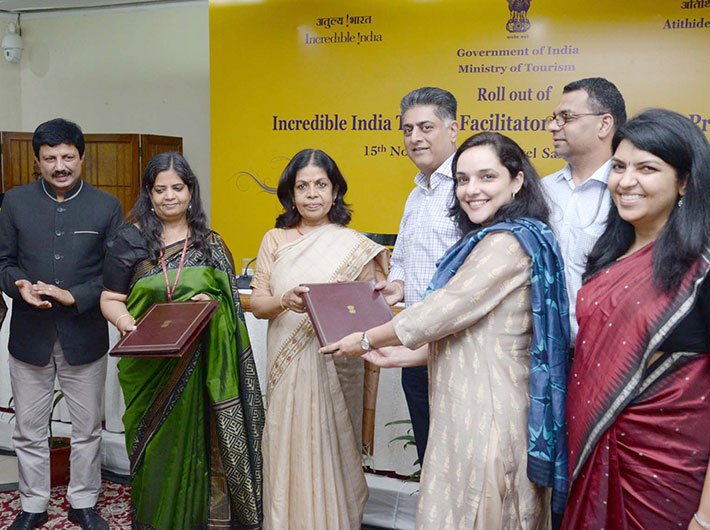
The secretary, ministry of tourism, Rashmi Verma at the roll out of the Incredible India Tourist Facilitator Certification (IITFC) Programme, in New Delhi

The ministry of tourism has rolled out a six-month online programme, Incredible India Tourist Facilitator Certification (IITFC), on November 15, in order to boost the tourism sector in the country. 

 
Within five days of its roll out, the programme has seen enrollment of more than 1,500 candidates from across the country. The six-month online programme can be joined by anyone who is 18 years of age. The programme is divided into three categories – basic, advance and language. The fee for each category is Rs 2,000 and an additional examination fee.
 
Rashmi Verma, secretary, ministry of tourism, said, “This online programme will have a lot of advantages like job creation for local people, harnessing local experience and traditional knowledge and it also has the flexibility of any age or any place people to join. This initiative will also ensure an enriching experience for the tourists, as it will address the issue of shortage of tourist guides. It will provide a lot of competition which will further ensure in providing best tourist facilitators.”
 
Niraj Sharan, additional director general, Travel Trade Division, said that the IITFC programme aspires to reach out to far-flung audience encompassing a diversity of candidates ranging from an enthusiastic student who has recently qualified for higher secondary to an ambitious homemaker willing to grasp tourist facilitation skills from the comfort of their home. It will also act as an enabler for transforming a local citizen with no specified skills having proficiency in a regional language into a potential bread earner for their households.
 
Sharan further says, “This programme will change the concept of guide and it will be replaced by the tourist facilitators.”
 
Explaining the whole process, Sharan said, “This is a completely online programme, which can be pursued by the candidates while being in the job too and online course material will be provided to the candidate.”
 
Explaining the process of getting the certificate, he said, “The candidate has to start with the basic programme. After completion of the basic programme, there will be an internal assessment done by an agency through online test. Without passing the internal assessment, the candidate won’t be able to obtain the certificate or go on to pursue the further advance or language course.”
 

Comments


Other News

“Cancer is just a mind game”

Dr. Ananda Shankar Jayant, a Padma Shri awardee, inspired audiences for decades through her mastery of Bharatanatyam and Kuchipudi. But it was her journey through cancer that taught some of life`s most powerful lessons in courage and resilience.

Why Swami Vivekananda is the pathfinder for our times

Swami Vivekananda for Our Times  Edited and compiled by Rajiv Sikri, with Introduction by S. Gurumurthy Rupa Publications, 552 pages, Rs 695  

Five ways to realise the potential of India’s handicraft and handloom sector

India`s economic ambitions are increasingly defined by the industries of the future. Semiconductors, electronics, artificial intelligence and advanced manufacturing dominate policy conversations. Yet one of India`s largest employment-intensive sectors continues to occupy a surprisingly marginal place in ec

Beyond toilets: Why open defecation persists in rural India

Despite the awareness campaigns on sanitation across India, open defecation (OD) is practised openly and widely in both rural and urban areas. Research shows that rural respondents are well aware of the negative impacts of OD, yet this awareness does not lead to toilet construction or use. In rural North I

What unpaid nation builders want from policymakers

The Supreme Court recently described homemakers as “nation builders” and fixed a notional monthly income of Rs 30,000 for them in motor accident compensation cases. The judgment was not about wages. It was about compensation. Yet it inadvertently raised a larger economic question: If a homemake

What the US–Iran peace deal means for India

After months of rising tensions, the United States and Iran have reached a memorandum of understanding called the "Islamabad Agreement." This agreement allows for the immediate reopening of the Strait of Hormuz without tolls and provides Iran with relief from sanctions, depending on its complianc


Archives

Current Issue

Opinion

Facebook Twitter Google Plus Linkedin Subscribe Newsletter

Twitter







