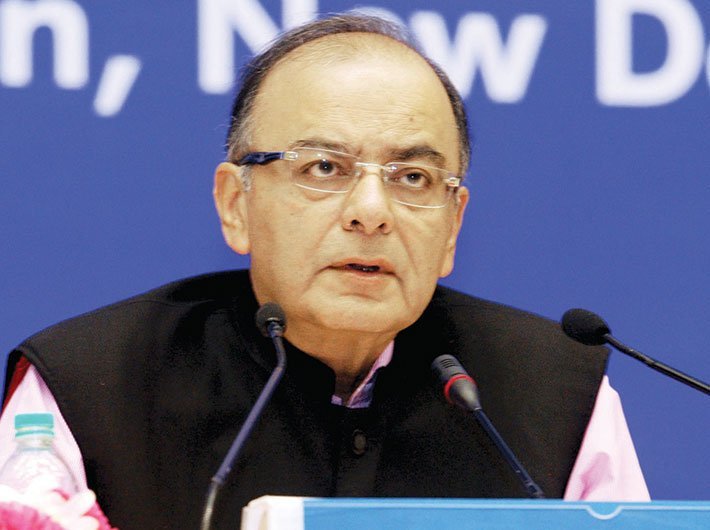
Budget should focus on direct tax reforms to provide much needed relief to the common person, says Pahle India Foundation
Pahle India Foundation (PIF) has suggested that finance minister Arun Jaitley should take cognizance of some of the possible negative effects of demonetization and take steps to minimize its negative impacts and enhance the adoption of digital currency and transactions in his budget speech.
PIF had organized a seminar and the recommendations were presented to Jaitley.
Direct Tax Reforms: In this context, Jaitley should focus on direct tax reforms to provide much needed relief to the common person. These reforms could include;
- (i) preventing the emergence of ‘tax terrorism;’
- (ii) Identifying all those who have tried to launder their ‘illegal incomes’ accounts and exacting the penal tax charges from them.
- (iii) rationalizing and simplifying the tax structure by eliminating exemptions, cesses and surcharges;
- (iv) simultaneously lowering both personal and corporate income tax rates.
- (v) continuing with some restraint on cash use to encourage digital money.
Arun Jaitley should act on his promise of bringing down the corporate tax rate to 25% from the current 33.5%. The effective corporate income tax incidence is no more than 23%. Thus, if he removes all the exemptions, he will not really suffer a revenue loss. The 2% two cut in the corporate income tax rate coming along with a sharp reduction if not elimination of exemptions, will surely be more than made up by an expanded tax net. It will improve compliance, reduce litigation and harassment by marauding tax inspectors. This step has also been suggested in the draft Direct Tax Code and should therefore be implemented in this budget.
Personal Income Tax Reduction: Unfortunately, we still suffer from widespread poverty in our country (12.3% of our population lives on $ 1.00 per day!). Given the poverty and average annual nominal per capita income in 2016 being only Rs 93,230, it would be quite inequitable to raise the level of income that is exempted from personal income tax from the present level of Rs2.5 lakh. However, there is scope for rationalizing the personal income tax structure. The highest rate of personal income tax at 33% rate (30% plus cesses) presently becomes applicable at an annual income of Rs 10 lakh. Imposing this high rate at this income level encourages non-compliance as it is seen as far too high by middle class professionals and small traders and entrepreneurs.
This is perhaps also reflected in the rather bizarre fact that as few as 24 lakh people in India declare their annual income as above Rs. 10 lakh is ample evidence of the consequent widespread tax avoidance. My suggestion would be to apply this highest rate of 30% at an income level of Rs 24 lakh per annum. This would both expand the tax net and provide a much needed rise in disposal incomes of the middle class. This will boost consumption boost, which is currently much needed in the post demonetization period.
Indirect Tax Rationalization: Another tax measure that the finance minister should take is to roll back some of the excise duty increases on petroleum products (petrol plus diesel) that were announced over the last two years. Excise duties were hiked eight times during 2014-16 to absorb some of the gains from the steep fall in global oil prices as government revenues. With global oil prices having firmed up over the last six months, it is time to reverse some of these excise duty hikes. This will provide a timely relief to the common man and also bring down costs in the economy. Both measures will stimulate economic activity.
With the likely introduction of the GST in July 2017, the forthcoming budget would be the logical place to start bringing indirect tax rates on goods and services in line with the rates proposed under the GST. This should see a rather sharp reduction in central excise duties on goods and a modest increase in tax on services.
Boosting Slackening Investment: Private investment activity, which started to plummet during the last two years of the UPA government, needs to be revived urgently and significantly. The following steps will help in this regard:
- Not tinker at this stage with long term capital gains tax as it will discourage savings and further sour investor sentiment.
- Change financial sector regulation from being entity based to activity based regulation. This will encourage NBFCs to lend to SMEs and housing sector.
- The tax regime for the leasing industry also needs substantial simplification and rationalization. Revival of leasing will boost investment activity.
- SMEs should certainly not be hounded by tax inspectors for extracting rents. Instead, commercial banks may consider raising their working capital limits in line with their higher deposits made after demonetization.
Hiking Public Capital Expenditure: Finance minister will do well to announce an increase of at least 25% in public capital expenditure in 2017-18 over the revised budget estimates for 2016-17. This will give a clear signal to all concerned that the Modi government is serious about expanding productive capacities in the economy and generate additional employment.
Fiscal Versus Revenue Deficit: Fiscal hawks should be aware that their stance could well have serious national security implications at the present conjuncture. The Finance Minister has to take the necessary though difficult call between placating and pampering international credit rating agencies, with somewhat dubious credentials, against a rising storm of youth agitation fed by continued frustration of their exploding aspirations. The Finance Minister must surely recognize that in the absence of a strong economic recovery by March 2018, BJP’s political fortunes in 2019 general elections could take a severe knock. Please Mr. Jaitley, do not succumb to threats either from fiscal hawks or rating agencies as these are paper tigers while the rising tide of youth anger is certainly not.
Instead the Finance Minister may focus his attention on eliminating revenue deficit as quickly as possible. Rising revenue deficit clearly implies living beyond one’s means. The share of revenue expenditure in total government expenditure has been rising inexorably from about 60% during the 70s to an unsustainable 85% in 2015. The noxious impact of FRBM implementation has been a continuing reduction in capital expenditure to meet FRBM targets. This must be reversed. Surely borrowing done to raise productivity and expand production capacities is fully justified.
Time Bound Affordable Housing Program: The Government should hugely ramp up its capital allocation for affordable and workers’ housing and establish a special task force to monitor the project’s execution in a tight deadline of 18 months. Land already in Government possession should be handed over to these projects for facilitating their execution. The government should consider providing affordable housing infrastructure status.
Special Infrastructure Fund: The budget should also announce the setting up of a ‘Special Fund’ to assist in the re-starting of stalled infrastructure projects. However, this should not imply bailing out those corporations who took unnecessary risks and failed in project implementation. Finally, the proposed National Infrastructure Investment Fund (NIIF), that has been long in the making, could also be directed to help in re-starting stalled projects.