
Supreme Court gets five new judges

President approves appointments

GN Bureau | June 1, 2026

#Judiciary   #Supreme Court   #Law  


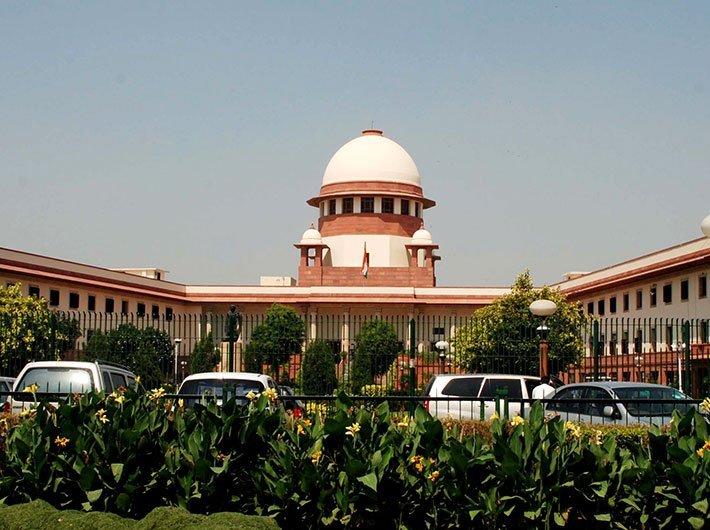
Five new judges were appointed to the Supreme Court of India on Monday.

"Vide Notifications of even number dated 01.06.2026, in exercise of the powers conferred by clause (2) of Article 124 of the Constitution of India, the Hon’ble President of India is pleased to appoint (i) Shri Justice Sheel Nagu, Chief Justice, High Court of Punjab and Haryana, (ii) Shri Justice Shree Chandrashekhar, Chief Justice, High Court of Bombay, (iii) Shri Justice Sanjeev Sachdeva, Chief Justice, High Court of Madhya Pradesh, (iv) Shri Justice Arun Palli, Chief Justice, High Court of Jammu & Kashmir and Ladakh and (v) Smt. Venkita Subramani Mohana, Senior advocate, to be Judges of the Supreme Court of India with effect from the date they assume charge of their office," an official release said.

On May 6, the Union Cabinet had approved the proposal for introducing The Supreme Court (Number of Judges) Amendment Bill, 2026 in Parliament to amend The Supreme Court (Number of Judges) Act, 1956 for increasing the number of judges of the apex court by four from the present 33 to 37 (excluding the Chief Justice of India). 
 
The increase in the number of Judges will allow the apex court to function more efficiently and effectively ensuring speedy justice. 
 
The expenditure on salary of Judges and supporting staff and other facilities will be met from the Consolidated Fund of India. 
 
Article 124 (1) in Constitution of India inter-alia provided “There shall be a Supreme Court of India consisting of a Chief Justice of India and, until Parliament by law prescribes a larger number, of not more than seven other Judges…”. 
 
An act to increase the Judge strength of the Supreme Court of India was enacted in 1956 vide The Supreme Court (Number of Judges) Act 1956. Section 2 of the Act provided for the maximum number of Judges (excluding the Chief Justice of India) to be 10.
 
The Judge strength of the Supreme Court of India was increased to 13 by The Supreme Court (Number of Judges) Amendment Act, 1960, and to 17 by The Supreme Court (Number of Judges) Amendment Act, 1977. The working strength of the Supreme Court of India was, however, restricted to 15 Judges by the Cabinet, excluding the Chief Justice of India, till the end of 1979, when the restriction was withdrawn at the request of the Chief Justice of India. 
 
The Supreme Court (Number of Judges) Amendment Act, 1986 further augmented the Judge strength of the Supreme Court of India, excluding the Chief Justice of India, from 17 to 25. Subsequently, The Supreme Court (Number of Judges) Amendment Act, 2008 further augmented the Judge strength of the Supreme Court of India from 25 to 30.       
 
The Judge strength of the Supreme Court of India was last increased from 30 to 33 (excluding the Chief Justice of India) by further amending the original act vide The Supreme Court (Number of Judges) Amendment Act, 2019.

Comments


Other News

The women India doesn`t count enough

She runs a tailoring shop from a single room in her house. Every morning she stitches school uniforms, answers queries on WhatsApp, collects payments through UPI and orders fabric online. Officially, she still belongs to India`s informal economy. Yet her enterprise is no longer disconnected from the formal

“Cancer is just a mind game”

Dr. Ananda Shankar Jayant, a Padma Shri awardee, inspired audiences for decades through her mastery of Bharatanatyam and Kuchipudi. But it was her journey through cancer that taught some of life`s most powerful lessons in courage and resilience.

Why Swami Vivekananda is the pathfinder for our times

Swami Vivekananda for Our Times  Edited and compiled by Rajiv Sikri, with Introduction by S. Gurumurthy Rupa Publications, 552 pages, Rs 695  

Five ways to realise the potential of India’s handicraft and handloom sector

India`s economic ambitions are increasingly defined by the industries of the future. Semiconductors, electronics, artificial intelligence and advanced manufacturing dominate policy conversations. Yet one of India`s largest employment-intensive sectors continues to occupy a surprisingly marginal place in ec

Beyond toilets: Why open defecation persists in rural India

Despite the awareness campaigns on sanitation across India, open defecation (OD) is practised openly and widely in both rural and urban areas. Research shows that rural respondents are well aware of the negative impacts of OD, yet this awareness does not lead to toilet construction or use. In rural North I

What unpaid nation builders want from policymakers

The Supreme Court recently described homemakers as “nation builders” and fixed a notional monthly income of Rs 30,000 for them in motor accident compensation cases. The judgment was not about wages. It was about compensation. Yet it inadvertently raised a larger economic question: If a homemake


Archives

Current Issue

Opinion

Facebook Twitter Google Plus Linkedin Subscribe Newsletter

Twitter






