
To understand India, Nehru’s perennial classic remains the best bet

Thinkers, politicians, writers name favourite books on the theme of India for the Independence Day special edition of Governance Now

GN Bureau | August 13, 2015
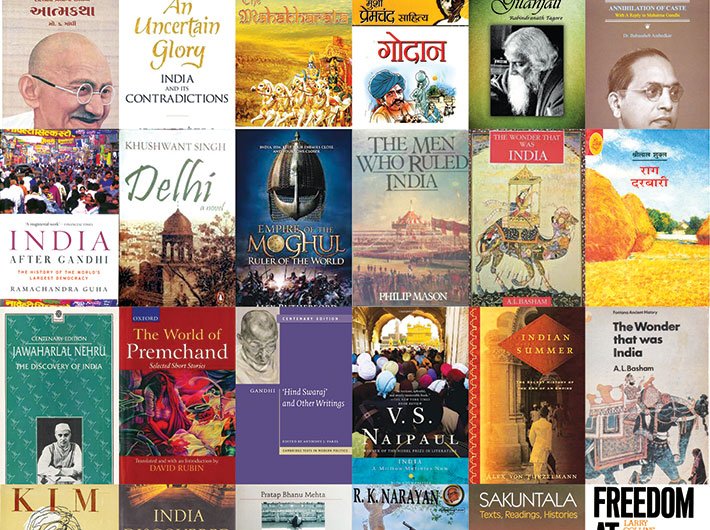


When not one but two senior editors, both baptized in the JP movement, spoke the same words on different occasions – that “you must read X to understand India” (X being Gora plus Ghare Baire for one and Raag Darbari for the other), we thought it would be worthwhile to make a master list of readings that make the idea of India comprehensible.

For the Independence Day special edition, we turned to some of the most discerning readers of our times to name roughly five (or more, or less) books that they think best explain India – and have played a part in defining it, too. (We are grateful to them for their time and replies.)

This was not a formal opinion poll. Moreover, the people we spoke with – political leaders, opinion leaders, policymakers, economists, litterateurs, scientists and artists – included some of the best minds of our times, but such a list cannot be exhaustive. Yet, the replies we received give broad contours of an ‘India canon’, and on top of the list is … The Discovery of India by Jawaharlal Nehru.

We spoke with about 30 people, and as many as eight of them named Nehru’s “perennial classic” as one of the books they would suggest if you want to understand the idea of India. They included Rajmohan Gandhi, Martha Nussbaum, Andre Beteille, Bibek Debroy, Mani Shankar Aiyar, KR Meera, Justice (retd) CS Dharmadhikari and Raziuddin Aquil.

Just to clarify once again, this was not a structured survey, and the replies are not tabulated and books need not be ranked, but there are two books which were named by four people each: Mahatma Gandhi’s ‘The Story of My Experiments with Truth’ and Ramachandra Guha’s ‘India after Gandhi’. Gandhi’s ‘Hind Swaraj’ was recommended by Ashis Nandy and Martha Nussbaum.

Among other titles that cropped up more than once are BR Ambedkar’s Annihilation of Caste, AL Basham’s old classic ‘The Wonder That Was India’, the Mahabharata and Ramayana. Not many names here to understand the 21st century India, but the only recently released work that has come up in replies is Jean Dreze and Amartya Sen’s ‘India: An Uncertain Glory’.

As for the works of fiction that best capture the Indian reality – and imagination, our respondents most frequently turned to Shrilal Shukla’s inimitable ‘Raag Darbari’ (named by people as diverse as Jean Dreze, Ganesh Devy and Sudhir Mishra). Tagore’s ‘Ghare Baire’ and ‘Gora’, of course, figure in the replies, and so do Khushwant Singh and Saadat Hasan Manto, In particular, several respondents named one or the other novel by RK Narayan (For Bibek Debroy, any of his works will serve the purpose).

So, this long weekend, you can give yourself a break and pick up one of these works that you have heard a lot about but are yet to read. Or you can pick up a copy of the latest issue of Governance Now, and read about them all and join the debate with the following respondents:

 
Ashis Nandy

Martha Nussbaum

Rajmohan Gandhi

Jean Dreze

Andre Beteille

Gopalkrishna Gandhi

Bibek Debroy

Kashinath Singh

Mark Tully

Soumitra Chatterjee

KR Meera

Ganesh Devy

Subroto Bagchi

Mani Shankar Aiyar

Ram Bahadur Rai

Prithviraj Chavan

Kamini Jaiswal

Somnath Chatterjee

Probal Dasgupta

Naren Bedide

Aakar Patel

Sanjana Kapoor

Sudhir Mishra

Raziuddin Aquil

Pinky Anand

CS Dharmadhikari

Bhalchandra Mungekar

Arvind Gaur

Ramakrishna V Hosur


Comments


Other News

Consumer Justice at a Crossroads

Over the past four decades, India`s consumer protection landscape has undergone a remarkable transformation. What began with the Consumer Protection Act, 1986 as a simple mechanism to empower ordinary citizens has evolved into a comprehensive framework capable of addressing challenges ranging from mislea

Doctors, experts call for ban on junk food ads, mandate warning labels

More than 30 doctors, medical scientists and public health professionals have urged the government to take decisive action against the aggressive advertising and marketing of junk food, calling for a watershed ban on advertisements for foods high in fat, sugar and salt (HFSS) and ultra-processed foods (UPF

Asiatic Lion population rises from 523 in 2015 to 891 in 2025

On World Lion Day 2026, environment, forest and climate change Minister  Bhupender Yadav celebrated India’s remarkable journey in lion conservation and reaffirmed the country’s unwavering commitment to protecting wildlife and biodiversity.   In a post on soc

Railways imposed ₹5.13 crore fine for food quality and hygiene violations

Indian Railways serve about 58 crore meals every year on an average. About only 0.0008% food quality related complaints are received on average. Based on complaints during the last three years, appropriate penal actions have been taken by IRCTC. Such actions include imposition of fines amounting to ₹5.13

STHAVAR: Why every Indian built asset needs a permanent digital identity

India has built digital systems for identity, payments, taxation, documents, logistics and public services. State governments, ministries, infrastructure agencies and urban local bodies have also created portals for land records, building permissions, project monitoring, property taxation and municipal s

Saksham Skill census identifies 22,000 job-ready candidates in one Mumbai ward

A first-of-its-kind AI-enabled skill census conducted in Mumbai`s H-West Ward has identified a potential livelihood pipeline of nearly 22,000 candidates, generated over 32,000 provisional job matches while revealing that 71.2 per cent of surveyed homemakers are willing to join the workforce, according to

Upcoming Conferences


-->

Archives

Current Issue

Opinion

Facebook Twitter Google Plus Linkedin Subscribe Newsletter

Twitter






