
Union Budget 2020-21: Central tenet is Ease of Living

At the core are ideas of corruption-free, policy-driven good governance, clean and sound financial sector

GN Bureau | February 1, 2020

#Union Budget   #finance minister   #finance ministry   #Nirmala Sitharaman   #parliament   #economy   #society  
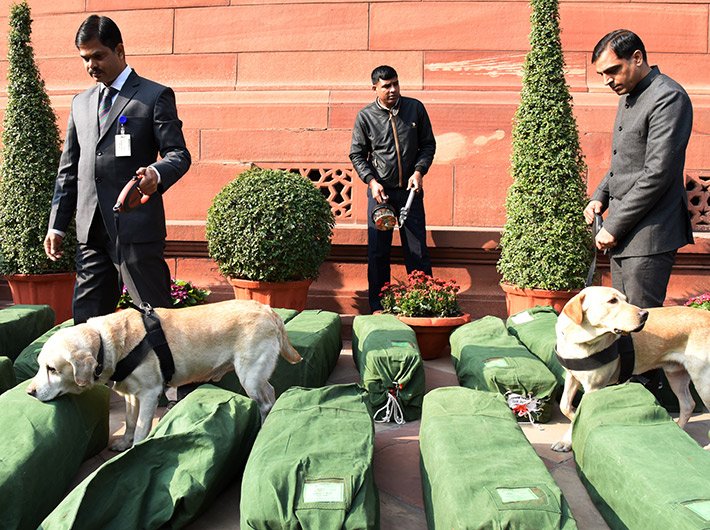
Sniffer dogs check the bundles of the budget documents in the parliament complex ahead of the budget presentation.

“Our prime minister has laid before us ‘Ease of Living’ as a goal to be achieved on behalf of all citizens,” said minister for finance Nirmala Sitharaman while presenting the union budget 2020-21 in parliament Saturday. With this backdrop, our government shall work towards taking the country forward so that we can leapfrog to the next level of health, prosperity and wellbeing,” she added. 

This budget, with the central tenet of Ease of Living for all citizens, is woven around three prominent themes:

* Aspirational India in which all sections of the society seek better standards of living, with access to health, education and better jobs. Its components are Agriculture Irrigation and Rural development; Wellness, Water & Sanitation; and Education & Skills.

* Economic development for all, indicated in the P’s exhortation of “Sabka Saath, Sabka Vikas, Sabka Vishwas”. This would entail pervasive economic reforms and yielding more space for the private sector to ensure higher productivity and greater efficiency. Three components of which are Industry, Commerce and Investment; Infrastructure; and the New Economy.

* A Caring Society, based on Antyodaya, which is both humane and compassionate. Three components of which are Women & Child, Social Welfare; Culture and Tourism and Environment & Climate Change.

These three broad themes are held together by corruption-free, policy-driven good governance and a clean and sound financial sector. The finance minister also said that this budget was being presented against the backdrop of two cross-cutting developments; namely, proliferation of technologies like Machine Learning, Robotics, AI, Analytics, Bio-Informatics; and the highest ever cohort of productive age population (15-65 years). Consequently, the digital revolution has placed India in a unique leadership position globally. The government aims to:

* Achieve seamless delivery of services through Digital governance
* Improve physical quality of life through National Infrastructure Pipeline
* Mitigate Risks through Disaster Resilience
* Boost Social security through Pension and Insurance penetration.

The FM also said that the budget reflects the government’s firm commitment to substantially boost investment in agriculture, infrastructure, social sector, education and health. This is substantiated by increase in expenditure of Rs 3,43,678 crores over Revised Estimates (2019-20) while keeping the fiscal deficit at 3.8% of GDP, she added.

Comments


Other News

How Rafi, Raj Kapoor helped pave the way for a great uranium deal

There`s a certain moment in diplomacy that`s too personal to be captured in a communiqué, too small to make the front page, but more revealing than the front page. This week, prime minister Narendra Modi reached Tashkent and, amid the pomp of state visits, managed to evoke the old Bollywood tunes

Distinguishing Fish 1 and Fish 2: The pragmatism behind India’s WTO ratification

 India became the 123rd WTO member to ratify the multilateral Agreement on Fisheries subsidies (AoFS) when it deposited the Instrument of Acceptance for Phase 1 on July 20, 2026. The ratification is restricted to disciplining Illegal, Unreported and Unregulated fishing (IUU), protection for overfished

The 7% growth problem: Why the next 7% will be harder

India has become accustomed to hearing the 7% growth number. It is now less a milestone than an expectation. Yet the paradox is becoming clearer: maintaining 7% growth may be considerably harder than achieving it once. India’s real GDP grew 7.7% in FY2025–26, following growth of 6.5% in FY202

The Constitution cannot be altered: Justice Abhay Oka

Justice Abhay Oka, who retired from the Supreme Court in May 2025, has said that the Constitution of India cannot be altered. Explaining the landmark Kesavananda Bharati judgment (1973) on the basic structure of the Constitution, he said, “This is one judgment that has saved democracy in India.&rdq

How the flora and fauna evolved in the Indian subcontinent

Mammals of India  By A.J.T. Johnsingh and P.O. Nameer HarperCollins India in association with Bombay Natural History Society  

India`s renewable race is moving beyond megawatts

When Shell bought Sprng Energy in 2022, India`s renewable energy market appeared to offer precisely what global energy majors were seeking: scale, growth and a place in one of the world`s largest energy transitions. Four years later, Shell is selling the same business to Aditya Birla Group for an enterpris

Upcoming Conferences


-->

Archives

Current Issue

Opinion

Facebook Twitter Google Plus Linkedin Subscribe Newsletter

Twitter






