
70 words that define India, why Doklam stand-off won’t lead to a war, and more

Here are stories you must read on the weekend

GN Bureau | August 18, 2017

#Doklam   #Independence Day   #weekend stories   #Prakash Javadekar  


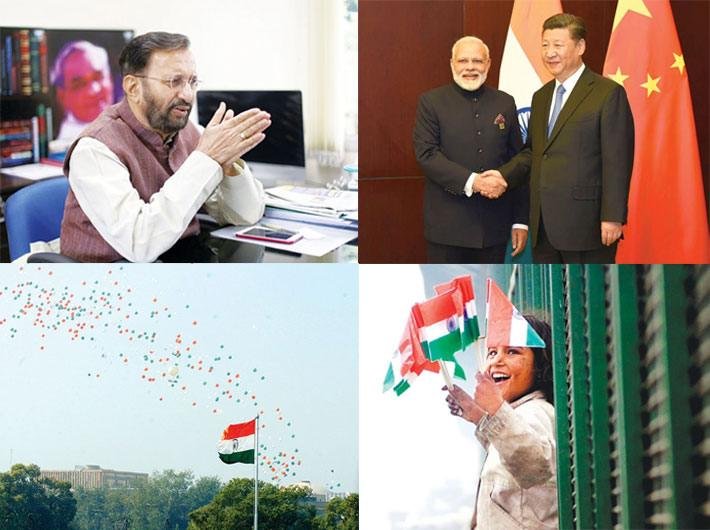
As India celebrates 70 years of freedom, Governance Now looks back and picks 70 words – or phrases, buzzwords, slogans, events – that best define this ancient nation and young democracy. Here, you will find much to be proud of, much tinged with pangs of nostalgia. Then there are entries that provide a cautionary tale on the lines of “those who ignore the history are condemned to repeat it”. Not to mention some that support the fond belief that history’s second act is usually not so tragic.
 
 
Governance in the nitty gritty details of the everyday life is tedious and slow, backbreaking and endless. Ask any district collector or assistant engineer and he will tell. These issues magnify a hundred fold at the last point in the delivery chain. While we have well-considered policies in place, with even the financial resources to implement them, it is when we reach the last mile, and are at the point of handing over the public good to the citizen, that the glitches arise. Much has been written about the quality of the delivery of services at the last mile. And yet, the problems remain, often insurmountable. And so, as we enter the eighth decade of our freedom, the challenges are clear and indistinct, sharply focussed and fuzzy. 
 
 
My first priority – and that reflects my worry as well – is to improve the quality of government schools. It’s a tough job. Unfortunately, government schools which were much better earlier have deteriorated in two decades, says Prakash Javadekar, minister of human resource development. He adds, “That happened after teachers got more facilities – and I believe they must get it. After this, we saw they were lacking in motivation. There is a good lot among them and also a lot which is not so good. As a result of this, teaching in government schools has suffered. Then after the RTE [Right to Education Act] was brought in, there were no detentions in schools. This further reduced the accountability of teachers as he is not tested for anything. Therefore, we are now introducing detentions at class 5th and class 8th.”
 
 
India and China are not prepared for a war over Doklam plateau in Bhutan, assessed JNU professor Srikanth Kondapalli, a well-known China expert who is back  from Beijing and Shanghai after spending two months there. In an interview with Governance Now, Kondapalli said both countries will not opt for war as it will be catastrophic and millions would die.


Comments


Other News

Dharmendra Pradhan tenders resignation

Dharmendra Pradhan, education minister at the centre of the storm of the NEET paper leak, offered his resignation to the prime minister on Saturday.   He posted a two-page letter on X, saying he was pained by the events of the last ten days. "This is not a matter of personal

Cabinet approves scheme of chemical parks

The union cabinet chaired by the PM has approved Bharat Audyogik Vikas Yojana Rasayan or BHAVYA - Rasayan Scheme for establishing three dedicated Chemical Parks in the country. The Scheme was announced in the Union Budget of FY 2026–27.   The Scheme will have a total financ

Anurag Jain, IAS appointed as Chief Executive Officer, NITI Aayog

 Anurag Jain, a 1989-batch IAS officer of the Madhya Pradesh cadre, has been appointed as the Chief Executive Officer (CEO) of NITI Aayog for a two-year term after serving as the Chief Secretary of Madhya Pradesh. A distinguished administrator with extensive experience in infrastructure, industrial de

Shri Ashok Barnwal, IAS has been appointed as the Chief Secretary of Madhya Pradesh

 Ashok Barnwal, a 1991-batch IAS officer of the Madhya Pradesh cadre, has been appointed as the Chief Secretary of Madhya Pradesh, succeeding Anurag Jain following his appointment as CEO of NITI Aayog. Prior to assuming the state`s top bureaucratic position, Barnwal served as Additional Chief Secretar

PM announces fast-track courts for paper leak cases

Prime minister Narendra Modi on Thursday stated that the government has decided to set up fast-track courts to ensure swift and stringent punishment for those involved in paper leaks. Emphasising that nothing is more important than the welfare and future of the youth, he noted that h

Making India’s textile & apparel sector sustainable

India’s textile and apparel sector sits at the heart of the economy but is constrained by traditional manufacturing approach. It contributes close to 2% of GDP and around 11% of manufacturing gross value added, with GDP share expected to reach 5% by the end of the decade. The sector employs around 45

Upcoming Conferences


Archives

Current Issue

Opinion

Facebook Twitter Google Plus Linkedin Subscribe Newsletter

Twitter







