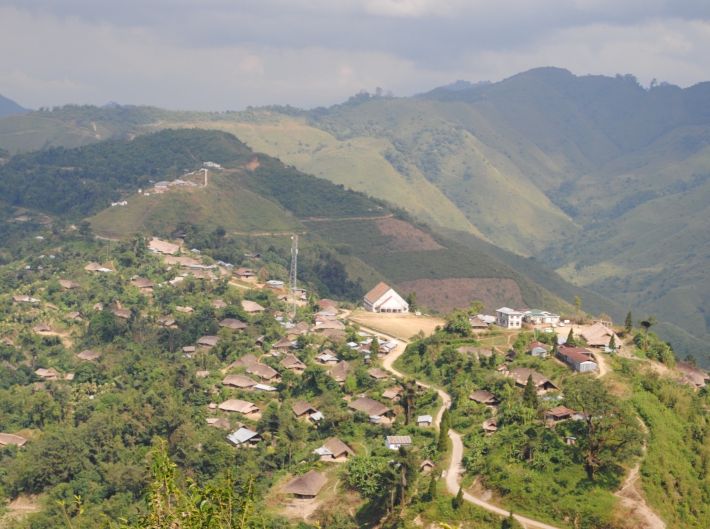
Here, the border runs through a house. A man can sit down to a meal in one country and fall asleep in another, and nobody in Longwa gives it a second thought. The village is cut through by an invisible border line. For them, their village came first and then the border. The residence of the village chief known as the Angh is proportionately split between two counties. It sits directly on the international boundary line, dividing the house. The sleeping quarters are in India, while the kitchen, dining area, and living room are in Myanmar. It’s the sort of unusual sight that attracts visitors but one that has long become ordinary for the villagers.
Cradled between India and Myanmar, Longwa belongs to the Konyaks, a tribe of Nagaland, India. A people whose old men still carry the tattoos of a time when a village's worth was measured in heads. The headhunting is long over. The faces remain, and so does the village's habit of looking at the hills on the far side as a continuation of its own land. Fields lie across the line. Villagers go across the international boundary to work the fields on another country. There is no wall to climb and no queue to join, only an invisible pillar in the grass that the visitor is shown and the villager walks past. The village does not think of itself as living on a border. It thinks of the border as something that just happened one day.
There is one day, however, when the line matters. When elections come, Longwa does not vote as one village. The households that fall on the Indian side go to the polls in India and choose its representatives, while their neighbours across the line, who are citizens of Myanmar, vote there.
Then again, the same chief rules over both halves, but on polling day the village divides along a line that on every other day it ignores. Over 30 villages come under the Myanmar jurisdiction but they remain under the customary rule of the Angh. The village has about five schools – one of them is run by the Myanmar authorities, locally referred to as the “Burmese School”. Students are taught in the Burmese medium here by teachers sent from Myanmar. Because Longwa functions as one unified Village, children from both Indian and Myanmar sides attend it. Similarly, children from the Myanmar side also attend the schools on the Indian side.
That is the Longwa on the postcards, and much of it is true. The same openness that keeps a family together across two countries is what has left the village so exposed.
Opium is not new here. Ask in Longwa how it began and you may hear that the British brought it to quiet a people they could not conquer. The records tell a different story. An official writing in 1931 wrote that the Konyaks were opium addicts who had acquired the habit from plainsmen, with whom they have been in close contact for a very long time. Either way, the drug arrived from outside, and the village has been living with the consequences ever since. What has changed is its scale and its company. Across the hills in Myanmar, poppy has become one of the few reliable crops in a country torn by conflict, and UNODC's 2025 survey put cultivation at 53,100 hectares, the highest since 2015, and output at about 1,010 tonnes, more than twice Afghanistan's, which makes Myanmar the world's leading known source of illicit opium.
India has banned unlicensed cultivation, possession, and consumption of opium under the Narcotic Drugs and Psychotropic Substances (NDPS) Act, 1985, however, illicit cultivation and sales still happen because drugs are a high profit commodity, so many people give in to it as an easy way to earn.
Around 2011, with the joint effort of the church, the local community, and the government, agricultural bodies came together to introduce black cardamom as a direct replacement for poppy cultivation. Cardamom fetches high prices, helping transform the village economy and reduce local poppy farming.
Now the line that the village has long ignored is close to becoming more ‘real’. In 2024, the Indian government announced that it would fence the Indo-Myanmar border and bring free movement to an end, after the ethnic conflict in Manipur, where free movement across the border had been blamed for the violence.
For the nation, it is a question of security. For Longwa, it is about family. A fence would not only separate two countries, but a mother from a daughter, a field from the man who tills it, and a chief's kitchen from his bedroom. The Nagaland Assembly made a resolution asking the central government to reconsider, and the Angh himself has said plainly that his people do not want the border fenced. Yet the village is not asking for an unguarded line. What the village wants is a border that stops the drugs but not the family, and no one has yet explained how to build one.
The centre sees a gap to be closed. The village sees a door that has to stay open, and both are right about something. So the question could be how do you guard a border against smuggling without cutting families apart.
Regardless, the night falls the way it always has, the border still runs across homes. Someone is cooking in the part that belongs to Myanmar. Someone is putting out a bed in the part that belongs to India. The argument over the fence stays at the door. Inside, nothing has changed.
Chentiru Imchen is a Master’s student of Advertising, PR and Corporate Communication in Sharda University.