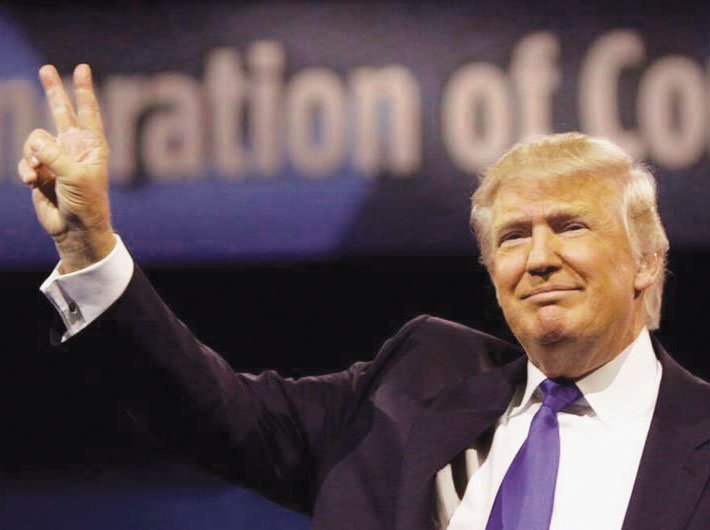
US president Donald Trump hints at stringent action against Pakistan if it continues to be a safe haven for terrorists
Pakistani leaders must be feeling frustrated after US president Donald Trump warned Islamabad that America would not remain a silent spectator if Pakistan continued to be a safe haven for terrorists. Secretary of State Rex Tillerson also said Pakistan could lose the privilege of being a US ally if it “failed to change their posture”. These two statements mirrored New Delhi’s line of thinking.
In fact, through his statement when Trump laid down his strategy for South Asia, he appeared to be emphasizing on two issues: One, US is going to increase troops’ deployment in Afghanistan and second, the US-Pakistan relations would not be the same if terrorists are not reined in.
“In Afghanistan and Pakistan, America’s interests are clear: We must stop the resurgence of safe havens that enable terrorists to threaten America, and we must prevent nuclear weapons and materials from coming into the hands of terrorists and being used against us, or anywhere in the world for that matter,” Trump said. It showed growing distance between the US and Pakistan, its close ally.
But will it have any impact on Pakistan?
Earlier, former US president Barack Obama too tried his best to make the Pakistani leadership realise that Islamabad would not get American money if it didn’t act against terrorist groups. Obama cut down annual civilian and military aid to Pakistan, yet Islamabad hardly did anything. Experts say Pakistan will not yield easily even thought it knows that Trump is not Obama.
“No amount of threat (from the US) will be able to bring a change in Pakistan’s strategy towards terrorist organizations. Over the years they (Pakistan) have very clearly identified and are determined who should be targeted and who should not be….they are attacking TTP (Tehrik –i-Taliban) but sparing the Haqqani group, Afghan Taliban and Lashkar-e-Taiba and Jaish-e-Mohammad,” said professor SD Muni, who is currently working as a distinguished fellow at the Institute for Defence Studies and Analyses, a New Delhi-based think-tank.
He added: “Pakistan coordinates with China and I fear, Russia may also jump into this…in order to cushion off American pressure on Pakistan.” However, he agrees that the US may put economic sanctions on Pakistan to get this country back to its “senses”. If that happens it may cripple the economy of Pakistan. Moreover in that case, what would happen to the on-going China-Pakistan Economic Corridor, no one knows.
However, for the moment Trump’s statement has given Indian policymakers a reason to feel elated as it suggests that the US would not commit the same mistake in Afghanistan that it did with Iraq, the West Asian country which has turned into terrorists and insurgents’ killing field after the withdrawal of US troops in 2011. It should be remembered that during his presidential campaign, Trump had said that keeping American soldiers stationed in Afghanistan was not in the financial interest of America and that he would withdraw them once he became the president. More than seven months into office, Trump seems to have changed his stand on Afghanistan. Not only he has committed to send more troops to Afghanistan, he has also asked India to fork out money for the development of the land locked nation.
“Another critical part of the South Asia strategy for America is to further develop its strategic partnership with India -- the world’s largest democracy and a key security and economic partner of the US. We appreciate India’s important contributions to stability in Afghanistan, but India makes billions of dollars in trade with the US, and we want them to help us more with Afghanistan, especially in the area of economic assistance and development,” Trump said in his statement.
India has already invested over $2 billion in the development of the insurgency-hit country. This apart, it is also engaged in strengthening of Afghanistan’s security infrastructure. Besides, four attack helicopters, some non-lethal equipment have been provided to the Afghan soldiers.
If sources are to be believed, talks are on between Indian and Afghan authorities for the supply of some aircraft and transport equipment to Afghan troops.
Amid this, if the US seeks more assistance from India, New Delhi is ready to offer it.
“We welcome president Trump’s determination to enhance efforts to overcome the challenges facing Afghanistan and confronting issues of safe havens and other forms of cross-border support enjoyed by terrorists. India shares these concerns and objectives,” external affairs ministry said in its statement, adding that it is “committed to supporting the government and the people of Afghanistan in their efforts to bring peace, security, stability and prosperity in their country”.