How Anita Dash rebuilt her family's future with support from the PM Formalization of Micro Food Processing Enterprises (PMFME) Scheme
In 2012, Anita Dash wasn't dreaming of building a dairy brand. She wasn't studying business models or planning market expansion. Like countless mothers across India, her focus was on something much simpler: giving her children a better future.
At the time, her most valuable asset was a single cow.
Every morning, Anita would collect fresh milk and make her way through the neighbourhood, delivering it directly to households. The income was modest, but it helped keep the family afloat. More importantly, it gave her hope. She believed that if she worked hard enough and earned people's trust, she could slowly create opportunities that had never existed for her before.
That faith would eventually transform her life.
One Customer at a Time
What began as a small household activity soon started gaining momentum. Customers appreciated the quality of Anita's milk and the reliability with which she delivered it. Word travelled quickly. Families began recommending her to friends and relatives, and demand steadily increased.
Instead of spending her earnings, Anita reinvested them back into her work. One cow became several. Several became many more.
Over the next few years, through sheer persistence and without any major financial backing, she expanded her dairy operation significantly. By 2015, Anita had grown her herd to nearly 60 cows, a remarkable achievement for someone who had started with virtually nothing but determination and hard work.
For a while, the future seemed secure. But growth brought challenges she had never anticipated.
When Growth Became a Challenge
As demand increased, Anita found herself relying on milk procured from local farmers to meet customer needs. However, maintaining a consistent supply soon became difficult. Deliveries were often delayed, quantities fluctuated, and some suppliers failed to meet commitments altogether.
For a business built on trust, inconsistency was dangerous.
Customers who had depended on her for years were beginning to look elsewhere. Anita could see the risk clearly. The relationships she had spent years nurturing were under threat, and with them, the business she had worked so hard to build.
Many entrepreneurs encounter moments when circumstances seem stronger than their ambitions.
For Anita, this was one such moment.
Yet rather than accepting defeat, she decided to learn her way out of the problem.
A Classroom Called YouTube
With no formal training in food processing and few resources at her disposal, Anita turned to the internet. She spent hours watching YouTube videos, learning how milk could be transformed into products such as paneer, khoya, chhena poda, and dahi rasagolla. What started as an experiment to manage fluctuating milk supplies soon opened her eyes to a completely new opportunity.
Processed dairy products not only reduced dependence on immediate sales of raw milk but also offered higher value and better profitability. Anita began producing small batches and selling them locally.
The response was encouraging.
Customers loved the products for their freshness and quality. Demand grew steadily, and for the first time, Anita realized that she could move beyond being a milk supplier. She could create a business with its own identity.
What had begun as a solution to a challenge was gradually becoming a new vision.
Turning a Dream into Krishna Dairy with support from PMFME
In 2021, Anita decided to formalize her growing venture and established Krishna Dairy. The dream was clear but scaling it required resources she did not have. Modern dairy processing needs machinery, packaging units, storage facilities, and working capital. For a small entrepreneur, these investments can often feel out of reach.
That is when support under the PM Formalization of Micro Food Processing Enterprises (PMFME) Scheme became a crucial turning point.
Through the scheme, facilitated by Palladium, Anita secured a bank loan of ₹26.89 lakh, enabling her to invest in advanced processing machinery and strengthen her operations.
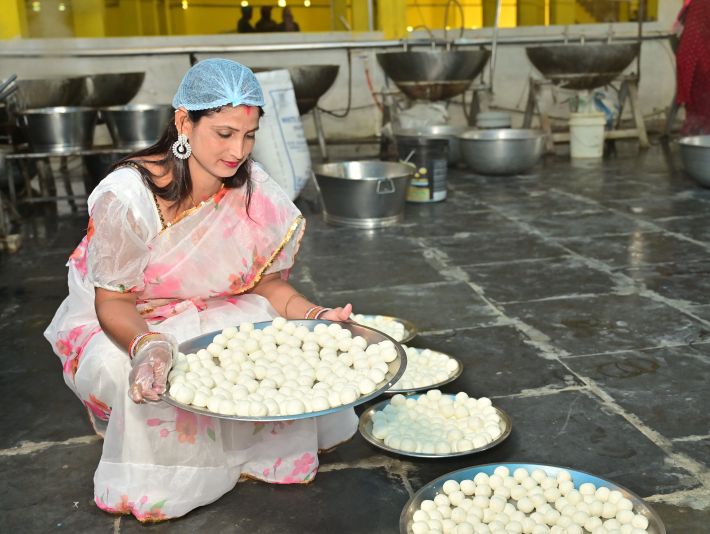
What was once a labor-intensive setup evolved into a modern enterprise capable of producing nearly 20 quintals of dairy products every day. Production increased, efficiency improved, and the business gained the capacity to meet growing market demand while maintaining quality standards.
For Anita, it was the moment when years of struggle began translating into sustainable growth.
Success That Extends Beyond One Family
Today, Krishna Dairy generates an annual turnover of ₹3.50 Cr, reflecting a 50% increase in income over the previous year. Its products reach retail outlets across Balasore district, a long way from the days when Anita personally carried milk from house to house.
But perhaps the most meaningful outcome of her success lies beyond revenue figures.
The enterprise now employs 64 people, including 34 women, creating stable livelihood opportunities within the community. For many of these women, the job provides both financial independence and the ability to work close to home.
Reflecting on her journey, Anita says, “I started this business because my family needed me to find a way forward. Today, when I see my work giving us a better life, I feel proud that I didn’t give up when things were difficult.”
What started as a mother's effort to support her own children has quietly become a source of opportunity for many other families.
Parul Sharma is a Manager with Palladium India.