
There’s a challenge and also an opportunity. Educators, institutions and AI pioneers must join hands to ensure that academic authenticity thrives in this changing landscape
Ashank Mittal and Dr Palakh Jain | August 22, 2023

This article delves into the transformative influence of AI on academic integrity, specifically focusing on the deployment of AI-based tools in detecting and addressing plagiarism. The ensuing sections expound on the evolution of plagiarism detection, the implications for education, and the concurrent responsibilities of educators and students in this new paradigm.
Evolution of Plagiarism Detection and AI
The Indian education system has long been characterised by rote learning, which, in turn, has led to assignments primarily consisting of verbatim reproductions of authors' texts. However, a pivotal shift occurred in November 2022 with the introduction of a Generative Pre-Trained Transformer Tool, shaped by ‘Open AI’, an influential foundation with investors like Elon Musk. Trained with an astonishing 75 billion parameters, this tool has democratised access to AI-powered text generation for students worldwide. An ensuing consequence has been the emergence of the term ‘High AI Similarity’, flagging a significant proportion of student reports submitted for assessment.
Table 1: Diagnosis of 13.8 lakh student reports by TurnItIn in July 2023
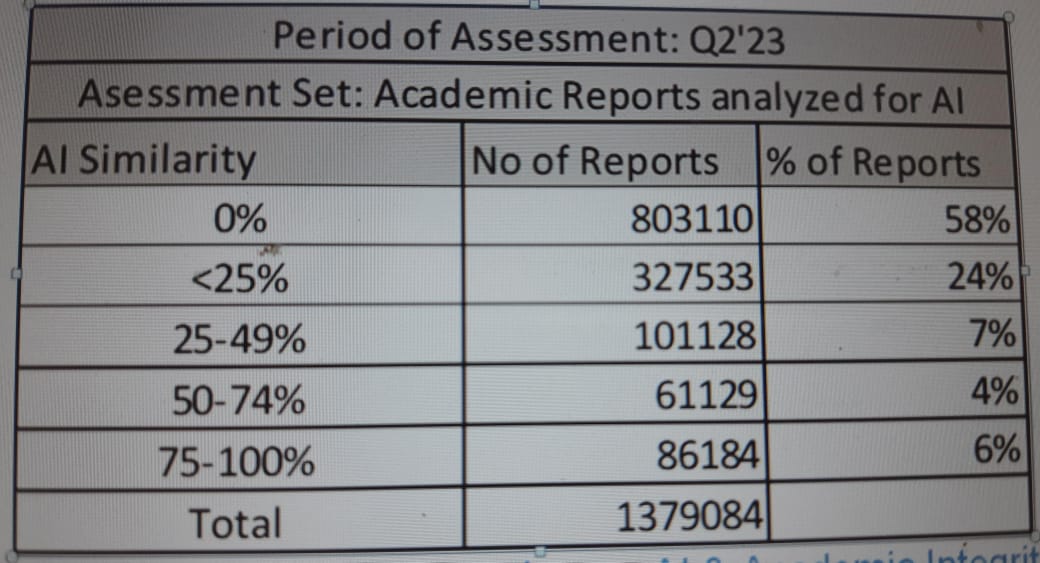
Source: TurnITIn Presentation on AI & Academic Integrity
Plagiarism Detection with AI Tools
In Q2’23, TurnItin estimated that of the 13.8 lakh academic reports, about 1.5 lakh could be flagged for high levels of AI similarity. TurnItIn is an AI-powered EdTech Venture established in 2014 to authenticate the authenticity and originality of texts in academic contexts. With a substantial presence across UK and European universities, TurnItIn's significance amplifies when examining the recent developments in AI-enabled plagiarism detection. As educators, it is imperative to seek insights from the creators of such tools, understanding their motivations and objectives.
AI's Disruptive Impact on Academic Writing
The realm of academic writing faces a dual disruption from AI. Automated essay writing tools offer the prospect of generating content with minimal prompts, while plagiarism detection software like TurnItIn enhances the precision of identifying text similarities. These tools, while transformative, necessitate a nuanced perspective. They should serve as diagnostic aids rather than definitive arbiters of academic misconduct.
Promoting Academic Integrity in the AI Era
It is crucial for educators to leverage AI-powered tools to foster a positive learning environment. Encouraging self-reviews centred on grasping the concept of 'Original Authorship' can enhance contextual understanding and holistic engagement with assignments. The evolution of peer reviews also gains significance in this context, where AI aids as a supporting tool, augmenting human judgment in deciphering academic misconduct and maintaining the spirit of original authorship.
Balancing Human Judgment with AI Precision
The integration of AI-based plagiarism prediction tools into the peer review process bolsters consistency and transparency. While AI efficiently detects textual similarities, human reviewers possess the capability to grasp content nuances, intents, and contexts. The distinction between legitimate citations and plagiarism hinges on this dual assessment, reinforcing the notion that appropriately cited content, even with high text similarity, should not be immediately labelled as misconduct.
Long-Term Impact and Evolution
In the foreseeable future, AI's role in academic integrity remains twofold. In a setting where rote learning prevails, AI aids in upholding academic standards through plagiarism detection. However, the trajectory of education is poised to evolve. AI-generated content could become a tool for enhancing learning, where students engage with AI-generated text for analysis and commentary, fostering critical thinking rather than memorization.
Conclusion: A Dual Perspective on AI and Academic Integrity
In conclusion, the advent of AI-driven tools has spurred a profound shift in academic integrity paradigms. As AI redefines the boundaries of education, its influence on academic integrity remains both a challenge and an opportunity. This dual perspective necessitates an ongoing dialogue between educators, institutions, and AI pioneers to ensure that academic authenticity thrives in this changing landscape.
Ashank Mittal is a Phd scholar at Bennett University. Dr Palakh Jain is Associate Professor at Bennett University and Senior Visiting Fellow, Pahle India Foundation.
Delivering the IXth Chief Justice M.C. Chagla Memorial Lecture on ‘Human Rights and Sustainable Development Goals’, in Mumbai Friday, former Chief Justice of India Bhushan R. Gavai questioned whether conventional economic indicators such as gross domestic product (GDP), national income,
Seventeen years after the centre first approved the widening of National Highway 66 between Mumbai and Goa into a four-lane highway, a fresh RTI reply has revealed a sharp escalation in the project`s sanctioned cost. According to the RTI reply obtained by activist Jeetendra
Prime minister Narendra Modi on Thursday inaugurated SEMICON India 2026 in New Delhi. Addressing the occasion and highlighting the significance of the event`s fifth edition, the PM drew a parallel between the launch of Semicon India and Vishwakarma Diwas. He pointed out the beautiful coincidence of
The union cabinet, chaired by the prime minister, has approved the proposal of the Ministry of Labour & Employment to enhance the wage ceiling for mandatory coverage under the Employees’ Provident Fund Organisation (EPFO) from Rs.15,000 to Rs.25,000 per month. The decision is expected to bring
The new UPI framework introduced has no impact on any person to person transactions, and UPI will continue to remain completely free for all person-to-person transactions, irrespective of the amount transferred, the finance ministry clarified on Tuesday. Payments to merchan
On Thursday, prime minister Narendra Modi will inaugurate SEMICON India 2026 at Yashobhoomi in Dwarka, New Delhi. Global chipmakers, policymakers and investors will fill the halls, all watching an industry India has built from the ground up. For three days, the country`s semi-con (semiconductor) manufact











