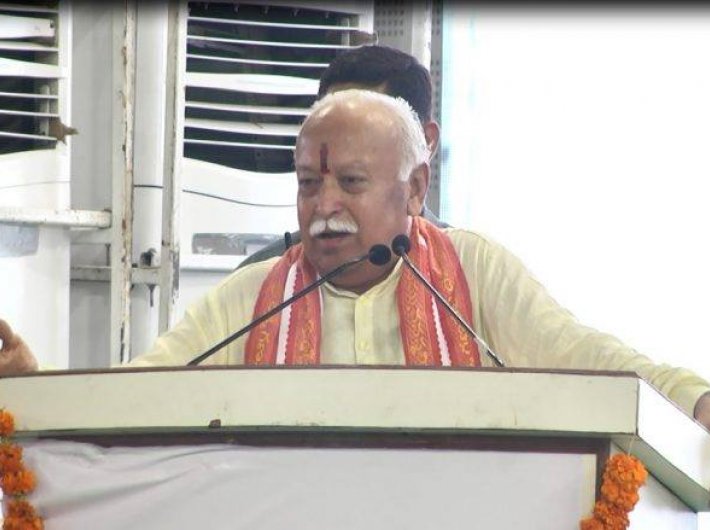
His message: No need to look at the Sangh Parivar through the prism of secular narrative
In a candid conversation with diplomats from 50-odd countries recently, RSS chief Mohan Bhagwat is learnt to have drawn a distinction between Hinduism and Hindu-ness. Bhagwat's considered view, according to reports, was that while Hinduism can be guided by certain rigidities, codes and dogmas, Hindu-ness is a liberated concept, free from such limitations.
Here's what he is reported to have said in that closed-door meeting, according to a report in The Indian Express, quoting tweets of unnamed attendees: "With time, we change. When someone says I am a Hindu it is not about religion or how one lives. It is about accepting others as they are. It is not about wearing this, eating this. That imposition is an 'ism'. Hindu-ness is free from this 'ism'. Hindu-ness is the ever changing quality of Hinduism."
In some quarters, this postulation might be seen as a subtle and tactical reorientation of the Sangh Parivar to make it appear like an inclusive organisation, just like Prime Minister Narendra Modi's visit to the Siddi Saeed mosque in Ahmedabad along with Japanese prime minister Shinzo Abe was interpreted.
Some might even interpret Bhagwat's statement as a radical departure from the stated position of the RSS as an organisation beholden to dogmas and a rigid or codified ideology when it pertains to "Hindu".
But is this the reality?
A cursory glance at the evolution of the Sangh Parivar will make it clear that ever since its inception the RSS has been negotiating a complex set of variables that makes its commitment to constitutionality sit at odds with its concept of a Hindu nation. Of course, its concept of the Hindu nation is largely derived from Max Mueller's scholarly study, "History of Ancient Sanskrit Literature" on Hindu traditions expressed through the four Vedas. The Arya Samaj movement launched by Dayanand Saraswati further strengthened the historical myth about Hindus being defined by cultural and geographical indicators.
But there are umpteen instances which show that neither the RSS nor its political arm – the Bharatiya Janata Party (BJP) or even its earlier avatar, the Bhartiya Jana Sangh – has shown any rigidity on the primacy of Hindu-ness in India. Far from it, those steering the organisations have consistently shown a remarkable flexibility in their approach to the religious identity of Hindus.
If you have any doubts about this, look up the exposition of Jana Sangh's founder, Shyama Prasad Mukherjee who, after resigning as the president of the Hindu Maha Sabha, said: "In the India of today, more than 85 percent of her people are Hindus and if they are unable to protect their own economic and political interests or India's inherent rights through the working of a fully democratic constitution, no separate political party, which would confine its membership to the Hindu fold alone, could ever save Hindus or their country. On the other hand, if the majority community itself retains its political exclusiveness it would inevitably encourage the growth of communal political organisations representing the interests of various minority groups within the country itself, leading to highly prejudicial results."
Mukherjee's press statement was extensively quoted by Bruce Graham in his book, "Hindu Nationalism and Indian politics", to highlight the point that just before the formation of the Jan Sangh, Mukherjee had a bitter fallout within the Hindu Maha Sabha over making the organisation inclusive. This makes one thing clear, that the formation of the Jan Sangh was not premised on an exclusivist agenda.
Coming close on the heels of Mahatma Gandhi's assassination, that led to the banning of the RSS, Sarsanghchalak MS Golwalkar, known as "Guru ji", had given an unambiguous undertaking to the government to restrict the organisation's activity to the cultural sphere within the ambit of the Constitution.
Given the RSS' overtly exclusive agenda of promoting Hindu consolidation in the cultural sense, the Jan Sangh was also perceived to be an exclusive entity that promoted only Hindu interests. That was apparently a wrong impression which got dispelled during the incarceration of RSS-Jan Sangh leaders during the Emergency, along with socialist and Jamaat leaders.
Immediately after the Emergency, the RSS for the first time threw open its doors for Muslims. This evoked sharp reactions within the organisation as some of the top leaders reacted angrily to the then RSS chief Bala Sahab Deoras' endeavour and called it a dilution of the concept on which the RSS was founded.
Deoras remained unfazed. At a civic reception for Deoras in 1977, after the Janata Party's victory, presided over by noted jurists Nani Palkhiwala and Mohammad Currim (MC) Chagla, the latter was quoted as saying, "I am a Muslim by religion but Hindu by race" – a formulation that did not please the Muslim clergy.
Of course, in Golwalkar's time, it would have been unthinkable to open up the RSS for Muslims in the immediate aftermath of the post-Partition trauma. But Deoras, a successor chosen by Golwalkar, tried to change the perception about the RSS in the post-Emergency phase and at least attempted to make it an inclusive organisation without distancing it from its core ideological positions on "Hindus", which often appears incongruent with secular narratives of constitutionalism.
In this context, Bhagwat's iteration of making a distinction between Hindu-ness and Hinduism is a mere repetition of what his predecessors have stated umpteen times in more nuanced ways. That he chose to articulate his view before an audience of foreign diplomats is an attempt to dissuade foreigners from looking at the Sangh Parivar through a prism of "secular narratives" in the context of the current skewed debate (in the eyes of the Parivar) on nationalism and tolerance, rather than a nuanced shift in its position.
[This column first appeared in First Post]