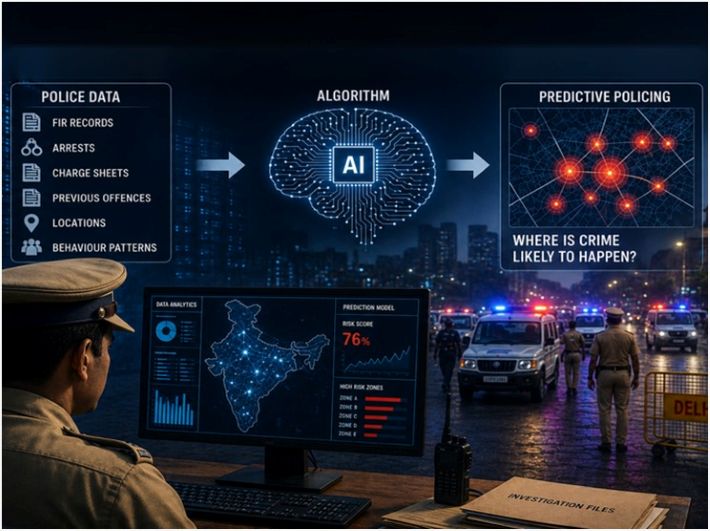
India wants AI to predict crime. But what happens when the data used to predict tomorrow’s crime reflects yesterday’s policing?
For decades, policing has followed a familiar sequence: a crime occurs, the police respond, an investigation produces records and those records become part of the institutional memory of the criminal justice system. Artificial intelligence is beginning to alter that sequence. Instead of merely recording what has happened, increasingly sophisticated systems can analyse large volumes of criminal justice data to identify patterns, repeat offenders and potential criminal networks before the next offence occurs.
India is moving decisively in that direction. On June 19, 2026, the union government announced that a predictive policing framework was being developed using artificial intelligence, machine learning and pattern analysis to identify and prevent repeat offenders and interstate criminal networks before crimes occur. It also stated that CCTNS had reached 17,840 police stations and that 37.68 crore digital records were available for AI-based analysis. Plans were also announced to convert large databases relating to fingerprints, narcotics offenders and human trafficking into actionable intelligence.
The promise is substantial. Police forces deal with enormous quantities of information, much of which cannot be effectively analysed through manual methods. AI can identify connections across records, assist investigations and potentially allow limited resources to be directed towards serious and emerging threats. The question, therefore, is not whether technology should have a role in policing. It is whether the data used to predict crime can be distinguished from the history of how the state has policed crime.
The problem with the data
A police database is not a neutral mirror of crime. It contains FIRs, arrests, investigations, suspects and other interactions with the criminal justice system but these records are also shaped by institutional choices: where police patrol, which complaints receive attention, which areas are subjected to greater surveillance and which offences are more likely to be detected. A neighbourhood that receives more police attention may consequently generate more recorded incidents than another neighbourhood where similar conduct receives less scrutiny.
This becomes a problem when historical police records become training data. An algorithm may identify a correlation between a particular locality and recorded crime without being able to distinguish whether that correlation reflects the underlying incidence of crime or the intensity of previous police activity. The algorithm does not observe “crime” directly. It observes the data produced by the criminal justice system.
Research on predictive policing has demonstrated how this can create a feedback loop. When a predictive system directs police towards a particular neighbourhood, officers are more likely to discover and record offences there. Those newly discovered incidents can then become inputs for the next prediction, leading the system to send police back to the same neighbourhood. The model can therefore become increasingly confident in a pattern that its own deployment helped produce.
The result is a cycle: historical data produces a prediction; the prediction influences police action; police action produces new data and the new data strengthens the next prediction.
The problem is therefore more complicated than the familiar claim that “algorithms can be biased”. The deeper concern is that a system can convert the history of policing into an apparently objective prediction about the future of crime. If yesterday’s policing choices become tomorrow’s evidence, technological efficiency may reproduce institutional patterns rather than correct them.
India is building the infrastructure for this transition
This concern is particularly relevant in India because predictive policing is emerging within a much larger project of criminal justice digitization.
The Crime and Criminal Tracking Network and Systems or CCTNS connects police stations through common digital system and enables police processes such as FIR and chargesheet records to be digitized and searched across the national data centre. As of 1 February 2026, all 17,798 police stations across the country were using CCTNS including all 1,204 police stations in Maharashtra.
The Inter-Operable Criminal Justice System or ICJS has subsequently sought to connect the principal pillars of criminal justice – police, courts, prisons, forensic laboratories and prosecution, so that information held in separate systems can be accessed and exchanged. The government has also described AI and machine learning enabled investigation as part of this technology based justice infrastructure.
This development matters because digitization and algorithmic analysis are not the same thing. Digitization records information. Integration makes more information available across institutions. Algorithmic analysis can then turn that information into predictions that influence future state action.
The union government’s June 2026 announcement makes this transition explicit. The government described the development of a predictive- policy framework based on AI, machine learning and pattern analysis, moving beyond a system that acts only after crime has occurred towards one intended to prevent crime before it happens.
Maharashtra provides a useful state level illustration. In February 2024, the state approved the creation of MARVEL, a government owned special purpose vehicle intended to enable the state police to use artificial intelligence more effectively for law enforcement. In March 2026, Maharashtra Police also recorded administrative approval for an AI powered investigation platform.
These developments do not establish that Maharashtra has already deployed a biased predictive policing system. They demonstrate something more important for policy that is the transition from experimenting with AI to institutionalizing AI within policing is already underway.
That is precisely why governance cannot be treated as an afterthought.
From data integration to State action
The policy challenge becomes clearer if the process is viewed as a chain rather than as a single algorithm.
Data is collected. Data is integrated. Algorithms identify patterns. Predictions influence police action. Police action produces new data. That data feeds the next prediction.
Each stage can introduce a different form of error.
A data system can contain incomplete or unevenly generated records. An integration system can combine information whose original contexts differ. An algorithm can identify correlations without establishing causation. A police officer can give an algorithmic recommendation more weight than it deserves. And the resulting police action can change the dataset from which the system learns.
This is why evaluating a police AI system only by its technical accuracy is insufficient. A model may perform well against the dataset on which it is tested while still producing problematic outcomes once its predictions begin changing the environment in which it operates.
The question should therefore be expanded from “Is the algorithm accurate?” to “Accurate about what, based on which data and with what consequence?”
That is a governance question rather than merely a technological one.
When prediction becomes a rights issue
The first concern is equality. If historical policing has been uneven across neighbourhoods or communities, an algorithm trained on police generated records may reproduce those differences. This does not require an algorithm to contain an explicit instruction to discriminate. Unequal patterns can emerge indirectly through the data itself and through the decisions made using that data.
The second concern is privacy. As criminal justice databases become increasingly interconnected, more information about individuals can potentially be combined, analysed and repurposed.
India’s Digital Personal Data Protection Act, 2023 contains exemptions for certain processing connected with the prevention, detection, investigation and prosecution of offences. Such exemptions are important for legitimate policing but they do not by themselves answer questions about how high impact AI systems should be governed, audited and monitored.
The third concern is contestability. Suppose an algorithm identifies an individual, neighbourhood or network as high risk and that output materially influences police action. What can the affected person challenge? The final decision may formally belong to a police officer but the officer may have relied on an output whose underlying data, methodology or limitations are not visible to the person affected.
The existence of a human decision maker therefore does not automatically guarantee meaningful human oversight. If the human merely accepts an algorithmic recommendation without understanding or questioning it, the system has effectively shifted part of the decision making process into an opaque technical layer.
The strongest case for using AI
There is however, a serious argument on the other side.
Police forces already operate under conditions of limited time, fragmented information and imperfect human judgment. Asking them to ignore potentially useful algorithmic tools because those tools can make mistakes would be unrealistic. Human investigators are not free from bias and manual decision- making does not automatically produce fairer outcomes. AI may detect relationships across large datasets that an individual investigator would never identify.
This is why the answer should not be a blanket prohibition on predictive policing.
The better distinction is between AI as an investigative aid and AI as an unreviewable basis for consequential state action. The former can improve police capacity. The latter risks allowing technical outputs to acquire authority without a corresponding mechanism for scrutiny.
The objective should therefore be neither technological enthusiasm nor technological resistance. It should be to determine the conditions under which the state may legitimately rely on algorithmic predictions.
The accountability gap
The most difficult question is what happens when the system is wrong.
Imagine an AI system identifies a person, location or network as high risk. A police officer relies on that output and the prediction turns out to be incorrect. Responsibility could potentially be distributed across several actors: the officer who relied on the output, the police department that deployed the system, the developer that designed it and the institution responsible for the data on which it was trained.
This is where an important distinction must be made between accountability and liability. The first question is not necessarily who should be sued or punished. It is whether the state can reconstruct and explain how the decision was made, identify the people and institutions responsible for each stage, review whether the system was appropriate and provide a mechanism for correcting harmful outcomes.
If an officer says, “the algorithm recommended it,” while the department says, “the officer made the final decision,” and the developer says, “the system only provides a prediction,” responsibility can disappear into the space between them.
India therefore needs a clear chain of accountability before predictive policing becomes routine.
A 4A framework for police AI
1. Auditability
Every consequential use of AI should leave an audit trail. Authorities should be able to identify which system was used, what version was operating, what categories of data informed the output, what the system produced and which officer ultimately relied on it. Without such records, investigating an erroneous decision after the fact becomes extremely difficult.
2. Attribution
Responsibility should be assigned across the AI lifecycle rather than concentrated only on the final police officer. The department deploying the system, the developer designing it and the institution supplying or maintaining the relevant data should each have defined responsibilities. The existence of an algorithm should never make it impossible to identify a human or institutional decision maker.
3. Adversarial review
Human oversight should mean more than obtaining a police officer’s formal approval. Where an algorithm materially contributes to a consequential decision, the responsible officer should be required to assess the output independently and record reasons for relying on it. Questionable outputs should be capable of being escalated for independent review rather than becoming self validating.
4. Accountability
Finally, there must be a process for what happens when the system fails. High impact police AI should be subject to periodic independent evaluation covering accuracy, data quality, error rates, unequal impacts, privacy and compliance with operational safeguards. Where serious failures occur, authorities should be required to investigate them, correct the underlying system or data where necessary and document what action was taken.
These safeguards should operate before, during and after deployment. A system should not first be tested on the public and only later subjected to meaningful scrutiny.
The test should not be whether AI predicts more
India’s transition towards AI enabled policing is not inherently undesirable. A state that refuses to use technology capable of helping investigators analyse enormous quantities of information may itself fail to protect citizens effectively. But efficiency cannot become the only measure of success.
A predictive policing system should be evaluated not only by how many crimes it helps identify or prevent but also by how its data was generated, whether its predictions alter subsequent police behaviour, how often it is wrong, who bears the consequences of those errors and whether affected individuals have a meaningful avenue for review.
The distinction matters because police data is not the same thing as crime itself. It is a record of what the criminal justice system has observed, recorded and acted upon. Once that distinction disappears inside an algorithm, past policing can begin to look like objective evidence about future crime.
India has already built much of the digital infrastructure required to make criminal justice data more interconnected and analytically useful. The next challenge is institutional rather than technological: deciding how much authority an algorithmic prediction should have over the exercise of state power.
The question India must therefore answer is not simply whether its algorithms can predict crime.
It is whether the state can demonstrate that what its algorithms are predicting is crime and not merely the accumulated history of where, how and against whom the state has previously policed.
Yashi Gupta is a student of the Tata Institute of Social Sciences, Mumbai.