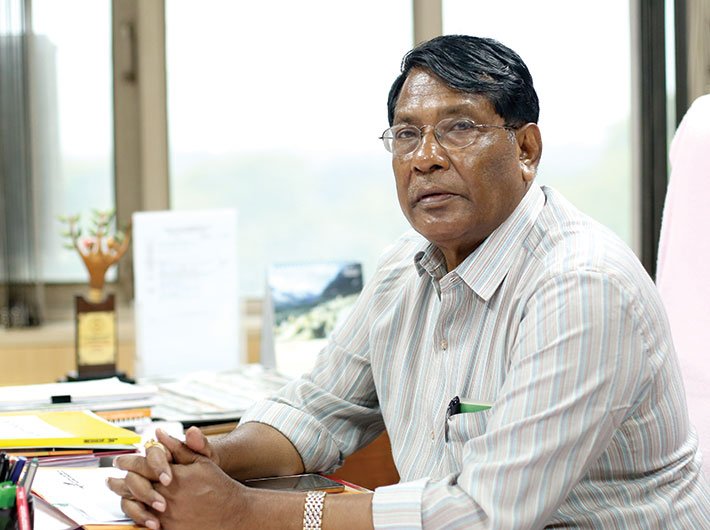
Rameshwar Oraon, a former Congress MP and current chairperson, National commission for Scheduled Tribes explains what is wrong with the commission
Rameshwar Oraon, a former Congress MP who went on to serve as minister of state for tribal affairs, is completing his second consecutive term as the head of the ST commission. In an interview with Archana Mishra days before his successor is expected to be named, Oraon explains what is wrong with the commission.
What is the commission doing about the controversy related to the ordinance by the Jharkhand government to amend the Chotanagpur Tenancy (CNT) Act, 1908 and the Santhal Pargana Tenancy (Supplementary Provisions) (SPT) Act, 1949?
The Jharkhand government has already submitted the ordinance to the president. The tribal commission has also been asked to study the ordinance for analysis and opinion. After going through the documents, the commission wants that it should not be passed. It will drastically impact tribal life in the state. A tribal has only one property – land, and to protect the land two Acts were framed during the colonial rule. The CNT Act was made in 1908 and SPT Act (original) in 1855. Both these Acts are historical and have helped tribals. The Bihar government had already made amendments in both the Acts when Jharkhand was part of it.
The proposed amendments to the Act allow transfer of tribal land for public purposes such as for building roads, canals, railway [tracks], water pipelines, schools, colleges, universities, panchayat buildings or any other activity which the state government may prefer to add in future. If the ordinance is passed, it would open gates for non-tribals to buy tribal lands, leading to a massive land alienation. And, once a tribal loses the land, he cannot buy it again. Also, there has been an amendment to convert agricultural land for non-agricultural purposes, so that the land can be sold like tomatoes.
While the focus is on tribal empowerment, their land is being acquired for industry. How can the two go together?
Acquiring land from the tribals can never lead to empowerment. Instead it leads to impoverishment. When Jharkhand was formed as a new state [on November 15, 2000], a bid was made to acquire the tribal land. I won’t name the politician but during his speech he once said that tribal land should be open for all so that a tribal can mint money by establishing business on his land. I was also present during the meeting and refused to accept his viewpoint. According to me, a poor cannot start his own industry by selling off his land. Empowerment of the tribals is possible only through improvement in the health and education sector. There are no teachers in schools run in these belts. In the middle school, there are only two teachers. In the high school, there aren’t any English or Mathematics teachers. Even the health framework is in a poor state. If there is a malaria outbreak, several villages at a stretch are affected by it. Such cases are not reported because there is no healthcare facility. No health camps are organised nor is any screening mechanism in place to help the poor tribals. Empowerment is possible only if we provide them these basic amenities.
READ: ST Commission - Toothless
What is the commission’s role regarding a distressed tribal who lives in an area where the fight is between the state and Maoists, leading to fake encounters and false implications?
It is a law and order matter, and the commission has no authority to monitor that. However, if there is unjustified firing or killing of a tribal, the commission [intervenes]. If a judicial committee is appointed, then further investigation is done. Also, in the case of fake encounters, compensation is increased.
In Chhattisgarh, a girl was killed on the charge of being a Naxal. A single judge-led committee was appointed to inquire into the matter. It was found that she was not a Naxalite. So, we approached the government, provided compensation and a job to her brother. In a fake encounter that happened this year [in Odisha], we knew it was unjustified so we asked the government to appoint a special committee for inquiry. The committee, however, is headed by the ADG [additional director general] of police. I also know that nothing will be done. But we are trying to address other aspects which lead to encounters of those villagers.
What is the commission doing for those who are falsely implicated as Naxals?
In the name of fighting Naxalism, tribals are being falsely implicated and the number of such cases is gradually increasing. I admit we cannot do much as we don’t have a machinery to regulate these activities. We cannot scrutinise each and every case. It is the responsibility of the state to address such cases. But we advise the state government to control the situation as those killed or implicated are the [residents] of their state.
Which are the policy issues the commission is currently working on?
We are working to improve existing policies. There is no proper policy rehabilitation after the displacement. Displacement is written in the destiny of the tribals. They don’t get jobs. The colony where these tribals stay is in a poor condition. The land they receive as compensation is also not sufficient to sustain the family. They don’t have the money to buy land or invest in any business. There should be a policy that should look at the long term benefits of the displaced population.
What are the commission’s recommendations on these issues?
We have already prepared a list of recommendations and will be submitting it to the ministry [of tribal affairs] by the end of this month [October]. We want that all the tribals should be kept in the BPL [below poverty line] card category. Focus is on education as there are no teachers. But, Chhattisgarh and Madhya Pradesh are doing really good in the education sector. A special school has been opened for selected tribal students in Chhattisgarh to take up higher studies till standard XII. Students are taught science in English medium to make them eligible for medical and engineering studies. There is no concrete policy to deal with specific health issues – malaria, sickle cell anemia and silicosis. There should be a specific policy for these diseases. We are also working on the implementation of the Forest Rights Act and employment of tribal population through Mahatma Gandhi National Rural Employment Guarantee Act.
In annual reports, the commission has complained of poor response from the state governments in seeking advice from it on policy matters.
Acts are being made by the state governments and there are certain Acts where no interest of the tribals is taken into account. There is a provision in the constitution that every matter related to the tribals will be sent to the commission for referral and suggestion. However, states are not sending their reports as per the directives. Only a few states are sending it. The centre, on the other hand, is very particular about policy matters or bills related to tribals. They seek our advice.
How has the commission been operating and taking decisions in the absence of members in the core committee?
The commission has the power to make rules for itself. It should comprise of minimum three people. Currently, there are two people. So, if some suggestion is sought by the government then we give it. In such a situation, the chairperson or a vice chairperson can take a decision on behalf of the commission. It has been continuing for more than two years.
Has the division of states on the basis of tribal domination led to development?
It is not helping in states like Jharkhand and Chhattisgarh. We call them tribal dominated states, but nothing is being done as per their status. If you look at the utilisation of funds under tribal sub-plan, it is very inappropriate. Money is being used, but states are not able to answer where it is being used. What they show in the balance sheet. If it were used properly, work should have been visible on ground.
[email protected]
(The interview appears in the November 1-15, 2016 issue of Governance Now)