
Improving livelihood with financial access is the task ahead

Priority now for active use of accounts to save money, get insurance and overdraft

geetanjali

Geetanjali Minhas | January 19, 2018 | Mumbai

#PMJDY   #Jan Dhan   #Financial Inclusion   #State Bank of India   #PK Gupta   #Banking Reforms   #Casebook Launch   #Banking   #Demonetisation  
GN Photo
GN Photo

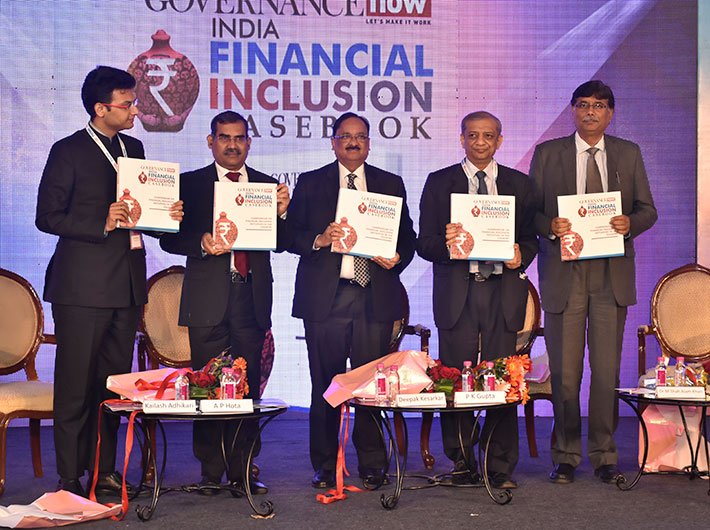
“Demonetisation has created an entire system of digitisation and financial inclusion,” said PK Gupta, managing director (Retail and Digital Banking), State Bank of India, at the launch of the Governance Now India Financial Inclusion Case Book in Mumbai on Friday. He further stated though there are targets yet to be achieved, approximately 30 crores accounts have been opened in under Jan-Dhan Yojana. Out of these, 10 crores accounts are with SBI. Apart from this the bank has 60,000 banking correspondents. The number of zero bank accounts is less than 20 percent.

Gupta told the gathering that the bank runs 338 financial literacy centres and has trained 42 lakh people so far. It is also running 151 rural self-employment training institutes which have trained 5.37 lakh people. About 3.5 lakh of these people have now self-employed. SBI is now looking at giving loans of Rs 20,000- 25,000 lakhs under Swachh Bharat for the construction of toilets.

AP Hota, former MD and CEO, National Payments Corporation of India (NPCI), said, “The idea of providing bank accounts has more or less been achieved and no longer a challenge.”

He said that financial access is being provided with 1,26,000 fixed point and 3 lakh business correspondents. “Though people are aware of facilities available in banking system and government schemes, real success will come only when their livelihood improves because of financial access and they stop their dependence on non-institutional channels."

Emphasising on the access to rural healthcare, Hota said that the existing government schemes have to be refined for ‘health for all’. “The next stage of financial inclusion should work in close combination with development machinery in rural areas. Putting all the burden of financial inclusion on banks is not right and it is time to see that the government and banking system work together to see that there is improvement in people’s life,” he said.

Speakers from various public and private banks, cooperative banks and digital solution providers were present in the event.


Comments


Other News

From one cow to a dairy business

In 2012, Anita Dash wasn`t dreaming of building a dairy brand. She wasn`t studying business models or planning market expansion. Like countless mothers across India, her focus was on something much simpler: giving her children a better future.   At the time, her most valuable

Ethanol blending: The two sides of a story

India`s crude oil consumption is estimated to be around 88.5% imported from abroad. This one single figure is also responsible for why ethanol has become both an economic strategy and fuel policy at the same time. In an economy like India, which depends so heavily on foreign oil, any increase in internat

Food inflation: Not a macroeconomic statistic but a developmental indicator

India`s retail inflation shows a reassuring picture at first glance. According to the latest data, Consumer Price Index (CPI) inflation edged up to 4.38% in June 2026 from 3.93% in May 2026, but continued to remain within the Reserve Bank of India`s (RBI) target band of 4% (+/- 2%). However, beneath this

Skin in the game or masterful market timing?

When a company founder opens their personal chequebook to buy shares in their own business, stock markets usually applaud. To the average retail investor, it feels like the ultimate vote of confidence, a sign that the people running the show have real skin in the game and believe brighter days are ahead.

India’s freedom struggle was shaped by wider Asian political thought

As we mark 80th anniversary of independence, ‘Asianism and the Fall of Empire’ (HarperCollins India) by historian Mithi Mukherjee offers a new perspective on Ind

What is colonialism? A relook at modern history

The Chromatic World Order: The Fiction That Rules Our World  By Sajid Mohamed Aakar Books  

Upcoming Conferences


-->

Archives

Current Issue

Opinion

Facebook Twitter Google Plus Linkedin Subscribe Newsletter

Twitter






