
India in their mind

An ambitious attempt to render a 2,500-year history of imagining India

shreerupa

Shreerupa Mitra-Jha | April 29, 2014
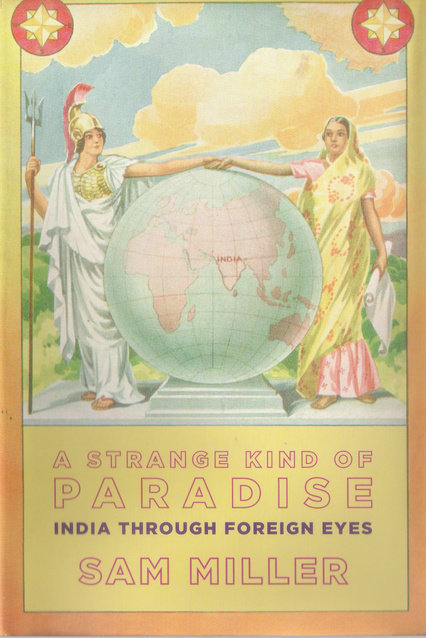


Book review: A Strange Kind of Paradise: India Through Foreign Eyes: Sam Miller (Interview): Penguin India, 440 pages, Rs 599

Edward Said in his book Culture and Imperialism argues thus: “Just as none of us is outside or beyond geography, none of us is completely free from the struggle over geography. That struggle is complex and interesting because it is not only about soldiers and cannons but also about ideas, about forms, about images and imaginings.” Miller etches well his struggle with geography and the historical struggle over the imaginative geography of India. He achieves this by an interesting narrative structure. The author, who is British,  simultaneously traces his 25-year journey in India with 2,500 years of  historical imagining of India by ‘outsiders’; the Greeks, the Romans, the 14th century Arab travellers, the 16th century Jesuit missionaries, traders of the 15th century, and the Renaissance thinkers, among others.

Readers looking for serious scholarship will be disappointed. It is engrossing in a history-made-fun sort of a way. The author is obviously well travelled in India. The book is liberally sprinkled with lesser known facts which a Lonely Planet guide on India may not provide: Pondicherry museum has the oldest European artifact (from the time of crucification) in India, Patna museum has a fragment of Tripitaka’s skull which was presented by the Chinese government to India in 1950, Muhammad bin Tughlaq’s palace is on the Outer Ring Road of Delhi below the IIT flyover called Bijay Mandal, Rose Aylmer’s (Landours’ love interest) pinecone-shaped tomb is in the Park Street cemetery of Kolkata, there is a light and sound show at the Cranganore church where St. Thomas first set foot in AD 52, India’s first mosque, again in Cranganore, was built in AD 629 and so on.

The chapters on personal history are called ‘intermissions’. The intermissions work well but sometimes begin and end rather abruptly.  The other chapters touch upon the known historical facts but concentrate more on the personality quirks of historical figures— the irascible but cowardly Vasco da Gama, the generous with outsiders but otherwise ruthless Tughlaq, the satyrical Ibn Battuta, the curmudgeonly St. Thomas are a few instances. History in this book, however, is his story.  Understanbly so.  It is much harder to access women’s early accounts on India, if any. Predictably, women’s voices come only with the East India Company. Having said that, Miller’s book even in its light-mode rendering of history, tackles a huge temporal sweep quite dexterously. He begins with Scylax, the great seafarer who returned from a scouting trip down the Indus in BC 500 and was said to have met people whose feet were so large that they could shelter themselves from the midday sun and ends with Steve Jobs in 2008 who describes Indian villagers as having more intuition than rationality.

The book bears what is becoming Millers’ signature style—each chapter begins with a hand-drawn map. The chapters are quirkily titled. For instance, the fourteenth chapter is called In which the Author quizzes his neighbors, gets a vague idea of the dimensions of Roberto Rossellini’s penis and watches far too many movies. An easy style combined with a knack for correlating random facts, A Strange Kind of Paradise makes for a light, engaging read.

Comments


Other News

Cabinet approves setting up of Integrated Transport & Logistics Authority

The union cabinet, chaired by prime minister Narendra Modi, on Tuesday approved the setting up of a Special Purpose Vehicle (SPV), called Integrated Transport & Logistics Authority (ITLA), to strengthen research, planning, appraisal, monitoring and impact assessment within the broad domains of Transp

Why foundational literacy and numeracy is key to school education

Foundational Literacy and Numeracy (FLN) are often described as the building blocks of education. Yet, their significance goes well beyond a child’s ability to read a sentence, write a response or solve a basic mathematical problem. These foundational skills shape how children understand the world,

When police data becomes the algorithm

For decades, policing has followed a familiar sequence: a crime occurs, the police respond, an investigation produces records and those records become part of the institutional memory of the criminal justice system. Artificial intelligence is beginning to alter that sequence. Instead of merely recording

Before India voted, the framers worried about the referee

“We are making a Constitution forever and not only for today.” Shibban Lal Saksena said this in the Constituent Assembly on June 15, 1949. He was warning that a ruling party might one day choose a loyalist to run India’s elections. Seventy-seven years later, the Supreme Court is wrestli

Delhi moves to real-time traffic management

The Cabinet Committee on Economic Affairs (CCEA), chaired by prime minister Narendra Modi, has approved implementation of the ITMS Project by Delhi Police at an estimated cost of Rs.1,789.52 crore, inclusive of taxes. The project will cover 42 identified traffic corridors and will be implemented in three

MDR on UPI: Can sustainability come without weakening the network?

The extraordinary transaction volumes and value (₹29.82 Lakh crore in August 2026 alone) of the Unified Payments Interface (UPI) have made it not only an Indian success story, but a global one. In 2024, UPI accounted for nearly 49% of the world’s real-time payment transaction volume, with more th


Upcoming Conferences


-->

Archives

Current Issue

Opinion

Facebook Twitter Google Plus Linkedin Subscribe Newsletter

Twitter





