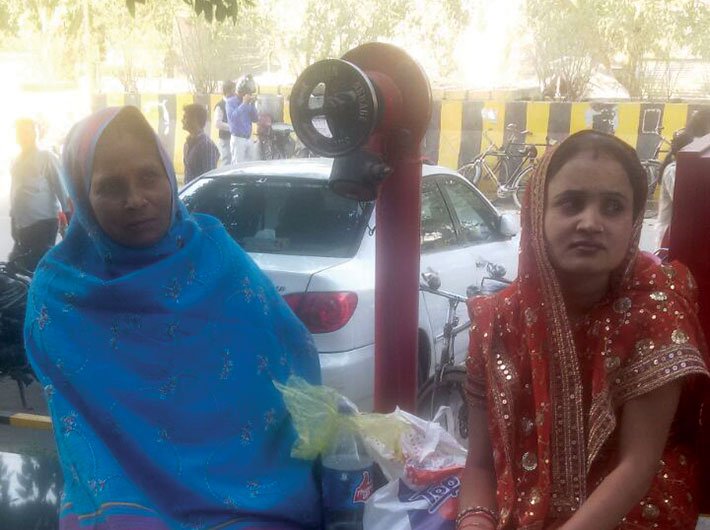
The common people standing in long queues outside banks are facing a host of problems, with some even running out of cash to buy vegetables.
“Mom, I have no cash, can’t come home. Can you come here and bring along some money?” The early morning SOS message from my daughter, a student of tourism studies in Agra, over phone was distressing. She had been looking forward to a two-day break from her hectic schedule and wanted to be home. She, apparently has no time to stand in the queues outside banks or ATM in a town she barely knew to withdraw cash.
After her call, I shed my fear of standing in the queue; at 11 am, I was outside my bank, which had sent me a message about special arrangements for the account holders. This branch of the private bank located in Noida’s industrial-belt was housed in an upmarket building. Its premises were beautiful and staff courteous to the core. I found a separate queue for women but none for the account holders. The women’s queue was much smaller than the two serpentine queues of men.
I had decided to stay on.
Most of the people, who had come to exchange their old notes of ₹ 500 and ₹ 1,000 rendered useless after demonetization, were workers from surrounding areas.
A woman with frizzy hair glistening with mustard oil was standing in front of me. She carried a plastic bag which she kept close to herself. In between a paan chewing man would come and instruct her to keep money safe. Finally, she told the man, who apparently was her husband, that he can keep the money till she reached closer to the entry point.
The paan chewing man took the money.
He told me that he had stood in the queue to exchange ₹ 4,500 of 500 and 1000 denomination for three days. Each time, the cash would get over before his turn came. “I realized that women have better chance of getting it since their queue is shorter.”
His wife told me that they desperately needed the money to buy food. “Bahut dikkat ho raha hai – sabzi khareedne ke liye bhi paise nahin hai (It’s getting difficult; we don’t have money to buy vegetables),” she said.
A couple of women, asked me to help them in filling the forms for exchanging currency. I obliged them. Each one was intending to exchange four notes of ₹ 1000 and one of 500 denomination and carried Aadhar card as identity proof.
They had got the forms from the stationery shop in the basement. “He told me that the cost of the form was ₹2 and photocopying cost was for ₹ 5,” one of the men told me. Shouldn’t the forms be given free. And photocopy cost ₹ 2 per copy!
“What is the name of this bank?” a woman standing behind tapped on my shoulder. She told me that she was visiting a bank for the first time.
The potbellied UP policeman in the meanwhile was close to getting into fisticuffs with a group of young persons, who were getting restless. They were heckling him each time he allowed well-dressed people in. “Yeh staff wale hain (They are members of staff)” he would explain, sheepishly, evoking laughter from the crowd.
“I will teach you a lesson and you will keep standing in this queue for all your life.” He threatened the man who was the loudest in the group. “Saala, Bihar mein hota to….(Expletive. Wish you were in Bihar…),” murmured he as the cop’s attention went into managing the queues. He would, once in a while come out of the ATM cubicle, and direct the queue to either swing to the right or to the left. This seemed of no relevance.
“Yeh kasrat kara raha hai kya (Is he getting us do exercise?)” asked a woman in an exasperated tone.
We were standing in the atrium of a relatively unoccupied building. Besides this private bank, it has a branch of nationalised bank too. “It seems, the queue is moving faster there,” quipped a man, who was accompanying his wife, with whom he had a joint account in the private bank.
“Aisa lagta hai (It looks so),” his wife said in a reassuring tone.
Meanwhile, a frail looking woman with a toddler in her arms and another, whose hands she was holding, was getting annoyed. ”Why did you come with the children?” I asked her. It seems she had come from a nearby village and has been standing with the children since morning. Her husband had gone to work and had instructed her to go to the bank. “Where would I leave my kids?” she said.
The young one had urinated on the floor. She sat on the staircase and quickly changed his dress. She had also carried food and water for the children.
Most of the people in the queues looked tired and had sullen looks. However, a group of youngsters were losing patience. They would physically push people each time the guard permitted four persons from each queue in.
I heard someone say,” Very soon they would come out to tell you that cash is over; this has been happening for three days.”
Everyone heaved a sigh of relief as two men donning uniforms of private security agency carrying a silver chest entered the bank. “Your prayers have been heard – the cash has arrived,” I heard someone say.
I read the notice on the wall saying the bank will exchange cash till 2 pm. It was 1.30 and I was at 11th place in the queue. Now, I was nervous.
Meanwhile, the pan chewing man was back in the role of a mentor to his wife. ”You should gate crash, if he does not allow you.” This time she gave him an angry look.
Now he was addressing others – sons, fathers, husband and brothers – who were hanging around after placing their womenfolk in the queue. “ Kahan hai kala dhan (where is the black money?); Woh sub peeche se aa rahe hai bank kai ander (That [black money] is entering the bank through the back door.)
Some of the people standing close to him nodded while others gave him blank looks. He went on. “ Kal dekha tha kaise appne neta ke sone se ladi beti to bye-bye karne aaye they (Did you notice how they were bidding farewell to the gold-laden daughter of their leader, the other day [alluding to the multi-crore wedding of BJP leader Janardhan Reddy’s daughter, who was seen wearing heavy gold jewellery].”
Finally, I was allowed in and had to stand in another queue. The bankers were not as courteous as they used to be. The table on which water-filled and covered tumblers were placed for the customers had been removed to make way for the rush. Nobody served me coffee, as I was used to.
I spoke to an officer, who, after knowing that I was a journalist, offered me a chair. He said the initial days after demonetizing were maddening for the staff. “We would close the bank at 8.30 and leave for home at 1.30am and return at 7.30. Honestly this was not sustainable.” However, now the bank is observing normal timing but their routine work like soliciting business is suffering and loan servicing has got into in slow mode.
“Our leaves have been cancelled, many of us had to change plans for our year-end vacations,” said a senior person in the bank. “But I am happy that 20 years later, I would be able to tell my kids the story of how I was part of a historic change.”
Why don’t you put the available cash in ATM machines to lessen the rush in the banks, I asked him. He said the ATMs could not handle soiled and dirty notes, that people had stacked as home savings and have taken out due to demonetization. “These notes get stuck in the machines.” He told me to be ready to live with the chaos of monetization till year end.
In the meanwhile, another staffer told him that people outside were shouting slogans not believing that exchange of notes was over for the day.
“Let them stay there for another two-three hours, they will disperse on their own.”
I left the bank with currency of 100 and 2000 denomination. Outside, I met Shanti, a mother of two sons, sitting with a tiffin box and two bags on the pavement. She told me that the family, originally from Shakti Nagar, a town near Varanasi, and comprised her two sons, a cousin and one daughter-in-law had left home with food and other essentials they would need for the day in the morning; travelled for two and a half hours on bus to be at the bank by 8.30 am.
“My village has two banks – SBI and PNB – but there is a huge rush. The other day, one woman was pushed into a nullah and she broke her arm.”
Shanti had come to Noida for exchanging money because of her two sons, who were working in a local factory. Their employer had paid them salary by cash. “He paid them ₹ 500 notes. For five days all the employees refused to take it but then he made an offer of paying them one month’s salary in advance.” She claims her sons did not take the offer, but had to take the cash for meeting expenses at home and treatment of their father, who is a patient of asthma-bronchitis.
The three women had already managed to exchange the money and were waiting for the two brothers who were still in the queue outside the nationalised bank branch.