
SY Quraishi offers suggestions to improve the institution and the process at the heart of our ‘experiment’
GN Bureau | October 30, 2023

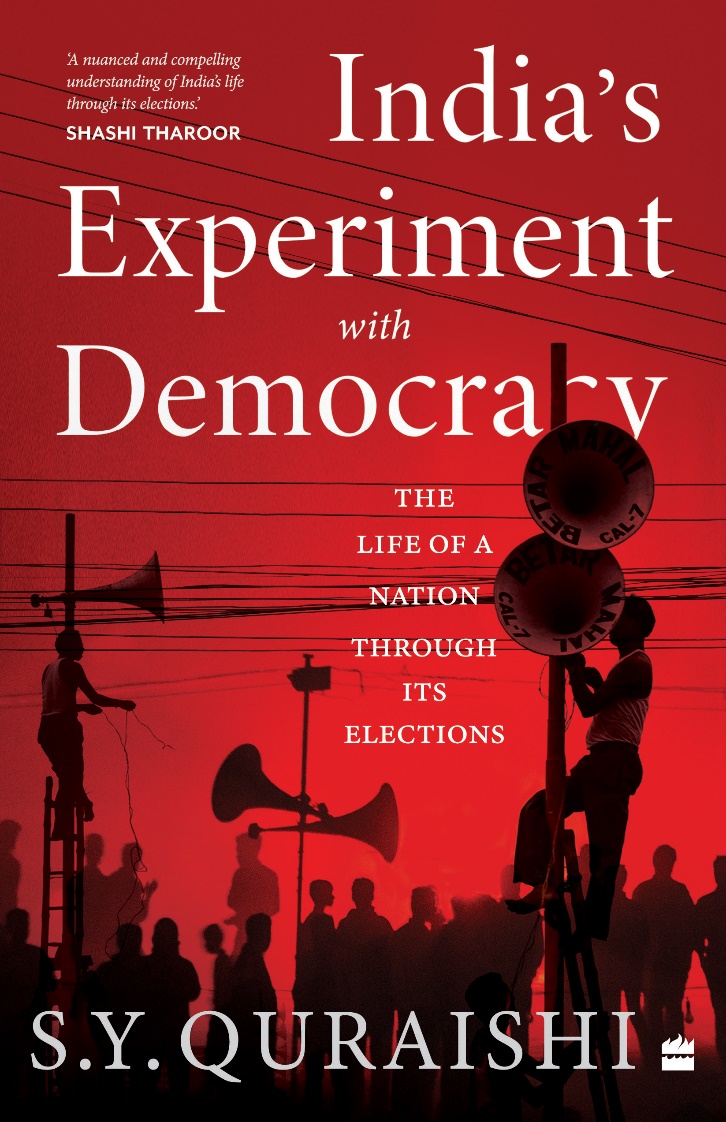
India’s Experiment with Democracy: The Life of a Nation through its Elections
By S. Y. Quraishi
HarperCollins, 560 pages, Rs 699
S. Y. Quraishi, former chief election commissioner (2010-12), is considered a walking encyclopedia of electioneering in India. He was born in June 1947, a week before Salman Rushdie, which makes him one of those Midnight’s Children, whose life stories possibly mirror the story of the Republic. (In the introduction, he also speaks of ‘India and me – a journey together’.) He has enthusiastically taken part in many a debate in this republic, and he has always been a voice of reason, of conscience.
‘India’s Experiment with Democracy’ is Quraishi’s second book on the topic, after ‘An Undocumented Wonder: The Making of the Great Indian Election’ (2014). The latest work is, according to the author, “a product of multiple decades of my life … essays, reflections, questions and explorations that have kept me occupied all throughout my career, ever since I started as an IAS officer in the early 1970s”. It is mostly a collection of previously published edit-page articles.
Given the long range of time over which they were written, they cover an immense range of topics, making it necessary to put together the chapters under several sections. They include: General Elections, The Role of the Election Commission: Powers, Procedures and Politics, State Elections, Electoral Reforms, International Elections. Then, the book branches out into other territories: Constitution and Indian Polity, Gender and the State of Democracy, Religion and the Future of India. All this is rounded off with an annexure on Legislative Framework of Election Law in India.
As a result, some of the chapters may seem dated, some comment on a controversy that made news at some point and was soon forgotten. The later sections break the coherence of the book too, making it an unwieldy collection. While the contents of these chapters are no less interesting – anything from the pen of this distinguished administrator of such vast experience is highly readable, but they possibly dilute the core of the book.
This is rather unfortunate, as there is a very coherent and very relevant book inside this book, focusing on Electoral Reforms – the holy grail of India’s democracy. Here he discusses the now formalised proposal of ‘One Nation, One Poll’. As a former CEC, his views, presented over three chapters, are critically important – all the more so, since few other former CECs have brought their experience to bear on the topic in an elaborate manner.
As the next general elections draw closer, the ten chapters forming Quraishi’s views on “main reforms and recommendations” would be a necessary reading.
In spite of the mixed-up nature of its composition, the book offers a thorough analysis of the institution and the process at the heart of our democracy, and makes eminently reasonable suggestions to improve it further. For citizens who are well aware of their stakes in this system, this book will remain indispensable for long.
Mumbai’s real estate market keeps growing, yet homeownership remains out of reach for much of its population. Three experts – urban researcher Hussain Indorewala, urban planner Vidyadhar Phatak and developer Kamlesh Thakur of NAREDCO Maharashtra, agree that simply constructing more apartments
US secretary of state Marco Rubio has said he was unfamiliar with the Wall Street Journal report suggesting Elon Musk had decided to throttle Starlink services in Ukraine, but rejected claims that Washington had ordered the restrictions to pressure Kyiv. “There was no
Breast cancer has become a public-health challenge in India. The greatest opportunity is to find cancers earlier. Artificial intelligence (AI) is opening a new era in breast cancer detection. AI systems can analyse mammograms and other breast-imaging studies, identify subtle abnormalities and assist radi
Indian agriculture is experiencing significant climate volatility, while the world economy seems to be in a highly volatile situation. Economic indices from various countries show that they need to recalibrate their strategies to withstand economic headwinds. In such a challenging situation, a country li
India’s southwest monsoon ended with a 13% rainfall deficit in 2026, its weakest performance in a decade, raising concerns over agricultural production, water security and the upcoming rabi season. With El Niño expected to persist into early 2027, experts warn that declining soil moisture, dep
For over a decade, India’s e-commerce story has rested on a simple premise: platforms connect buyers and sellers, while data fuels efficiency, personalisation, and scale. However, as the market matured, its structure has revealed a growing imbalance. E-commerce platforms, especially marketplace ent










