
Journalist-author Perry Garfinkel picks six of the mahatma’s moral principles and writes about his experience
GN Bureau | October 2, 2023
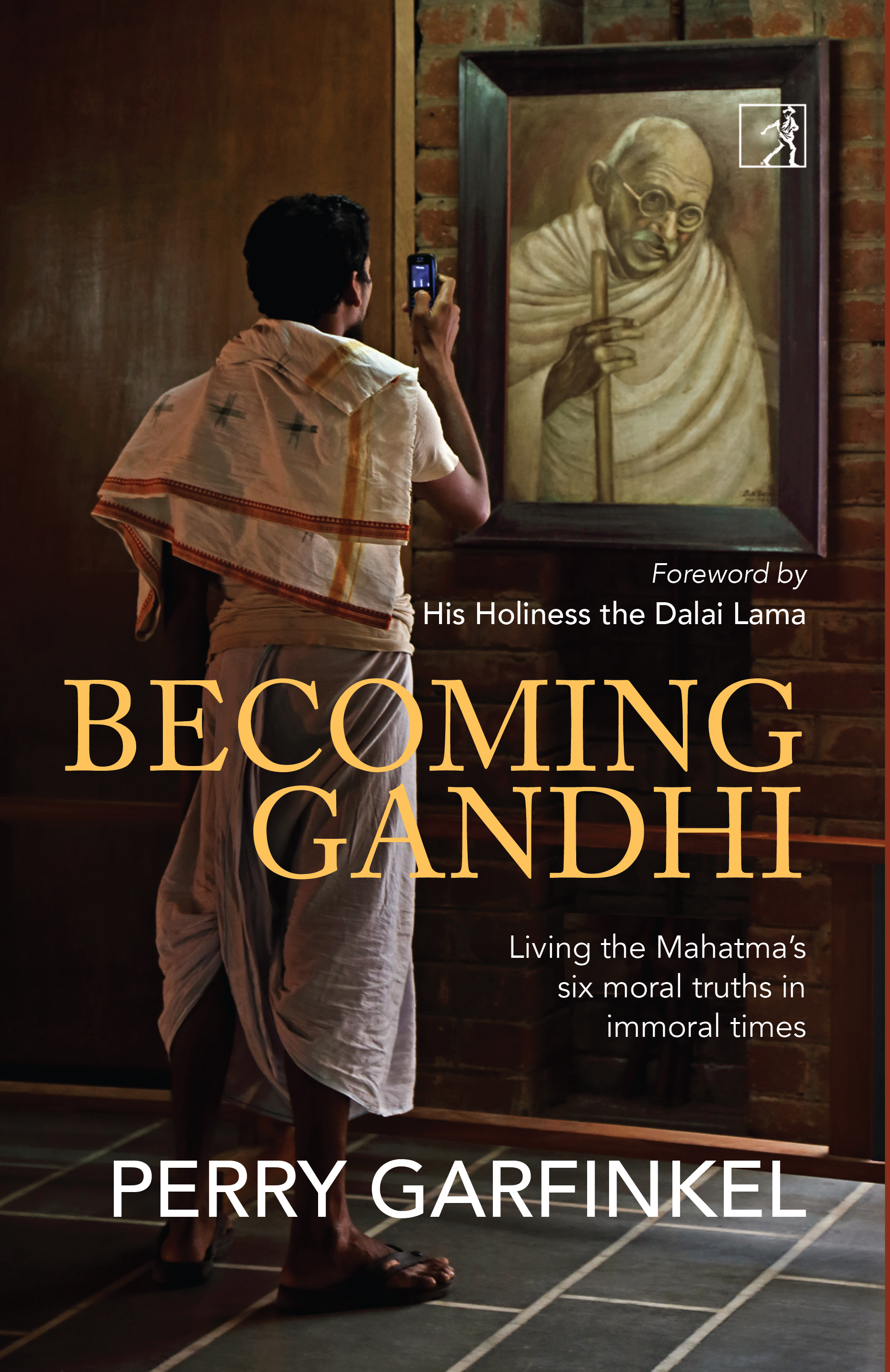
Becoming Gandhi: Living the Mahatma's 6 Moral Truths in Immoral Times
By Perry Garfinkel
Simon & Schuster India, 264 pages, Rs 699
Mahatma Gandhi is justly a great model of self-development. The way a diffident, callow, average youngster moulded himself into a force of history is a well-documented story that is bound to inspire many. He himself egged others on, saying that he was not born a mahatma, and what he could achieve was equally possible for others too. He was, after all, just a human being like them.
The key to his self-fashioning was the 12 vows, ‘dwadash vrat’, which were reminiscent of the yama-niyama of Patanjal Yogasutra as well as of the precepts of Buddhism and Jainism, among other traditions. Some of them were internal and spiritual, and hence about self-discipline – what he called ‘sva-raj’ or self-governance. Truth, non-violence and celibacy fall in that category. The rest were about one’s place in the world and responsibility to the others. Preferring Swadeshi, respecting all religions and opposing untouchability belong to this grouping.
Many have tried to live in accordance with the 12 rules, with varying results. The culture and milieu around you may arguably have a role to play in this self-formation.
For a journalist, however, there was a book idea lying in open for long, in the tradition of doing something, immersing oneself in something and then writing about the experience. Barbara Ehrenreich, for example, went undercover as an unskilled worker and for a year in 1998 and then wrote about how it feels to live on poverty-level wages (Nickel and Dimed, 2001).
Perry Garfinkel, a journalist, speaker and teacher, among other things, has several books to his credit, including Buddha or Bust (the full subtitle is worth mentioning: In Search of Truth, Meaning, Happiness, and the Man Who Found Them All). He not had that idea, he also put it into action, just as Gandhi did after reading Ruskin’s Unto This Last.
He took to heart one of Gandhi’s most famous sayings―“Be the change you want to see in the world”―and attempted a personal transformation. Committing to practice the Mahatma’s six main principles―truth, nonviolence, vegetarianism, simplicity, faith, and celibacy― in the 21st century world and in the process seeking to better himself, facing successes and failures that, at times, lead to self-effacing humour.
The result, happily, is not ‘just another book on Mahatma Gandhi’. Instead, it is a practical, first-hand application of six Gandhian ideals and how realistically these can be adhered to and practised in today’s world. Part-memoir, part self-help and a painstaking deep dive into the Mahatma’s life, this must-read book asks the timely and critical question: “Is it possible to live a moral life in immoral times?” With Gandhi’s principles as guidelines and using modern cultural references in a voice that all will relate to, Garfinkel makes a strong case that the Mahatma is more than relevant: he is essential.
“I have always believed that the best way to preserve the legacy of the great statesmen of the past is to try to abide by the values they upheld and to apply them in our contemporary situation,” writes the Dalai Lama in the foreword. “I am glad to see that writer Perry Garfinkel has done precisely that with Mahatma Gandhi and shares his experience in this book.”
Becoming Gandhi brings latest research on self-development to bear on Gandhian experiments, and also nudges the reader, in the best possible way, to “be the change”.
Here is an excerpt from the book:
“Be the change you want to see in the world.”
This is all to suggest that the phrase has renowned status, resonating with so many people these days. Yet, I suspect that none of the groups using it know that Gandhi did not actually say it quite that way. And while it’s fine to say it’s the thought that counts, what is that thought? Let’s deconstruct.
Be. One of the most complicated action words in the English language. “To be” is the most protean English verb, with the most irregular and constantly changing forms. I am, you are, they were, we’ve been, and so on. And that’s just for starters. In any tense, it connotes a state of being. To simply be. It sounds easy until you try it. Be in the moment; be the moment. Be fully present and accounted for. Be accountable; be responsible for your actions. Come into your beingness. Be somebody, not just anybody. Certainly don’t fall into actress/comedienne extraordinaire Lily Tomlin’s mistake: “I always wanted to be somebody, but now I realize I should have been more specific,” she advised in her award-winning 1985 one-woman Broadway show The Search for Signs of Intelligent Life in the Universe.
Be yourself; after all, that’s the only choice. Further, be with yourself and be happy with who you are.
“To be or not to be?” That is the question, isn’t it? Hamlet’s famous line, in the eponymously titled Shakespeare play of 1601, opens a soliloquy in which he struggles between living and dying. If that’s too ominous and finite a choice, it could be interpreted more metaphorically as do you want to “be” in this life, in your life, in charge of your life, or throw in the towel and let fate rule it? Do you want to just cash out? This is the essential inquiry of the human condition. Do I exist? If I do, then it’s my choice as to how I exist, where I take action, where I passively accept the dictates of some other entity. This, at least, is my assessment.
One more important notion about “be” in this context: As the first word in the phrase, “Be the change,” which is actually a full sentence, be is in the imperative form of the verb. We use imperative clauses when we want to tell someone to do something. It’s a command, literally. Thou shalt be. It has power, and it’s empowering. Nike coined “Just do it”—Gandhi would say, “Just be it.”
That was a lot to take in for only the first word.
Onward to change. First, I wonder what the fine-line differentiation is between “Be the change” and “Be change.” One could speculate. I contemplated it but have no interpretation that satisfies me. I want to take it this way: Be awake, aware, present, and ready. For what? Change. Don’t just be change. Be the change. In other words, work toward changing. Be the process of change. Then, ipso facto, you will have changed.
To change is part of the human condition, the inevitable march of time, taking its toll on body and mind but also hopefully enhancing and enriching our understanding of life and ourselves. From birth onward, even from the point of conception, we develop, thanks to the growth hormone produced by the pituitary gland. You don’t have to lift a finger to grow and change. This could not be what Gandhi meant by change.
To interpret what Gandhi meant by change, what anyone means when they talk about change, is much more complicated. What do I want to change? What do I need to change? What will I never change even at the risk of health and sanity? This is summed up in the so-called Serenity Prayer, most famously repeated at Alcoholics Anonymous meetings and other 12-step programs: “God (or Universe), grant me the serenity to accept the things I cannot change, the courage to change the things I can, and the wisdom to know the difference.”
Change requires, first, an attitudinal shift. Yes, I can and will change . . . if I really want to. One needs to make a strategic plan and stick to it. Pick a simple target, the low-hanging fruit of change. I’m going to floss for sixty seconds at least twice a week; the reward (Pavlov’s dog thrives, and salivates, on a reward, known in psychology circles as classical conditioning or Pavlovian or respondent conditioning) will be cleaner brighter teeth, less halitosis, more confidence when smiling, less insecurity about speaking closer to others, more friends and lovers, greater wealth, millions of followers on my Instagram account, appearances on major media networks, eternal life . . . OK, maybe I’ve gone too far.
Gandhi put it this way: “Carefully watch your thoughts, for they become your words. Manage and watch your words, for they will become your actions. Consider and judge your actions, for they have become your habits. Acknowledge and watch your habits, for they shall become your values. Understand and embrace your values, for they become your destiny.”
Ahaaa, to change my habits. Not so easy. The American Journal of Psychology defined habit as “a more or less fixed way of thinking, willing, or feeling acquired through previous repetition of a mental experience.” A 2002 daily experience study by habit researcher Professor Wendy Wood and colleagues found that 43 percent of daily behaviors are performed out of habit. New behaviors can become automatic through the process of habit formation. Old habits are hard to break; new habits are hard to form because the behavioral patterns that humans repeat become imprinted in neural pathways, but it is possible to form new habits through repetition.
[The excerpt reproduced with the permission of the publishers.]
“We are making a Constitution forever and not only for today.” Shibban Lal Saksena said this in the Constituent Assembly on June 15, 1949. He was warning that a ruling party might one day choose a loyalist to run India’s elections. Seventy-seven years later, the Supreme Court is wrestli
The Cabinet Committee on Economic Affairs (CCEA), chaired by prime minister Narendra Modi, has approved implementation of the ITMS Project by Delhi Police at an estimated cost of Rs.1,789.52 crore, inclusive of taxes. The project will cover 42 identified traffic corridors and will be implemented in three
The extraordinary transaction volumes and value (₹29.82 Lakh crore in August 2026 alone) of the Unified Payments Interface (UPI) have made it not only an Indian success story, but a global one. In 2024, UPI accounted for nearly 49% of the world’s real-time payment transaction volume, with more th
Diplomacy is akin to an art, wherein the summitry, conflict resolution and negotiations form apt constituents of the entire context of deal making and “playing for keeps” in the international arena. The Xi-Trump summit in Washington last week, in which the American president broke all conside
Moving to Delhi-NCR for education can be an exciting experience for students from Northeast India. It gives us a chance to meet new people, experience a different culture and become more independent. But living away from home also comes with challenges that people who have not experienced them may not al
The government has reduced the Basic Customs Duty (BCD) on major imported crude edible oils with a view to moderating domestic edible oil prices, providing relief to consumers and mitigating inflationary pressures arising from the sharp increase in international edible oil prices.











