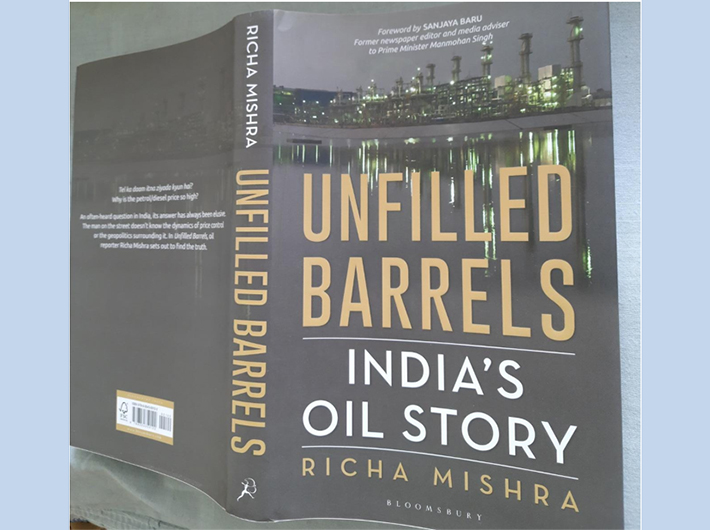
Excerpt from Richa Mishra’s ‘Unfilled Barrels: India’s Oil Story’ featuring a candid conversation with former petroleum minister
Unfilled Barrels: India’s Oil Story
By Richa Mishra
Bloomsbury, 200 pages, Rs 699
Over the past month or so, the oil prices are on the rise again. The phenomenon is attributed to a variety of factors, ranging from domestic politics to international relations – especially the war in Ukraine. The truth, however, is not simple. To answer the oft-raised question – ‘Tel ka daam itna zyaada kyun hai?’ Why is the petrol-diesel price so high? – one requires at least an overview of India’s energy sector and how it has evolved over the decades.
That is what Richa Mishra, a journalist (who says nothing excites her more than oil price movement), has set out to provide in this new book. It is the story of the growth of India’s oil and gas sector over the past half century and how India is poised against the backdrop of global upheavals with its huge dependency on oil and gas import.
‘Unfilled Barrels’ tries to recount India’s upstream journey in a systematic manner. It takes the reader back in history to the point where a herd of elephants were instrumental in accidental discovery of oil in the northeast. The book then gradually picks its way through the geology of Indian terrain and the challenges it threw. The early players in the arena (government and private players), the high stakes risk involved in the exploration, to the government’s focus on the development of hydrocarbon industry and finally how the formulation of the New Exploration Licensing Policy (NELP) became a game-changer.
The book highlights the emergence of other stakeholders right from public sector enterprises including ONGC to the fiercely competitive private players like Cairn Energy, and Reliance Industries. Despite the operational mix of domestic players, India’s 80% requirement is met through imports. This book attempts to answer the billion-dollar question: Why producing your own oil and gas matters? And in 21st century what kind of energy matrix is at play for filling India’s need of unfilled barrels.
In this excerpt, Mishra recounts her interview with Dharmendra Pradhan on 31 December, 2020, when he held the petroleum and natural gas portfolio. (He had been the petroleum minister in the first Modi government and again in the second term, till July 2021 when he became the education minister.)
Where the Missing Drops in the Barrels Are: Exploring the Unexplored
Getting straight to the point, I asked, ‘When I read the speeches of India’s first oil minister and yours today, I find that there is little difference in the issues and challenges mentioned in the two because both of you talk about domestic production and oil price. One wonders what went wrong and how.’
I asked Dharmendra Pradhan what changed for him since his first term.
‘When I started, a big challenge before me was crude oil price, which was at around US$105 a barrel (the Iraq invasion led to a further spike in price to about US$115 a barrel). We used to subsidise petroleum products at that time (to protect the common person from high oil prices).
The subsidy bill used to be more than one lakh crore rupees. Diesel, domestic liquefied petroleum gas (LPG) and superior kerosene oil (SKO) were subsidised. So, imagine the situation: The price was ranging between US$80 and US$100 a barrel. There was the subsidy burden. Added to this were the legacy issues left behind by the Rangarajan gas price formula (to decide on domestic gas price). This is how I started my journey,’ he reflected.
As if he saw my smirk—as journalists, we tend to be less sympathetic—he said, ‘Look, you have to understand that there were two or three primary issues that had drastic implications. High oil prices impacted the economy and made gas pricing controversial. It raised questions about how far the subsidy burden could go and what the way out was. This is how my journey in this ministry began, and I found my way. Yes, I could say I have successfully navigated the journey.’
His statement reminded me of what Piyush Goyal, his colleague who handled the coal and power ministries during the first Modi government, said to me about his first 100 days, describing it as ‘baptism by fire’. For Dharmendra Pradhan, one could say it was baptism by
black (oil) and blue (gas) gold.
Once a reporter, always a reporter. So I further nudged Dharmendra Pradhan on the issue of domestic production and geopolitics. In all seriousness, he told me, ‘We were successful in putting our case on the international platforms. The international scenario has changed. India was able to establish itself as an attractive market. Though oil is a global commodity and there is a global pricing mechanism, slowly and steadily, India was able to handle the situation due to its marketing strategy and changing geopolitics. Today, India sources crude oil from diverse areas, and there is a focus on renewable and gas-based energy. This helped us to send a message across to oil producers that it is no longer a monopoly and that they had to meet
consumer expectations. Touch wood, today the price is at a reasonable range.’
Touch wood indeed, and rightly so, I would say. In OPEC summits and conferences, Indian representatives never used to get the opportunity to meet the key players and had to make do with junior-level officers. Today, India is a strong voice as one of the big consumers. India
needs the OPEC+ (Organization of the Petroleum exporting Countries) nations, but they too need the market that India offers.
The naivety of the officers in India is also surprising. See this conversation, for example.
On 2 February 2021, I met a senior official of the finance ministry for the usual one-on-one post-Budget interactions that senior secretaries of the ministry have with media persons to demystify the government’s finance management and explain why certain decisions
were taken and some not.
Me: ‘What is the average crude oil price that the government has taken to work out the numbers for the budget?’
Officer: ‘For the last few years, we have not been worried about the crude oil prices. Our understanding is it will remain soft and not breach US$60 a barrel.’
Not even a fortnight had passed after this conversation than the crude oil price was around US$62 a barrel. Earlier, when preparing the budget, the government used to take a cushion of at least US$3 to US$4 a barrel in crude oil price. Statements like this make one wonder from where this confidence comes.
I remember the NELP days—the enthusiasm and the noise. All of us started to believe that India had tremendous potential, but the reality is something different.
This also made me ask successive secretaries in the MoPNG what holds India back. Where are the new big discoveries? Why hasn’t another Mumbai High or KG-d6 or Barmer happened?
Like me and many others, the ministry also seems to be looking for an answer. Dharmendra Pradhan left no stone unturned to increase domestic production, even if this meant reviewing the performance of a public sector exploration giant such as ONGC regularly. I remember how Saurabh Chandra, petroleum secretary (2014–2015), started to question ONGC about its
performance. Targets were set for ONGC.
I asked a senior serving official (2021) in the petroleum ministry why the performance of some ONGC officials is brilliant when they join the private sector, but when they are in ONGC, things don’t happen. The official politely told me, ‘Complacence settles in. The urge to perform is missing at the level of the top management.’ I am not sure how to react to this, as I have heard this explanation multiple times now.
So, I turned my focus towards the geopolitics that has a direct impact on oil prices and, in turn, on large consumer nations like ours. How does India deal with it? A growing alliance with the United States has seen India shifting away from traditional suppliers such as Iran.
Successive expert committees have come out with reports suggesting policy consistency, but alas, it remains a distant dream. This has been a sore point in India’s energy security. Energy is one area that cannot be treated in silos, the reason being that higher domestic production would mean less dependence on imports.
[The excerpt reproduced with the permission of the publishers.]