
Under new corporate social responsibility norms, companies spend '163 crore more than the requirement
GN Bureau | November 8, 2016
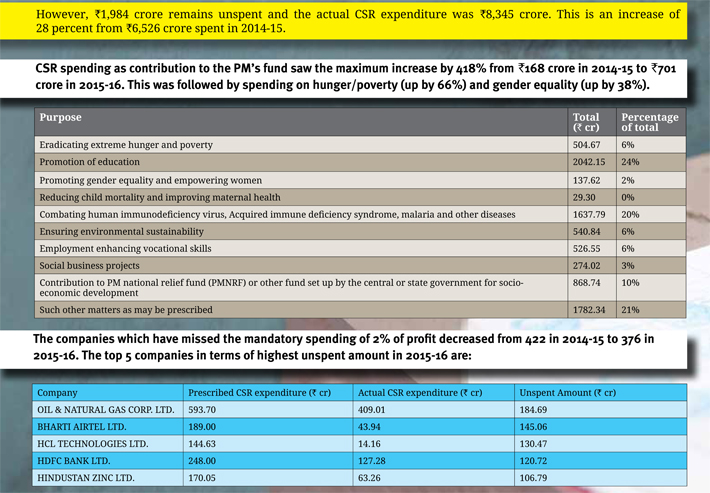
The spending under corporate social responsibility (CSR) by the NSE listed companies has seen a huge increase of 28 percent in 2015-16. The Companies Act (2013) has statutory provisions, making CSR mandatory for companies with net worth of Rs 500 crore or more, turnover of at least Rs 1,000 crore or net profit of at least Rs 5 crore. Such companies are required to spend at least 2 percent of their average net profits of last three years on CSR activities, while constituting a separate committee on their board. The law, implemented from April 2014, makes India the only country with a legislated CSR.
According to Prime Database, which has done the analysis, the average net profit of the 920 listed companies over last 3 years was Rs 4.60 lakh crore. As per the CSR provision, the companies were required to spend Rs 9,146 crore. The companies, however, spent Rs 9,309 crore, which is Rs 163 crore more than the requirement.

Breast cancer has become a public-health challenge in India. The greatest opportunity is to find cancers earlier. Artificial intelligence (AI) is opening a new era in breast cancer detection. AI systems can analyse mammograms and other breast-imaging studies, identify subtle abnormalities and assist radi
Indian agriculture is experiencing significant climate volatility, while the world economy seems to be in a highly volatile situation. Economic indices from various countries show that they need to recalibrate their strategies to withstand economic headwinds. In such a challenging situation, a country li
India’s southwest monsoon ended with a 13% rainfall deficit in 2026, its weakest performance in a decade, raising concerns over agricultural production, water security and the upcoming rabi season. With El Niño expected to persist into early 2027, experts warn that declining soil moisture, dep
For over a decade, India’s e-commerce story has rested on a simple premise: platforms connect buyers and sellers, while data fuels efficiency, personalisation, and scale. However, as the market matured, its structure has revealed a growing imbalance. E-commerce platforms, especially marketplace ent
The interaction between active Western Disturbances, increased atmospheric moisture and the region’s complex topography aswell as global warming are important factors behind intense rainfall in the Himalayas, leading to flash floods in Nepal, according to meteorologists. Nepal
Last summer, the two of us spent several weeks in rural Madhya Pradesh with a non-profit that works on gender justice through women’s self-help groups. We went in with a notebook full of laws. The Protection of Women from Domestic Violence Act. The Dowry Prohibition Act. Free legal aid for every wo










