Grappling with low finances, Hindustan Aeronautics Limited borrows Rs 962 crore from banks to pay salaries to its employees
The recent move by the Hindustan Aeronautics Limited (HAL) to borrow Rs 962 crore from banks to pay salaries to its employees has once again exposed the sorry state of the public sector undertakings (PSUs).
After reports of HAL’s financial crisis surfaced in the media, the defence PSU has been hogging the limelight for all the wrong reasons. Reports suggest that the armed forces owe Rs 15,700 crore to HAL, which includes Rs 14,500 crore by the Indian Air Force (IAF) alone.
“IAF is not an income generating organisation and the entire budget is provided by the defence ministry and if the air force has not cleared its dues then it is for the ministry to give a reply. It is very unfortunate that HAL has borrowed money from the market just to pay salaries,” says noted economist Prasenjit Bose.
Amidst the financial crunch, the HAL board convened a meeting on January 7 to find out a solution to the crisis and is likely to hold another round of meeting on January 8 as well.
Bose further says that the Indian Air Force and Indian Army are its main customers and if both the IAF and Indian Army are not clearing their dues then it is the government’s responsibility to make the armed forces clear their dues.
The government’s decision to purchase Rafale aircraft from France in a fly-away condition has put the HAL in a bad light as the move reflects centre’s poor confidence in the defence PSU.
T Suvarna Raju, former HAL CMD, in an interview to Hindustan Times on September 20, 2018, had said that HAL could have manufactured Rafale fighters in India provided the centre managed to close the original negotiations with Dassault and had actually signed a work-share contract with the French firm. He had insisted that the HAL has the ability to build advanced fighter aircraft.
Agrees Bose. He says that HAL is a highly specialised PSU. He alleges that the government is just keen on placing orders with private and foreign-based firms, which has left the defence PSUs bleeding.
A war of words has broken out between the Congress president Rahul Gandhi and the defence minister Nirmala Sitharaman after the former alleged prime minister Narendra Modi for weakening the HAL to help his “suit-boot” friend [Anil Ambani].
In its defence, the HAL has tweeted, “In view of the various media reports on HAL, following is clarified: HAL has taken overdraft of Rs 962 crores. With anticipated collection upto March, the cash position is expected to improve. Orders for LCA Mk1 A (83) & LCH (15) are in advanced stages.”
Bose, however, says that the bulk of orders worth Rs 1 lakh crore that are in the pipeline with HAL, as claimed by the defence minister, are under consideration. “Nobody knows when these orders will be materialized,” he says.
The government is trying to weaken the HAL by not clearing its dues. The Modi government is absolutely patronising private companies and neglecting the HAL, adds Bose.
For decades, PSUs in the country have been grappling with issues like poor financial performance and strikes by the employee unions against the government’s move to disinvest them. As on December 28, 2018 the government has raised Rs 34,142.35 crore as disinvestment proceeds against the target of Rs 80,000 crore in 2018-19 fiscal.
The government is hell-bent to raise disinvestment proceeds and apparently the PSUs are not the priority of the centre, says Bose.
Many government enterprises like Bharat Sanchar Nigam Limited (BSNL), Dredging Corporation of India (DCI), Pawan Hans and Air India have been opposing the centre’s move of selling their stake to private companies.
In December 2018, BSNL employees were on a strike after the government prevented the PSU from acquiring certain technologies and launching new products. The move would not have been favourable to Reliance Jio, says Bose.
Notwithstanding the controversy, HAL holds a lot of importance for the Indian defence sector as it manufactures some of the key fighter aircraft and helicopters needed for the IAF and Indian Army.
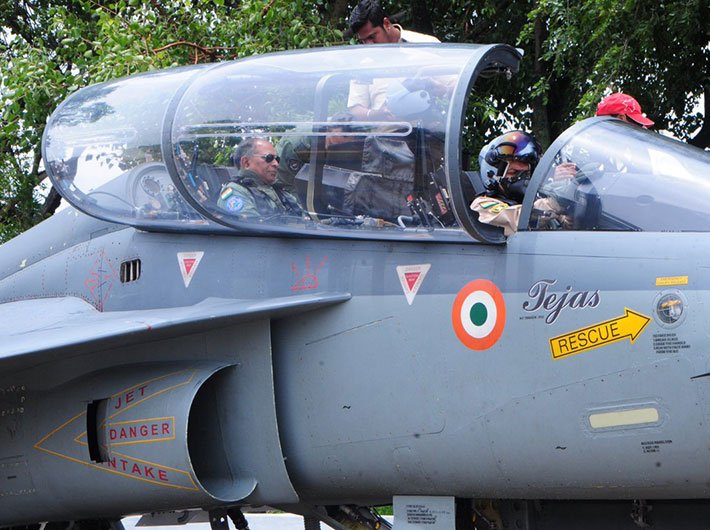
Minister of state for defence Subhash Bhamre in a written reply to Rajya Sabha on August 6, 2018 had said that apart from 40 LCA Tejas aircraft (20 initial operational clearance and 20 final operational clearance), the defence acquisition council has approved acquisition of 83 LCA Mk1A aircraft with enhanced capabilities with active electronically scanned array (AESA) radar, beyond visual range (BVR) missile, self-protection jammer (SPJ) and air-to-air refuelling (AAR) for which quotation has been submitted by HAL.
In case of fighter jets, the HAL is listed to make 123 Tejas planes; of these 20 are called the initial operational clearance (IOC) version and another 20 the FOC version. Out of total 20 IOC aircraft, 9 of them have been delivered by the HAL to IAF as on August 2018. The FOC version production was supposed to commence by 2018-end. The remaining 83 are the Tejas Mark 1A, which will come with 43 improvements.
As of January 2, 2019, HAL’s profit after tax dropped to Rs 2,070 crore in 2017-18 from Rs 2,616 crore in 2016-17, according to a PIB release.