
A Dignity March to end sexual violence

The 65-day-long march will cover 200 districts across 24 states/union territories across the nation. It will culminate in Delhi on February 22

geetanjali

Geetanjali Minhas | December 21, 2018 | Mumbai

#Rashtriya Garima Abhiyan   #rape   #sexual assault   #sexual violence   #Dignity March  
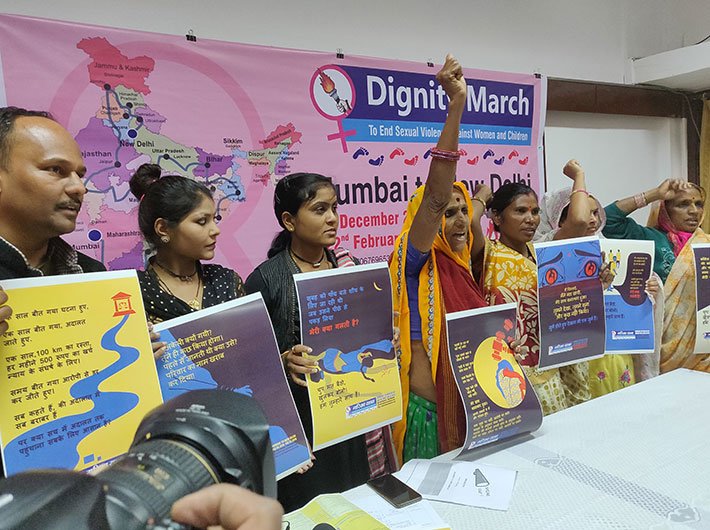
Survivor and activist, Bhanwari Devi (centre), at the Dignity March event

Around 5,000 survivors of sexual violence along with their family members from across the country have embarked on a 10,000 kms Dignity March from Mumbai. The 65-day-long march will cover 200 districts across 24 states/union territories across the nation. It will culminate in Delhi on February 22. 

 
The march aims to end victim shaming of women and children of sexual violence, shift humiliation on the perpetrators and create a non- judgmental and safe environment for the victims.
 
Organised by Rashtriya Garima Abhiyan, the march will create a network of survivors and ensure their participation in policy-making and implementation of laws and guidelines for crimes related to sexual violence.
 
Among others, survivor and activist, Bhanwari Devi, Urmila Devi and custodial gang-rape survivor, Janki Bai, were also present at the campaign’s event in Mumbai. 
 
The findings of an online survey were also released at the event. According to the survey, Speak Out!, 74 percent of the respondents said that they have faced sexual violence in their lifetime. Out of the 1,150 respondents who confirmed sexual violence, 92 percent are women, and 8 percent are men. 78 percent respondents said that the incidents happened when the survivor was a minor.
 
In terms of types of sexual violence, 31 percent of respondents said that they have been raped; 4 percent gang-raped; 4 percent faced an attempt to rape; 21 percent were inappropriately touched; 22 percent were stared at; 3 percent were forced to oral sex; 2 percent were forced to watch pornography; 2 percent faced sexual comments/slurs/songs; 2 percent were followed or stalked; 2 percent faced flashing /inappropriate bodily gesture; and 1 percent faced voyeurism. 28 percent of the respondents said that the incidents happened inside the homes of survivors and 18 percent said they had been abused in a deserted space. 
 
In 64 percent cases, the abuser was known to the victim. 62 percent survivors did not inform about the incident to anyone. 95 percent survivors did not file any complaint due to social stigma and 47 percent felt shame as the reason for not reporting
 
28 percent of the respondents belong to scheduled caste; 22 percent to scheduled tribes; 33 percent to other backward castes and 14 percent to general caste. Whereas, 1 percent belong to religious minority and 2 percent to other category.
 
Narrating her ordeal, Mamta Tanwar, mother of two, said that she used to work as a cook in Ujjain, Madhya Pradesh. A family acquaintance promised her a better job in Susner, about 100 miles away. She was tricked and taken to a brick and mortar room in an open field instead. She was held captive there and was raped by four men for two days. When she tried to run away, she was brutally beaten. After five days her perpetrators took her thumb impression on a blank paper and sold her to another man for Rs 2 lakh in Lala Khedi village. Mamta narrated her ordeal to the village sarpanch, but he turned a deaf ear. She was later rescued by a person from the same village. He left her in Indore. From there she went to Ujjain but her family had moved out. When she went to the police to file her complaint, the officials refused to register her complaint and said that she is making false allegations. For a while she took refuge at the Ujjain railway station. Slowly she started doing some tailoring work and now she lives alone in a rented room.
 

Comments


Other News

Ethanol blending: The two sides of a story

India`s crude oil consumption is estimated to be around 88.5% imported from abroad. This one single figure is also responsible for why ethanol has become both an economic strategy and fuel policy at the same time. In an economy like India, which depends so heavily on foreign oil, any increase in internat

Food inflation: Not a macroeconomic statistic but a developmental indicator

India`s retail inflation shows a reassuring picture at first glance. According to the latest data, Consumer Price Index (CPI) inflation edged up to 4.38% in June 2026 from 3.93% in May 2026, but continued to remain within the Reserve Bank of India`s (RBI) target band of 4% (+/- 2%). However, beneath this

Skin in the game or masterful market timing?

When a company founder opens their personal chequebook to buy shares in their own business, stock markets usually applaud. To the average retail investor, it feels like the ultimate vote of confidence, a sign that the people running the show have real skin in the game and believe brighter days are ahead.

India’s freedom struggle was shaped by wider Asian political thought

As we mark 80th anniversary of independence, ‘Asianism and the Fall of Empire’ (HarperCollins India) by historian Mithi Mukherjee offers a new perspective on Ind

What is colonialism? A relook at modern history

The Chromatic World Order: The Fiction That Rules Our World  By Sajid Mohamed Aakar Books  

Monsoon session of parliament adjourns sine die

The Monsoon Session, 2026 of Parliament which commenced on July 20 was adjourned sine die on Thursday. The session provided 19 sittings spread over a period of 25 days.   During the session 11 Bills were introduced in Lok Sabha and 2 Bills were introduced in Rajya Sabha. 12 B

Upcoming Conferences


-->

Archives

Current Issue

Opinion

Facebook Twitter Google Plus Linkedin Subscribe Newsletter

Twitter






