
The country tops the list for sex selective abortions
GN Bureau | May 2, 2015

More than 1,27,71,043 girls are missing in India. These girls have not vanished overnight but were killed in the uterus between 2000 and 2014.
This is almost half of the total sex selective abortions across the globe in this period and also the highest in the world followed by China and Pakistan. Around the world, as many as 2,45,61,345 girls disappeared before birth in the last 14 years.
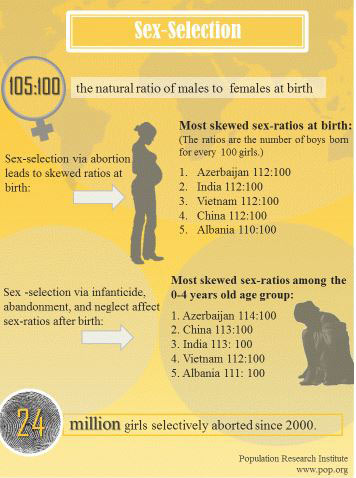 The Population Research Institute, a non-profit research group, revealed these data estimating that the daily average sex selective abortion in India is 2,332.6. China and Pakistan fall in the same line with 96,15,875 and 12,80,228 sex selective abortions between 2000 and 2014.
See how many sex-selective abortions are happening around the world
This calculation is based on averages from the countries where the problem is widespread. Many other countries practice sex selective abortions but it is not as frequent so as to affect the average sex ratio of the country. The countries on the list are those in which sex-selective abortions occur so frequently that they skew the national average. Therefore, the number of female fetus killed or aborted in this period may be even more than 24 million.
Over the last 14 years, there was an average of 4,575 abortions every day across the globe. That comes to about one abortion motivated by gender every 18 seconds.
In India, the declining sex ratio is evident when drawing a comparison in the census figures. According to Census 2011, the child sex ratio (the number of girls per 1,000 boys) in India has gone down from 976 in 1961 to 918 in 2011. This ratio was 962 in 1981, 945 in 1992 and 927 in 2001. This is happening at a time when women are competing with men in all spheres of life.
Another astonishing fact about the skewed child sex ratio comes from Census 2011 that reports maximum sex selective abortion from Surat district of Gujarat. The child sex ratio in Surat is 814 which is lowest in the country among urban agglomerations.
See facts about sex ratio in India
As we mark 80th anniversary of independence, ‘Asianism and the Fall of Empire’ (HarperCollins India) by historian Mithi Mukherjee offers a new perspective on Ind
The Chromatic World Order: The Fiction That Rules Our World By Sajid Mohamed Aakar Books
The Monsoon Session, 2026 of Parliament which commenced on July 20 was adjourned sine die on Thursday. The session provided 19 sittings spread over a period of 25 days. During the session 11 Bills were introduced in Lok Sabha and 2 Bills were introduced in Rajya Sabha. 12 B
Over the past four decades, India`s consumer protection landscape has undergone a remarkable transformation. What began with the Consumer Protection Act, 1986 as a simple mechanism to empower ordinary citizens has evolved into a comprehensive framework capable of addressing challenges ranging from mislea
More than 30 doctors, medical scientists and public health professionals have urged the government to take decisive action against the aggressive advertising and marketing of junk food, calling for a watershed ban on advertisements for foods high in fat, sugar and salt (HFSS) and ultra-processed foods (UPF
On World Lion Day 2026, environment, forest and climate change Minister Bhupender Yadav celebrated India’s remarkable journey in lion conservation and reaffirmed the country’s unwavering commitment to protecting wildlife and biodiversity. In a post on soc











