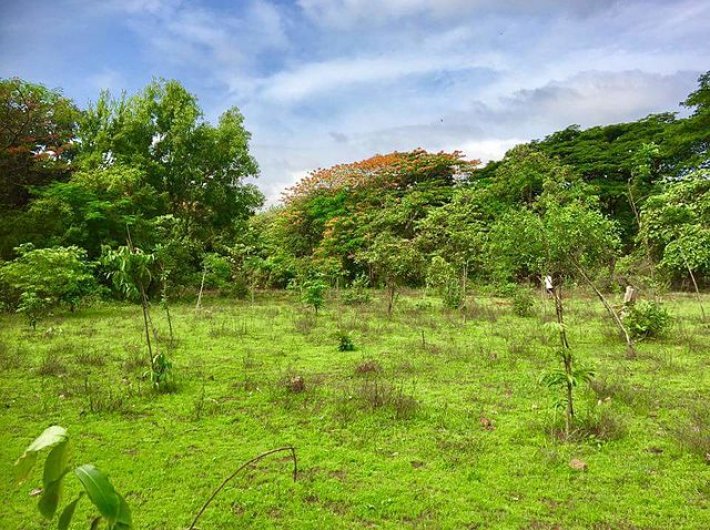
Citizen protesters had some relief on Monday as the Supreme Court ordered a status quo pm the cutting of trees in Aarey forests of Mumbai to build a Metro Rail shed.
The apex court’s forest bench will hear the matter in detail on October 21 to find out if the selected site falls in the eco-sensitive zone or not, a special bench of justices Arun Mishra and Ashok Bhushan said. The bench was convened urgently after the court took suo moto note of a letter from a group of students to the chief justice of India.
The state of Maharashtra also assured the court that no more trees will be felled till the next date of court hearing, October 21.
On October 4, the Bombay high court had dismissed all petitions against the decision of the tree authorities of the BrihanMumbai Municipal Corporation (BMC) to allow the felling of more than 2700 trees in Aarey area of Sanjay Gandhi National Park (SGNP) for a Metro 3 car shed.
Within hours, the authorities started felling the trees, and concerned citizens came out in the streets to protest against it. The protests prompted a group of student to write a letter to the CJI, Ranjan Gagoi, to intervene in the matter.
In the letter circulated to the media earlier today “clarifying the facts”, Zoru Bathena, one of the petitioners, said that while the metro project has many benefits, the issue is only regarding the depot (yard/parking lot for metro bogies) and the location of a depot/ yard is not critical to the project.
“The benefits to Mumbai with a Metro line are indisputable. These benefits will come irrespective of where the depot is located. A depot can be built anywhere. All it takes is 2 tracks to reach there,” says Bathena.
Seventy percent of the metro line 7 (Andheri E to Dahisar E) is complete; it does not have a depot as the government is still trying to find land. Metro line 2A (Dahisar W to Andheri W) has its depot located in the middle of the line and about 2 km away from the line.
The environmental activist adds that Aarey is contiguous with SGNP and there is no wall/road/plot separating the two. Mumbai Metro Rail Corporation (MMRCL), the authority executing metro projects, has published false maps to make them look separate, he claims.
“The areas on the depot plot without trees are low lying, water filled areas as trees don’t grow in water filled areas. These are the flood plains of the Mithi river and filling them will cause flooding chaos to Mumbai (seen three times in 2019).”
Bathena says that 2,700 trees on 25 ha means a tree cover of 100 trees per ha and this makes it a “forest” going by the given criteria .
The Marol-Maroshi and Goregaon-Powai roads are restricted roads falling under Eco Sensitive Zone (ESZ) of Aarey and traffic for public is restricted on them. It is only because of the metro work on the western express highway (WEH) and Jogeshwari Vikhroli link road (JVLR) that these roads have been temporarily opened up for public traffic.
Further, the letter says that the government has not studied any alternative sites for the metro car shed III properly. As per the government’s own technical committee report (TCR) of 2015, this fact has been admitted by the BMC commissioner, the MMRDA Commissioner and the UDD principal Secretary. In a town hall meeting on September 9, MMRCL managing director Ashwini Bhide had admitted that MMRCL had never studied any alternative option at the Colaba depot , which is the government’s own land and has been reserved for depot since 1984.
Bathena adds that as per the MoU between SGNP and MMRCL, trees being planted in SGNP are part of MMRCL’s CSR activity and the corporation has no right, title or interest over these trees. They have merely donated money to SGNP to help it with its reforestation exercise (which the government is doing anyway).
Countering the claims of eco-friendliness of a metro project, the green crusader says it does not take cars off the road and people should visit Delhi to see if the metro there has reduced traffic on the road. “Metro also does not reduce any pollution. It needs electricity to run its trains, AC and ventilation 24×7 and the cost of generating such mega electricity 24x7 far outweighs any vehicle pollution,” he adds.
Save Aarey Group, a citizens’ movement to protect the green lungs, was instrumental in government passing the ESZ notification on December 5, 2016 declaring both Royal Palms and Film City which are part of SGNP as protected areas under NDZ.
The government, however, has been maintaining that Aarey is not a forest. Bhide has said that the cutting of trees in Aarey Colony for construction is inevitable. The government of Maharashtra on Monday told the supreme court that all the trees required to be cut have been cut and no more trees will be cut now.