
Automation replacing workforce; fighting malnutrition; new mental health law

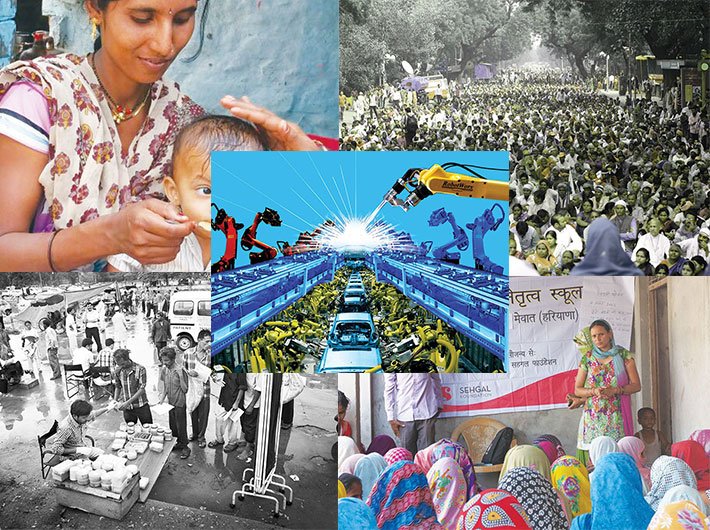
Are robots taking away our jobs; how can Karnataka show the way in tackling malnutrition; a psychiatrist's view on new mental health law; understanding populism: Here's what should be on your reading bucketlist this weekend

GN Bureau | May 13, 2017

#Automation   #Malnutrition   #Mental Health   #Governance   #Populism   #Weekend Stories  


At Raymond Limited’s modern textile facility in Vapi, whenever a supervisor has to check up on the looms, he doesn’t go walking around the factory floor asking the workers. He just looks at a computer screen. Looms in operation, their speed, their electricity and steam consumption, their error alarms – everything is available to him at a glance. The factory rolls out 75,000 metres of fabric daily, employing 1,100 workers. Just four years ago, a traditional weaving unit would produce no more than 18,000 metres, employing 2,600 workers.
Read: Here come the job killers!


India’s jinx in tackling this last unaddressed outpost in its growth and development story continues. Though a National Nutrition Mission was announced in 2014, no national programme has yet emerged, and this year’s budget speech makes no mention of it. Clearly, the subject appears to have got lodged on the backburner for the moment, and another opportunity seems to have been wasted, as this multi-turf subject continues to be stuck within the chakravyuha of stubborn turf protection, and without convergence or oversight. But an ongoing mission in Karnataka shows the way to overcome challenges.
Read: How to put India ‘on course’ to fight malnutrition


In March, parliament passed the Mental Health Care Bill, which among other things decriminalises suicide and bans the use of electric shocks for children. To understand the new law, we turned to psychiatrist Vikram Patel, former chairman and co-founder of the Centre for Global Mental Health at the London School of Hygiene and Tropical Medicine. Patel, named among the Time magazine’s 100 most influential people in the world in 2015, was member of the committee that drafted India’s first mental health policy, 2014.
Read excerpts from the interview: “A mentally ill patient has the same right of freedom as any Indian”


Volunteers have helped villagers in Haryana’s Nuh district to have better access to government schemes. The initiative is worth replicating in other parts of the country.
Read: Good grassroot governance
 

The rise of populism – the revolt of common people against the elite or the ‘system’ – has been one of the broad themes of the past decade. Till 2000, populism was confined to obscure corners of the world, in Latin America and the former Soviet Block, and was largely ignored by the developed countries. The last time populism was strong across the world was in the 1930s. Over the last few years, it has re-emerged as a major force in the developed world with the rise of UKIP in UK, National Front in France and Podemos in Spain to give a few examples. Populism is symbolised by Maduro/Chavez in Venezuela, Durete in the Philippines and Erdogan in Turkey. In India, the populist wave started in 2011 with the Anna Hazare-Arvind Kejriwal-led India Against Corruption movement.
Read: Populism: Its past and future
 

Comments


Other News

“Cancer is just a mind game”

Dr. Ananda Shankar Jayant, a Padma Shri awardee, inspired audiences for decades through her mastery of Bharatanatyam and Kuchipudi. But it was her journey through cancer that taught some of life`s most powerful lessons in courage and resilience.

Why Swami Vivekananda is the pathfinder for our times

Swami Vivekananda for Our Times  Edited and compiled by Rajiv Sikri, with Introduction by S. Gurumurthy Rupa Publications, 552 pages, Rs 695  

Five ways to realise the potential of India’s handicraft and handloom sector

India`s economic ambitions are increasingly defined by the industries of the future. Semiconductors, electronics, artificial intelligence and advanced manufacturing dominate policy conversations. Yet one of India`s largest employment-intensive sectors continues to occupy a surprisingly marginal place in ec

Beyond toilets: Why open defecation persists in rural India

Despite the awareness campaigns on sanitation across India, open defecation (OD) is practised openly and widely in both rural and urban areas. Research shows that rural respondents are well aware of the negative impacts of OD, yet this awareness does not lead to toilet construction or use. In rural North I

What unpaid nation builders want from policymakers

The Supreme Court recently described homemakers as “nation builders” and fixed a notional monthly income of Rs 30,000 for them in motor accident compensation cases. The judgment was not about wages. It was about compensation. Yet it inadvertently raised a larger economic question: If a homemake

What the US–Iran peace deal means for India

After months of rising tensions, the United States and Iran have reached a memorandum of understanding called the "Islamabad Agreement." This agreement allows for the immediate reopening of the Strait of Hormuz without tolls and provides Iran with relief from sanctions, depending on its complianc


Archives

Current Issue

Opinion

Facebook Twitter Google Plus Linkedin Subscribe Newsletter

Twitter






