
BJP-Sena alliance will go by pre-decided understanding: Fadnavis

Pawar is the biggest gainer, rules out any attempt at government formation

geetanjali

Geetanjali Minhas | October 25, 2019 | Mumbai

#Devendra Fadnavis   #NCP   #Congress   #BJP   #elections   #Maharashtra   #Sharad Pawar  
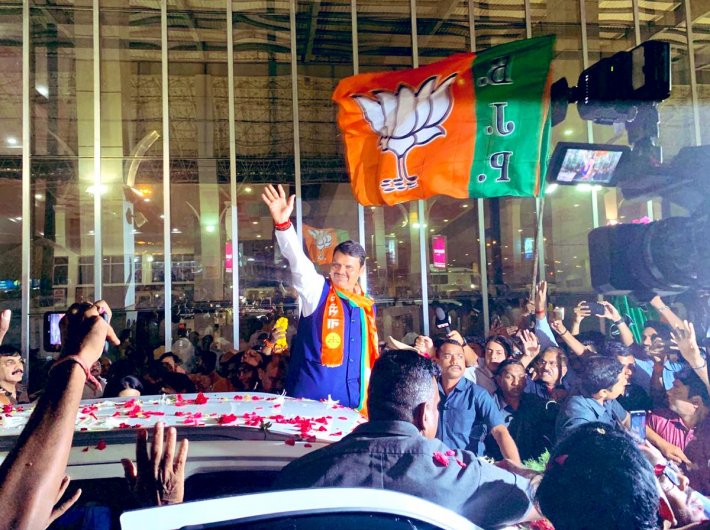
(Photo courtesy: @Dev_Fadnavis)

Though the ruling Bharatiya Janata Party (BJP) and Shiv Sena got fewer seats in the next Maharashtra assembly than what the exit polls had predicted, the alliance has retained its edge over the opposition. While their seats have reduced from 185 in 2014 to 161 in 2019, the Congress-Nationalist Congress Party (NCP) alliance has managed  to increase their numbers from 81 to 98 with Independents and smaller parties bagging 29 seats (from 20 earlier).

In the 288-member assembly, BJP has won 105, Sena 56, NCP 54 and Congress has bagged 44 seats. In the 2014 polls held soon after the historic Lok Sabha elections with the Modi wave, BJP had won 122 seats, Sena 63, Congress 42 and NCP had got 41 seats.

Chief minister Devendra Fadnavis said that though BJP won fewer seats, its strike rate has improved over the past five years with his party winning 70 percent of the seats it contested this time. Soon after results on Thursday, Fadnavis said that the alliance would be back in power and will go by what was “pre-decided” between them on the sharing of power.

While addressing a press conference, Fadnvais also stated that 15 rebels were in touch with him and the final numbers for the alliance may go up.

Shiv Sena chief Uddhav Thackeray reiterated that the basis of their alliance was the 50:50 formula on government formation. Ruling out any compromise on power sharing, he said the BJP can start with discussions even as Shiv Sena was in no rush to form government. “We forged alliance only on the 50:50 promise. We are not forcing the BJP but we are just reminding them of the basis of this alliance,” he said as he added, “though my party agreed to contest fewer seats, I cannot accommodate the BJP every time. I should allow my party to grow.”

His son Aditya, who is the first member of the Thackeray family to contest elections, won by 70,000 votes defeating his rival from NCP, Suresh Mane.     
 
Under the power sharing formula, the CM’s post would be shared between BJP and Shiv Sena in rotation, for 2.5 years each, or there will be equal sharing of powerful portfolios in the government.
 
Prominent winners in the assembly elections include Fadnavis, Shiv Sena leader Aditya Thackeray and leader of opposition in the legislative council, Dhananjay Munde. Former chief ministers Ashok Chavan and Prithviraj Chavan and former deputy chief minister Ajit Pawar were prominent winners in the opposition.

The Sharad Pawar-led NCP emerged as the largest gainer in terms of the number of seats compared to 2014 polls. Pawar aggressively conducted more than 60 rallies where one of his speeches in heavy rains in Satara district of western Maharashtra became the biggest hit .The Congress restricted its campaign largely to the micro level with Rahul Gandhi leading only eight rallies with Sonia and Priyanka Gandhi staying away. Congress leaders Prithviraj Chavan, Sushil Kumar Shinde, Ashok Chavan and  Balasaheb Thorat were busy campaigning in their respective constituencies.

Reacting to the results, Pawar said, “The message was that people did not like the arrogance of power. People have not accepted the talk of 220 seats (referring to BJP-Shiv Sena contesting 220 of 288 assembly seats expecting a huge win). The NCP accepts people's mandate humbly... the election result shows people did not like the arrogance of power.” He added that the people have asked his party to remain in the opposition and NCP will not try to form the next government in Maharashtra.
 
Former CM Prithviraj Chavan is quoted to have said that the results have thrown up an “interesting possibility”, but stopped short of indicating if the Congress and NCP will align with the Sena, which he termed as the “lesser evil” (compared to BJP), to form the government.

Comments


Other News

Trump’s China setback pushes US to woo India

A week after Donald Trump’s visit to China – the first by an American president in nine years, US secretary of state Marco Rubio arrived in India on May 23 on a four-day visit aimed at resetting Washington DC’s relations with New Delhi and attending the third Quad ministerial meeting.

EU–India FTA 2026: A high‑stakes prescription for Indian pharma and healthcare

India’s pharmaceutical industry stands as one of the world’s market leaders of generic pharmacy with market valuation of USD 50 billion in 2026. Characterised by high volume, low-cost generic manufacturing, with an annual growth rate of 10-12% primarily propelled by exports and domestic demand,

Legends, vignettes and tales from the freedom movement

Robin Hood of Kathiawar and Other Extraordinary Stories from India’s Freedom Movement By The Paperclip  HarperCollins, 348 pages, Rs 499  

Solicitor General Tushar Mehta tells quirky tales from the world of law

The Lawful and the Awful: Quirky Tales from the World of Law By Tushar Mehta Rupa Publications, 336 pages, Rs 995  

Cabinet meet discussed `Ease of Living`, `Ease of Doing Business`

The Council of Ministers has deliberated upon valuable perspectives and best practices relating to boosting ‘Ease of Living’ and ‘Ease of Doing Business’, prime minister Narendra Modi said on Friday.   As he shared details of the Council meeting held the d

India should deepen energy partnerships with Africa

The vulnerability of Strait of Hormuz continues to influence energy politics globally. India is highly dependent on imported crude oil as a significant portion of its oil imports still come from the Gulf ultimately making such disruptions particularly consequential and has immediate economic ramifications


Archives

Current Issue

Opinion

Facebook Twitter Google Plus Linkedin Subscribe Newsletter

Twitter






