
Budget 22: RBI to introduce ‘Digital Rupee’

75 digital banking units to be setup in 75 districts by scheduled commercial banks

GN Bureau | February 1, 2022

#RBI   #pandemic   #Covid-19   #welfare   #Nirmala Sitharaman   #finance minister   #finance ministry   #budget   #Economy   #digital money   #banking  
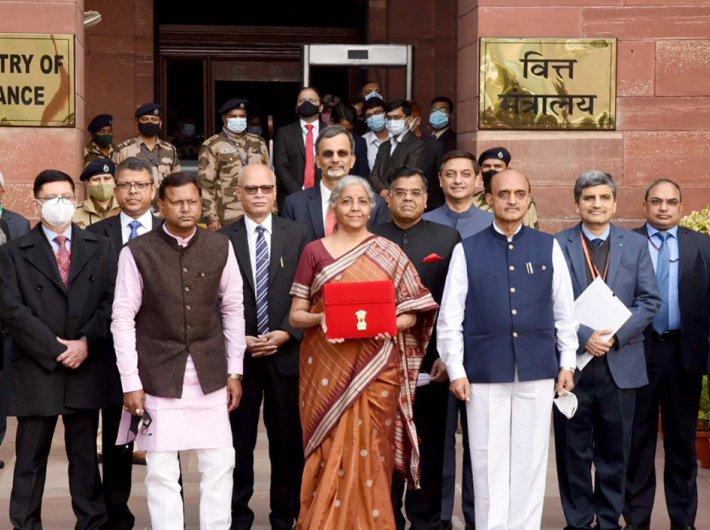
Finance minister Nirmala Sitharaman before leaving North Block to Rashtrapati Bhavan and Parliament House, along with the Ministers of State for Finance, Pankaj Chaowdhary and Dr. Bhagwat Kishanrao Karad and senior officials, to present the Union Budget on Tuesday.

Finance Minister Nirmala Sitharaman Tuesday announced the introduction of Digital Rupee to be issued by the Reserve Bank of India starting 2022-23. Presenting the Union Budget 2022-23 in the Parliament, she said that the Central Bank Digital Currency (CBDC) will give a big boost to digital economy. Digital currency will also lead to a more efficient and cheaper currency management system, the Minister stated. The Digital Currency will use block chain and other technologies.

Digital Banking:

Sitharaman said that in recent years, digital banking, digital payments and fintech innovations have grown at a rapid pace in the country. Government is continuously encouraging these sectors to ensure that the benefits of digital banking reach every nook and corner of the country in a consumer-friendly manner. Taking forward this agenda, and to mark 75 years of our independence, the Finance Minister announced that it is proposed to set up 75 Digital Banking Units (DBUs) in 75 districts of the country by Scheduled Commercial Banks.

Anytime-Anywhere Post Office Savings:

In another important announcement, the Finance Minister said that in 2022, 100 per cent of 1.5 lakh post offices will come on the core banking system enabling financial inclusion and access to accounts through net banking, mobile banking, ATMs, and also provide online transfer of funds between post office accounts and bank accounts. This will be helpful, especially for farmers and senior citizens in rural areas, enabling interoperability and financial inclusion.

Digital Payment:

The Finance Minister assured that the financial support for digital payment ecosystem announced in the previous Budget will continue in 2022-23. This will encourage further adoption of digital payments. There will also be a focus to promote use of payment platforms that are economical and user friendly, she said.


Comments


Other News

BJP set to capture West Bengal

The political map of the country is set to be redrawn with the BJP set to win the West Bengal assembly elections, apart from Assam and the union territory of Puducherry. In Kerala, meanwhile, the Congress-led UDF is set to regain power. The filmstar Vijay-led TVK has emerged as the front-runner in Tamil Na

Beyond LPG: Is PNG ready for India’s next cooking fuel transition?

India, the second-largest importer and consumer of LPG after China, faces growing pressure due to supply constraints. Most of India`s LPG imports transit through the Strait of Hormuz, a focal point of global turmoil. Given that LPG forms the backbone of household kitchens and the restaurant industry, any s

Maharashtra adopts hybrid model for Census 2026 data collection

The government has initiated preparations for Census 2026 in Maharashtra, introducing a hybrid approach that combines optional self-enumeration with comprehensive door-to-door data collection to ensure complete coverage across the state.   According to senior officials, the Self-

What the nine Indian Nobel winners have in common

A Touch Of Genius: The Wisdom of India’s Nobel Laureates Edited by Rudrangshu Mukherjee Aleph Books, Rs 1499, 848 pages  

Income Tax dept holds Ghatkopar Outreach on new IT Act

The Income Tax Department organised an outreach programme in Ghatkopar, Mumbai, to raise awareness about the key features of the Income Tax Act, 2025, effective April 1, 2026. The initiative is part of a nationwide effort to promote taxpayer awareness, simplify compliance, and strengthen a transparent, eff

Making AI work where governance is closest to people

India’s next governance leap may not solely come from digitisation. It will come from making public systems more intelligent, more adaptive, and more responsive to the dynamics at the grassroots. That opportunity is especially significant at the panchayat level, where governance is not an abstract po


Archives

Current Issue

Opinion

Facebook Twitter Google Plus Linkedin Subscribe Newsletter

Twitter






