
Citizenship bill in Lok Sabha, triggers debate

Home minister Amit Shah introduces the bill after a division of votes

GN Bureau | December 9, 2019

#home ministry   #parliament   #Amit Shah   #Citizenship Amendment bill  
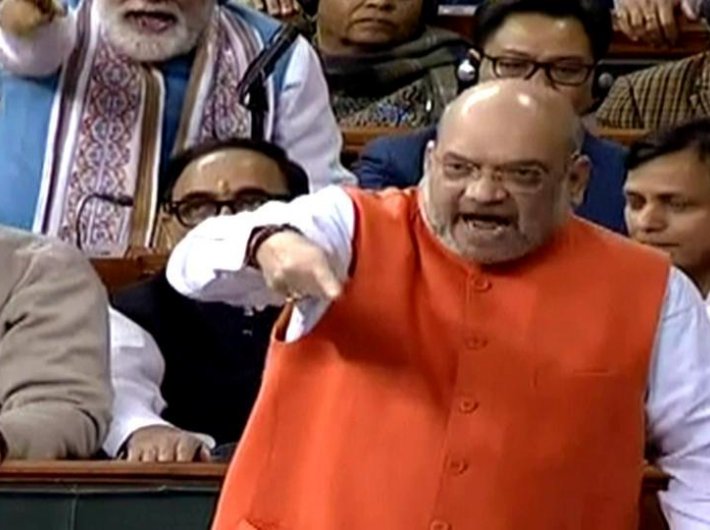
Home minister Amit Shah leading the discussion on the Citizenship Amendment Bill in the Lok Sabha on Monday

Home minister Amit Shah on Monday introduced in the Lok Sabha the Citizenship Amendment Bill, triggering a long-ranging debate on the ideas of India, with the opposition parties claiming it was regressive.

The bill seeks to grant citizenship to non-Muslim citizens of the neighbouring Pakistan, Afghanistan and Bangladesh who wanted to escape religious persecution in those countries.

While the matter is broadly seen on communal lines, the northeast, however, had its own worries about the bill, which could pave the way for influx of refugees especially in that region, notwithstanding their religion. Some of the northeastern states have witnessed protests against it. The home minister clarified that the government was fully committed to protect the culture and identity of the region and urged the people of the states not to protest against it.

While the opposition criticized the move for making religion the basis of citizenship, Shah claimed the bill was not even “0.001 percent” against the minorities of the country. He went on to blame the Congress for the partition, on which Manish Tewari of that party alleged that the seeds of the “two-nation theory” were sown by V.D. Savarkar’s Hindutva views.

Trinamul Congress termed the bill unconstitutional and divisive. CPM also claimed it was aimed to establish racial supremacy in India. TRS too was among those against it. On the other hand, JD(U) and Lok Janshakti Party supported the bill, maintaining that it was not against the idea of secularism. Biju Janata Dal, meanwhile, has promised to support the bill.

Meenakshi Lekhi of the BJP defended the legislation saying that the objective was to offer protection to “our people” who were denied their rights after the Partition.
 

Comments


Other News

Doctors, experts call for ban on junk food ads, mandate warning labels

More than 30 doctors, medical scientists and public health professionals have urged the government to take decisive action against the aggressive advertising and marketing of junk food, calling for a watershed ban on advertisements for foods high in fat, sugar and salt (HFSS) and ultra-processed foods (UPF

Asiatic Lion population rises from 523 in 2015 to 891 in 2025

On World Lion Day 2026, environment, forest and climate change Minister  Bhupender Yadav celebrated India’s remarkable journey in lion conservation and reaffirmed the country’s unwavering commitment to protecting wildlife and biodiversity.   In a post on soc

Railways imposed ₹5.13 crore fine for food quality and hygiene violations

Indian Railways serve about 58 crore meals every year on an average. About only 0.0008% food quality related complaints are received on average. Based on complaints during the last three years, appropriate penal actions have been taken by IRCTC. Such actions include imposition of fines amounting to ₹5.13

STHAVAR: Why every Indian built asset needs a permanent digital identity

India has built digital systems for identity, payments, taxation, documents, logistics and public services. State governments, ministries, infrastructure agencies and urban local bodies have also created portals for land records, building permissions, project monitoring, property taxation and municipal s

Saksham Skill census identifies 22,000 job-ready candidates in one Mumbai ward

A first-of-its-kind AI-enabled skill census conducted in Mumbai`s H-West Ward has identified a potential livelihood pipeline of nearly 22,000 candidates, generated over 32,000 provisional job matches while revealing that 71.2 per cent of surveyed homemakers are willing to join the workforce, according to

GI tags: Scaling traditional wealth into global brands

Geographical Indication (GI) tags have emerged as a powerful tool for protecting India`s cultural heritage, while creating economic opportunities for local communities. By linking products to their place of origin, GI tags preserve traditional knowledge, prevent misuse, and enhance consumer trust. They h

Upcoming Conferences


-->

Archives

Current Issue

Opinion

Facebook Twitter Google Plus Linkedin Subscribe Newsletter

Twitter






