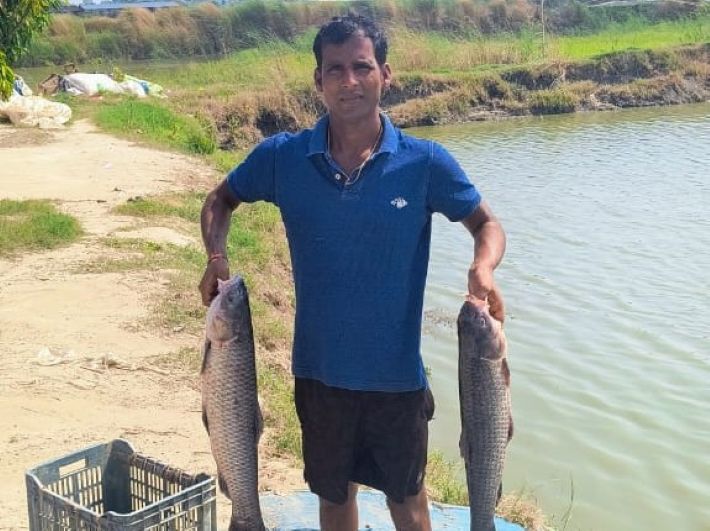
Bihar Aquaculture Improvement Program, to modernise and strengthen the state's aquaculture ecosystem through systemic reforms and capacity building, is also changing lives
East Champaran, Bihar: For nearly a decade, Jay Kumar Sahni’s life was far removed from the ponds where his family had made a living for generations. In Bengaluru, he ran a mobile-accessories shop and earned around ₹50,000 a month. It was a stable livelihood, but in 2018–19, Jay chose to leave it behind and return to Lakhnipur village in East Champaran, Bihar.
He came home to take over his family’s fish-farming enterprise.
At first, the decision was not an obvious one. The family’s ponds were being managed much as they had been for years, using conventional Indian Major Carp varieties and traditional methods. Returns were modest, feed costs were significant, and outcomes depended heavily on experience rather than scientific assessment. Jay had the land and the family’s knowledge behind him, but he needed to find a way to make the enterprise more productive and dependable.
The opportunity emerged through his involvement with the Bihar Aquaculture Improvement Program (BAIP), a statewide fisheries sector transformation initiative led by the Government of Bihar's Dairy, Fisheries and Animal Resources Department in partnership with the Gates Foundation and implemented by Palladium. Launched in December 2025, the program aims to modernise and strengthen Bihar's aquaculture ecosystem through systemic reforms and capacity building.
BAIP is targeting one million fish producers across the state, with ambitious goals of increasing overall fish production by 25%, enhancing pond productivity by 20%, doubling producer incomes, and ensuring that 60% of beneficiaries are women. Through its integrated approach, the program is strengthening livelihoods, promoting inclusive growth, and building a more resilient and sustainable aquaculture ecosystem in Bihar.
BAIP’s support helped Jay move beyond the traditional methods he had inherited. Through field-level demonstrations, awareness activities and technical guidance, he was introduced to genetically improved fish varieties, including Jayanti Rohu and Amrit Catla, and to scientific approaches to nursery management, seed quality, stocking and pond management.
The significance was not simply in introducing a new variety. Jay was able to understand how improved genetics could be used effectively and observe their performance in his own ponds. With technical support from the programme, he tested approximately three lakh spawn, two lakh Jayanti Rohu and one lakh Amrit Catla, during a production cycle.
The results gave him the confidence to change the way he approached his business.
Compared with his conventional stock, the improved varieties demonstrated stronger growth and survival performance, while feed consumption remained broadly comparable. For Jay, this was an important shift. If better growth and survival could be achieved without a corresponding increase in one of the major costs of fish farming, the economics of the enterprise began to look different.
What started as a trial gradually became a new way of working.
Jay strengthened his nursery management practices and began maintaining stunted fingerlings, allowing him to manage surplus stock and maintain a more reliable supply of quality seed. As his experience grew, so did the scale of his operation.
Today, Jay manages nearly 20 ponds across fish seed production and grow-out farming and reports an annual income of approximately ₹10 lakh. The demand for his seed has also increased. From the initial trial of three lakh spawn, he now anticipates requirements of nearly 30 lakh seed for upcoming production cycles.
The change is also visible in the market he serves. Jay estimates that improved varieties can command 15–20% higher price realisation at the fry and fingerling stages, while their profit potential can be substantially higher than conventional stock. But the impact of the change is not limited to Jay’s own income.
Farmers in and around Lakhnipur have begun taking notice of the performance of the seed he produces. Those who once relied primarily on conventional varieties are increasingly showing interest in improved seed. Jay’s ponds are becoming a practical demonstration of what farmers can achieve when improved genetics are combined with scientific management and technical knowledge.
In this way, an intervention that began with one farmer’s willingness to experiment is beginning to influence decisions beyond his own enterprise.
With the success of farmers like Jay Kumar serving as an example of the transformation underway in Bihar’s aquaculture sector, Shirsat Kapil Ashok, secretary, DF&ARD, Bihar, said, “The success of farmers like Jay Kumar highlights the transformative role that scientific aquaculture, improved fish seed, and capacity building can play in strengthening Bihar’s fisheries sector. It is gratifying to see how access to the right knowledge and technology is helping farmers make informed decisions, improve productivity, and create new opportunities within their communities. We see this as the beginning of a larger journey. Through the Bihar Aquaculture Improvement Program, our endeavour is to create an enabling ecosystem that empowers fish producers across the state, particularly small and emerging entrepreneurs, to adopt better practices, increase incomes, and contribute to Bihar’s long-term growth as a leading aquaculture state.”
Jay is now looking at the next stage of growth. He sees the need for aerators, solar-powered systems, better aquaculture infrastructure and access to finance to expand production and adopt new technologies. The ambition is no longer simply to sustain the family’s fish farming activity, but to build a larger enterprise capable of meeting growing demand for quality fish seed in the region.
“I knew the ponds had potential, but I also knew that continuing with the same methods would not take the business much further. The technical support helped me understand improved seed, growth and survival better. Today, I am able to make decisions about my ponds with much more confidence,” says Jay.
For Jay, the journey has come full circle. He left his village in search of opportunity and returned years later to find it in the family ponds he had always known. What changed was not the ponds themselves, but the knowledge, technology and confidence he brought to them.
Amit Patjoshi, CEO, Palladium India, says, “Jay’s journey demonstrates how access to improved technology, scientific knowledge and sustained field-level support can strengthen an individual enterprise and create confidence among other farmers. When farmers are able to test and see the benefits of improved practices in their own fields, the impact can extend beyond one enterprise.”
From a humble mobile accessories shop in Bengaluru to nearly 20 ponds in East Champaran, Jay’s story is ultimately about returning home and finding new potential in an old livelihood. With the right knowledge and support, the family enterprise he inherited is becoming a growing business, and a source of learning for farmers around him.
Parul Sharma is Manager, Communications, Palladium.