Congress plans Rs 100 crore social media war chest

Sibal stresses on need to take on BJP in the new arena to woo middle class

bhavdeepkang

Bhavdeep Kang | January 19, 2013


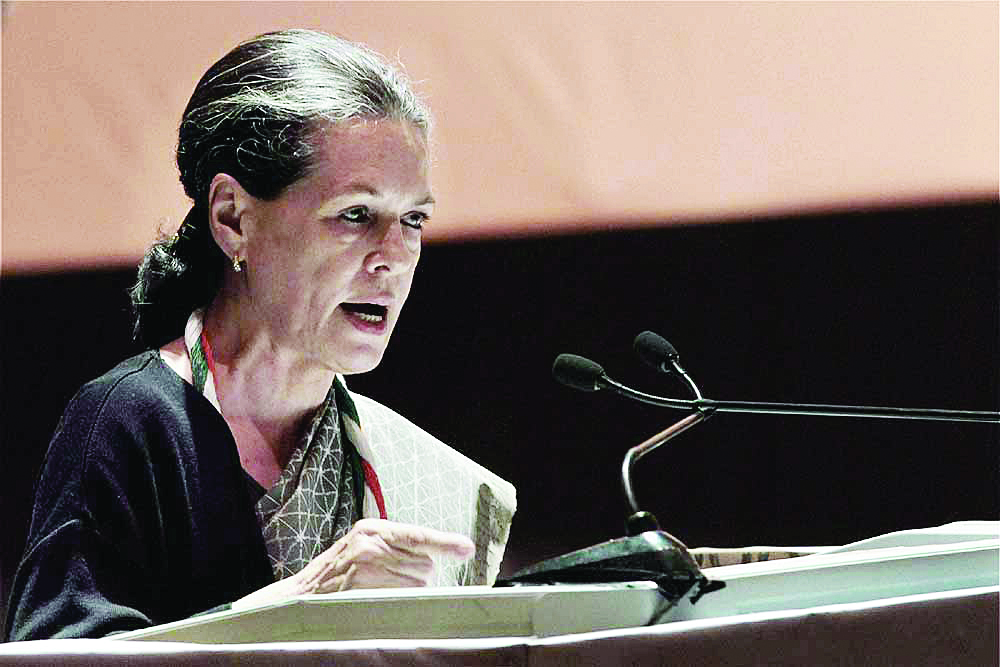
Sonia Gandhi addressing a party chintan shivir session in Jaipur

The Congress party would require Rs 100 crore during the next 18 months - till the Lok Sabha elections - to counter the main opposition BJP in the field of social media, telecom minister Kapil Sibal said at the session on emerging political challenges at the party's Chintan Shivir at Jaipur on Saturday.

The BJP, he said, had a hundred people tweeting against the Congress in the morning. By afternoon, the tweets would become news on TV channels and by the next day, they became headlines in the print media.

Sibal made a strong case for a pro-active approach to the social media. He pointed out that the BJP made extensive use of the social media to reach out to the middle class. He referred to the anti-government blitz on social networking sites following the brutal bus rape case and earlier during the Anna Hazare-led agitation for a Jan Lokpal Bill, which snowballed into street protests.

Also read: A lot left unsaid in Sonia's address

With the increasing penetration of the internet across social classes, the Congress should not be squeezed out of that space, Sibal said. He pointed out that elections in nine states and the Lok Sabha polls were imminent, so the party would have to undertake a strong counter-offensive on a war footing.

Digvijay Singh, who heads the committee on communications strategy, said the party was concerned about the march the BJP had stolen in terms of the social media. "Narendra Modi has a sanchar kendra near Ahmedabad for tracking the social media," he said, adding that a report on a counter-strategy would be submitted to Rahul Gandhi in the next ten days.

Congress president Sonia Gandhi spent almost two hours at the session on emerging political challenges at the Congress chintan shivir in Jaipur, in the course which the three Cs were discussed: communalism, corruption and coalition. She maintained a studious silence throughout.

Science and technology minister S Jaipal Reddy made two significant points. He said the Congress would have to undertake an exercise in social engineering in Uttar Pradesh and Bihar in order to establish itself in those states. He said that OBCs should be actively wooed. He also expressed the view that the Congress should not be on the defensive on the corruption issue. It should not appear in the public mind as being the source of corruption but should take the issue head on. Among others who spoke was information and broadcasting minister Manish Tewari. 

In the session on socio-economic issues, delegates strongly felt that the government's repeated doses of economic reforms should be tempered with welfare measures before going to polls. Congress leader Vayalar Ravi said there was no need to be wary of UPA II being seen as a pro-subsidy regime, because the US and OECD countries too disbursed heavy subsidies to farmers.

On Friday, the first day of the three-day conclave, the Congress president attended the session on the party organization and on women's empowerment, spending 45 minutes at each venue.

Comments


Other News

`India’s media & entertainment sector poised for historic leap`

The global Media & Entertainment (M&E) industry is on the brink of a major transformation as it marches toward 2030. International revenues are projected to reach $3.5 trillion by 2029, driven by a 3.7% CAGR between 2024 and 2029. This growth will be powered by the dominance of digital advertising,

The India we live in, the India it is

We proudly describe our nation as a land of Unity in Diversity. We have long celebrated our civilization based on plurality, where differences have been seen, not as threats but as expressions of a greater unity. From Kashmir to Kanyakumari, we rejoice our innumerable languages, castes, creeds, an

Intellectual toolkit to make sense of the world

Steven Pinker’s latest major work, ‘When Everyone Knows That Everyone Knows...: Common Knowledge and the Mysteries of Money, Power, and Everyday Life’, is an intellectually thrilling expedition into the heart of human society. Its core argument is that the secret to understanding why mark

Study uncovers genetic susceptibility behind high oral cancer burden in India

A Genome-Wide Association Study (GWAS) conducted by the Centre for Cancer Epidemiology (CCE) of the Advanced Centre for Treatment, Research and Education in Cancer (ACTREC) at the Tata Memorial Centre here has uncovered critical gen

This standout collection of essays marks 50 years of Emergency

50 Years of the Indian Emergency: Lessons for Democracy Edited by Peter Ronald deSouza and Harsh Sethi Orient BlackSwan, 338 pages, Rs 1025

Checkmate on carbon: Chess strategies for India’s climate economy

The climate crisis is no longer a peripheral debate but a central determinant of economic resilience, particularly for emerging economies like India. Much like a grandmaster sitting before a 64-square battlefield, policymakers and market actors are compelled to strategize in advance, balancing short-term s

Visionary Talk: Amitabh Gupta, Pune Police Commissioner with Kailashnath Adhikari, MD, Governance Now


Archives

Current Issue

Opinion

Facebook Twitter Google Plus Linkedin Subscribe Newsletter

Twitter