ECI messaging will reach a wide audience through 1.6 lakh bank branches, 2 lakh ATMs and 1.55 lakh post offices
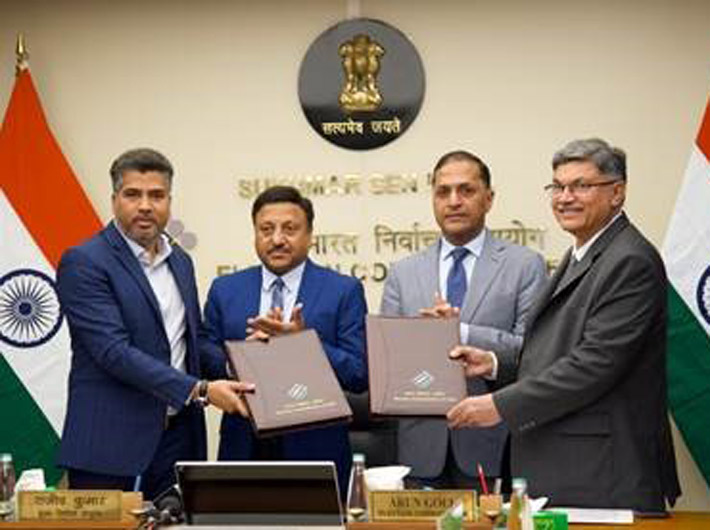
In a first-of-its-kind initiative, Election Commission of India (ECI) on Monday signed a memorandum of understanding (MoU) with two prominent organisations, the Indian Banks’ Association (IBA) and the Department of Posts (DoP), to amplify its voter outreach and awareness efforts ahead of the forthcoming General Elections to Lok Sabha 2024.
The initiative is in continuation of ECI’s untiring efforts to enhance electoral awareness in the country. Notably, ECI had recently signed an MoU with the Ministry of Education to formally integrate electoral literacy into the educational curriculum of schools and colleges. The MoU was signed in the presence of Chief Election Commissioner Rajiv Kumar and Election Commissioner Arun Goel. Vineet Pandey, Secretary, Department of Posts, Sunil Mehta, Chief Executive, IBA, and other officials from the three organisations were present on the occasion.
As part of the MoU, IBA & DoP with its members and affiliated institutions/units will extend support in promoting voter education through their extensive network on a pro-bono basis, employing various interventions to empower citizens with knowledge about their electoral rights, processes, and steps for registration and voting.
Highlights of the MoU:
* Members and affiliated institutions/units will display voter education messages prominently on their websites, directing visitors to learn more about the electoral process.
* Voter education content will be disseminated through various promotional channels such as social media and customer outreach platforms of member institutions, ensuring widespread awareness among stakeholders and the public.
* Voter education messages will be displayed in the form of posters, flex, and hoardings at office infrastructure/premises at major locations, reaching customers at key touchpoints.
* All member institutions under IBA & DoP will establish Voter Awareness Fora to engage employees and customers in discussions and initiatives related to voter education.
* Sensitize about training module on SVEEP in the regular orientation Programmes of employees of IBA & DoP.
* The Department of Posts will affix a special cancellation stamp (bearing voter education messages) on the postal articles.
Despite successfully managing and conducting elections by the Election Commission over the years in fair and peaceful way along with a significant increase in participation of the electors, there is also a concern that around 30 crore electors (out of 91 crore), did not cast their votes in General Election to Lok Sabha 2019. The voting percentage was 67.4%, which the Commission has taken as a challenge to improve upon.
This collaboration with IBA and Department of Posts, signifies a significant step towards strengthening democracy by empowering citizens with knowledge and awareness about their electoral rights and responsibilities. Through concerted efforts, both organizations are committed to fostering a culture of informed and active participation in the electoral process.
Background
The Indian Banks' Association (IBA), formed on September 26, 1946, started with 22 members and now has a strong network of 247 members across the country. Public sector banks are in lead with 90,000+ branches and 1.36 lakh ATMs followed by 42,000+ branches of Private Sector Banks with 79,000+ ATMs. Regional Rural Banks contribute 22,400+ branches, while Small Finance & Payment Banks operate around 7000 branches and 3000+ ATMs. Foreign Banks maintain 840 branches and 1,158 ATMs, and Local Area Banks have 81 branches. The cumulative number of the branches are 1.63 lakh+ with 2.19 lakh+ ATMs across the country.
For more than 150 years, the Department of Posts (DoP) has been the backbone of the country’s communication and has played a crucial role in the country’s social economic development. With more than 1,55,000 post offices, the DoP has the most widely distributed postal network in the world.