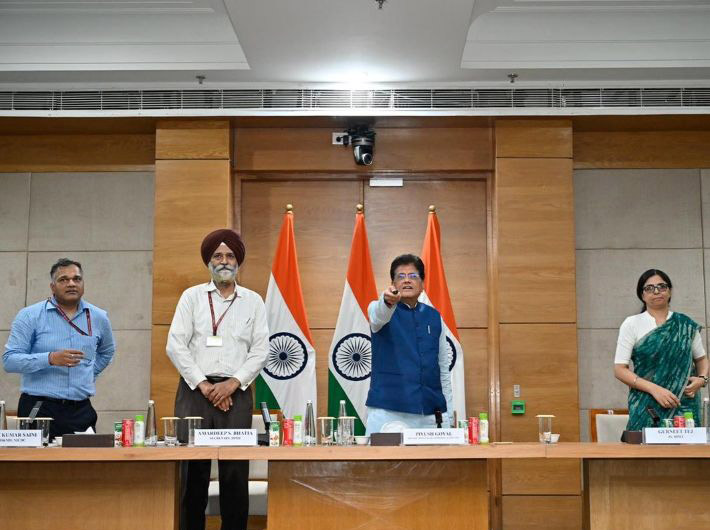
In a step towards the operationalisation of the Bharat Audyogik Vikas Yojana (BHAVYA), union minister of commerce & industry Piyush Goyal launched the BHAVYA Portal on Monday in New Delhi.
Addressing the gathering, Goyal said that the BHAVYA scheme will adopt a competitive model under which States will be encouraged to submit detailed project proposals highlighting their industrial strengths, availability of land, investor interest and sectoral potential. He said the government will work closely with industry to identify the most suitable sectors and infrastructure requirements for each location, whether for chemicals, manufacturing, data centres or other industries. He added that investors would be able to access detailed information on industrial parks through digital platforms, including land availability, connectivity and surrounding infrastructure, enabling them to make informed investment decisions. The scheme will seek to ensure that industrial parks are designed according to the specific needs of different sectors and investors, making them more attractive destinations for domestic and global investments.
The minister said that over the past decade, the government has focused on creating an enabling environment for economic development and social welfare through investments in roads, highways, railways, metros, airports, ports, power infrastructure, water availability and digital connectivity. He highlighted reforms such as GST, the Insolvency and Bankruptcy Code, labour reforms, expansion of 5G connectivity, promotion of startups, support for investments, and free trade agreements with complementary economies to promote trade, investment and technology transfer.
Goyal said that India is increasingly being viewed as a trusted partner and an attractive investment destination because of its scale, growing demand, young talent and youthful energy. He added that the Government remains committed to creating opportunities for businesses, industry, farmers, fishermen, startups and women entrepreneurs.
Announcing the BHAVYA Scheme, the minister said that it aims to develop 100 industrial parks across the country to promote large-scale job creation through greater investments. He said the parks will be developed in different sizes, ranging from 25 acres in hilly regions, smaller union territories and northeastern states, to between 100 and 500 acres in mid-sized states and regions, and up to 1,000 acres in locations closer to cities and towns, depending on need assessment and the commitment of states.
He said that land for the parks will be provided by the state governments, while the government of India will support infrastructure creation through the National Industrial Corridor Development Corporation (NICDC), which will partner with States under a 51:49 model. He said the objective is to create plug-and-play industrial parks focused on industries best suited to specific locations.
The minister said that the parks will provide infrastructure including assured water and power supply, road and rail connectivity, land titles, digital single-window clearances and, where feasible, air connectivity. He added that the government will also explore earmarking areas for startups, deep-tech enterprises, technology-oriented businesses, research and development activities, and innovation-led enterprises.
Approved by the union cabinet with an outlay of ₹33,660 crore, BHAVYA is the government's flagship programme for the development of 100 investment-ready, world-class industrial parks over a period of six years. The scheme aims to create integrated industrial ecosystems featuring multimodal connectivity, reliable utility infrastructure, digital governance systems, worker-support facilities, and sustainable development features.
The National Industrial Corridor Development Corporation (NICDC), designated as the Project Management Agency for the scheme, is responsible for its implementation and monitoring. Drawing upon its extensive experience in developing industrial corridors and integrated industrial infrastructure across the country, NICDC has developed the BHAVYA Portal as a comprehensive digital platform to support the entire project lifecycle under the Scheme.
The operational guidelines for BHAVYA were released by the Department for Promotion of Industry and Internal Trade (DPIIT) in May 2026, and the launch of the portal marks the next critical step in translating policy into implementation.
The portal will serve as the single digital interface for end-to-end implementation of the Scheme, facilitating the submission of Detailed Project Report (DPR) proposals, project appraisal and evaluation, and real-time monitoring of implementation progress. It will support the challenge-based competitive selection framework under BHAVYA by providing a structured and transparent mechanism for assessing proposals from States, Union Territories, and implementing agencies, while enabling efficient coordination among stakeholders throughout the project lifecycle.